What Is DeFi? A Beginner’s Guide to Decentralised Finance
Updated: September 2026
Written By
Table of Contents
- What Is DeFi?
- Understand the Fundamentals of DeFi
- How Does DeFi Work?
- What Can DeFi Be Used For?
- DeFi vs Traditional Finance
- What Are DeFi Apps?
- Do You Need a Crypto Wallet for DeFi?
- What Are Gas Fees in DeFi?
- Is DeFi Safe?
- Beginner Safety Note
- What Do You Need Before Using DeFi?
- Before You Start Checklist
- Pros and Cons of DeFi
- Beginner DeFi Terms to Know
- How Beginners Should Start Learning DeFi
- Key Facts
- Where to Go Next
- Frequently Asked Questions
QUICK FACTS
Best for:
DeFi beginners
Difficulty: Beginner-friendly
Main topic:
Decentralised finance
Covers:
Wallets, smart contracts, gas fees, DeFi apps, risks
You’ll learn:
What DeFi means, how DeFi works, what people use it for, key risks to understand and what to learn before using DeFi

DeFi, short for decentralised finance, describes financial apps and services that use blockchain networks, smart contracts, and digital assets.
Instead of relying entirely on a bank, broker, or other traditional intermediary, some of these services allow users to interact directly through a crypto wallet.
People use decentralised finance for activities such as swapping tokens, lending and borrowing digital assets, accessing decentralised exchanges, and providing liquidity.
However, direct access also brings additional responsibility. Wallet approvals, smart-contract risks, transaction fees, scams, and volatile assets can all create problems if you don’t understand what you are approving.
This beginner guide explains what DeFi is, how it works, what people use it for, and the risks to understand before interacting with decentralised financial tools.
DeFi forms part of the wider Web3 and crypto ecosystem, connecting digital assets with blockchain-based financial applications and services.
What Is DeFi?
Quick Answer
DeFi, or decentralised finance, describes blockchain-based financial applications that use smart contracts for activities such as trading, lending and borrowing. Users can often access these services through crypto wallets without relying entirely on traditional financial intermediaries.
DeFi operates across different blockchain networks. Ethereum is a prominent example, but decentralised financial applications are not limited to Ethereum.
Rather than describing one company or platform, the term covers a wider ecosystem of blockchain-based financial protocols and applications.
For example, one application may let users swap tokens, while another may allow people to lend digital assets or borrow against crypto collateral.
Ethereum’s DeFi overview illustrates the range of these services, including borrowing, saving, trading and investing through blockchain-based applications.
Understand the Fundamentals of DeFi
Before using any decentralised financial application, it helps to understand what makes these tools different from ordinary financial websites.
DeFi is not a single app, blockchain, token, or company.
Cryptocurrency refers to digital assets, while DeFi describes financial applications and protocols that use those assets for activities such as trading, lending and borrowing.
DeFi tools serve different purposes, from decentralised exchanges and lending protocols to applications that manage liquidity, and each can introduce different risks.
These financial applications can bring together technologies such as:
- Blockchain networks
- Smart contracts
- Crypto wallets
- Digital assets
- Decentralised applications, or dApps
- Decentralised exchanges
- Stablecoins
- Liquidity protocols
Many applications combine several of these technologies.
For instance, a user might connect a wallet to a decentralised exchange, approve a smart contract, swap one token for another, and pay a blockchain transaction fee during the process.
What Does Decentralised Finance Mean?
The word decentralised generally refers to reducing reliance on a single central organisation or intermediary.
Traditional financial services often depend on banks, brokers, payment processors, exchanges, or other companies to manage accounts and process transactions.
By comparison, decentralised financial protocols can use blockchain networks and computer programs called smart contracts to carry out certain functions.
However, decentralised does not automatically mean that every part of an application has no central control.
Developers still build and maintain software, governance systems may influence protocol decisions, websites can rely on central infrastructure, and different projects can have different levels of decentralisation.
Therefore, beginners should look at how a specific protocol works rather than assuming every service labelled “DeFi” operates in exactly the same way.
How Does DeFi Work?
A simple DeFi interaction may look like this:
User → Crypto wallet → DeFi app → Smart contract → Blockchain network
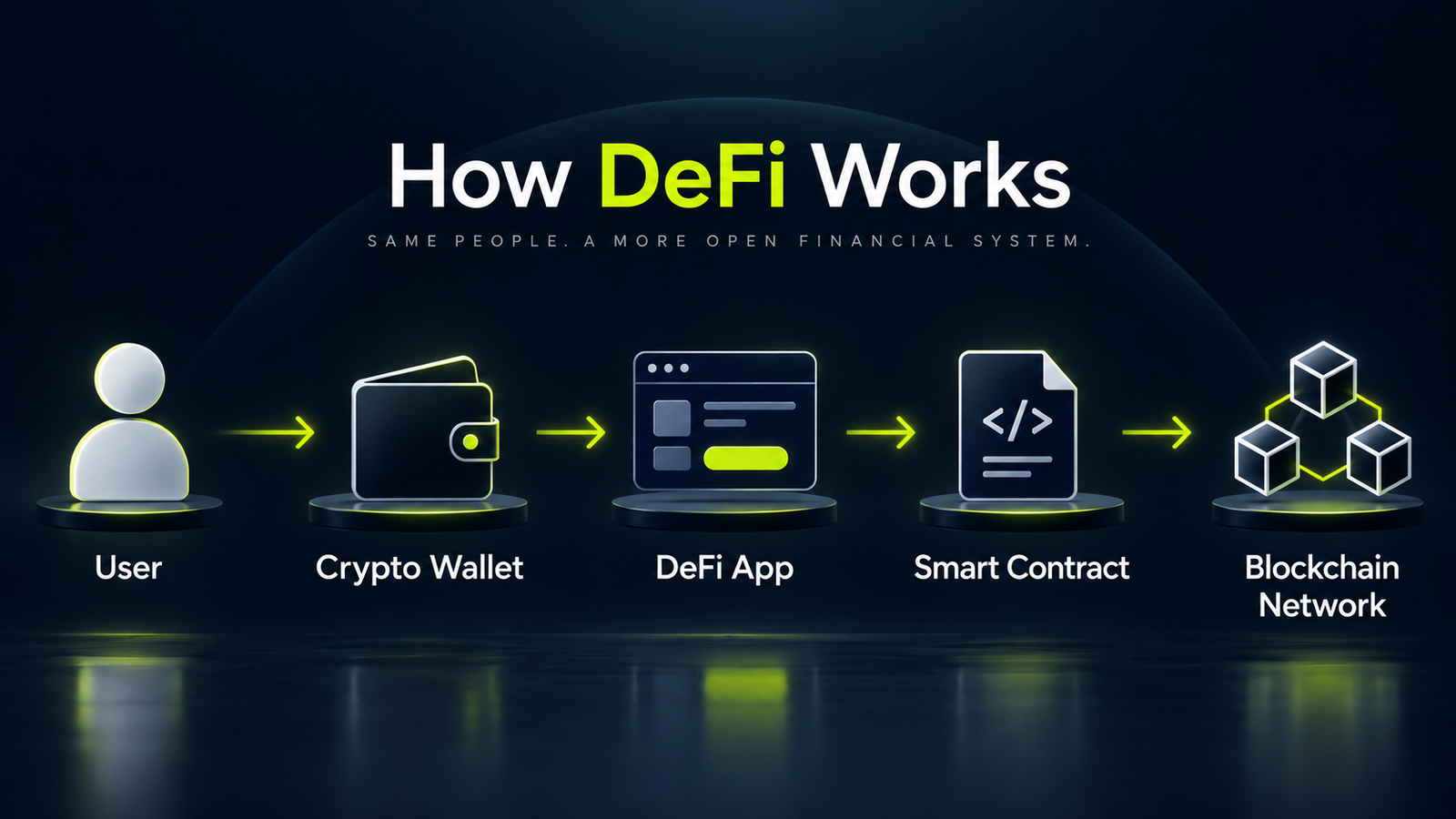
The exact process varies between platforms and networks, but these components often work together.
First, a user opens a decentralised application.
Next, they may connect a compatible crypto wallet.
The app can then show available actions, such as swapping tokens, depositing assets, borrowing funds, or supplying liquidity.
When the user approves an action, their wallet may ask them to review and sign a blockchain transaction.
A smart contract can then process that action according to its programmed rules.
Finally, the blockchain network records the resulting transaction or change in state.
Smart contracts on Ethereum are programs stored on the blockchain. Users can interact with them by submitting transactions that trigger functions defined in the contract.
What Role Do Smart Contracts Play in DeFi?
Smart contracts help automate many of the actions that decentralised financial applications provide.
For example, a smart contract may contain rules for:
- Exchanging one token for another
- Accepting digital assets into a lending pool
- Calculating collateral requirements
- Distributing assets
- Recording liquidity positions
- Managing certain repayments
- Processing protocol rules
In other words, users do not necessarily need an employee or company representative to manually approve every action.
The software can process transactions according to its programmed logic.
However, automation does not remove risk.
Errors in smart-contract code, poor protocol design, malicious contracts, unsafe approvals, or unexpected market conditions can still result in losses.
What Can DeFi Be Used For?
Decentralised finance covers several types of financial activity.
Depending on the blockchain and protocol, users may encounter:
- Token swaps : exchanging one digital asset for another
- Decentralised exchanges : trading crypto without relying on a traditional centralised exchange account
- Lending : supplying assets to lending protocols
- Borrowing : borrowing digital assets, often against collateral
- Liquidity pools : supplying assets that help facilitate decentralised trading or other protocol functions
- Stablecoins : using blockchain-based assets designed to track another asset, such as a fiat currency
- Yield opportunities : receiving rewards, fees, or other returns for certain protocol activities
- Derivatives : accessing blockchain-based financial products linked to the value or performance of other assets
- Insurance-style protocols : blockchain applications designed around certain forms of risk protection
Many decentralised exchanges allow users to trade digital assets through connected wallets and smart contracts rather than first transferring their assets into a traditional centralised crypto exchange account.
Not every platform offers all of these functions, and similar services may work very differently from one protocol to another.
DeFi vs Traditional Finance
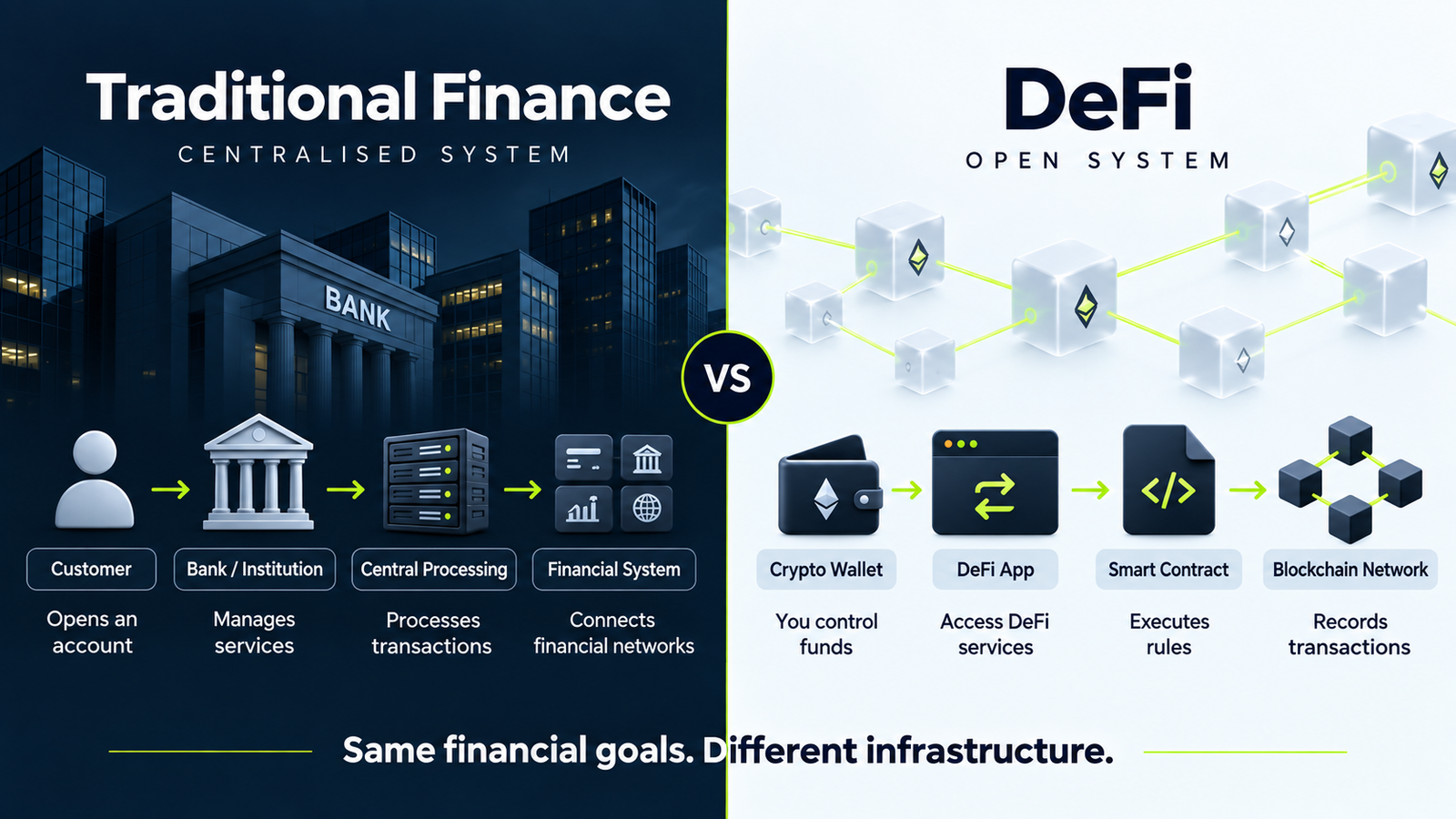
Decentralised and traditional finance can provide some similar financial functions, but they use very different infrastructure.
| Feature | DeFi | Traditional finance |
| Access | Often through a crypto wallet and blockchain app | Usually through a bank, broker, exchange, or financial account |
| Infrastructure | Blockchains, smart contracts, and protocols | Banks, payment systems, brokers, exchanges, and financial institutions |
| Asset control | Users may control assets through their own wallets | Institutions often hold or manage assets for customers |
| Availability | Many blockchain applications operate continuously | Some services follow business or market hours |
| Transactions | Blockchain networks process and record activity | Institutional systems process and record activity |
| Automation | Smart contracts can automate financial functions | Institutions and their software manage financial processes |
| User responsibility | Can require greater responsibility for wallets and approvals | Providers often manage more of the account experience |
| Main risks | Smart contracts, wallet mistakes, scams, liquidation, volatility | Market, credit, counterparty, operational, and institutional risks |
Neither system is automatically better for every user or financial activity.
Traditional institutions can provide customer service, regulated protections, account recovery, and familiar financial infrastructure.
On the other hand, decentralised protocols can give users direct access to certain financial tools and greater control over how they interact with digital assets.
The trade-off is that direct control often means more responsibility.
What Are DeFi Apps?
A DeFi app is a type of decentralised application (dApp) that provides an interface for interacting with blockchain-based financial protocols.
The website or app you see on screen is not necessarily the entire service.
Behind the interface, smart contracts may manage the underlying blockchain activity.
For example, when a user clicks a button to swap tokens, the application may prepare a transaction for the connected wallet. The user reviews the request and, if they approve it, signs the transaction.
The blockchain and relevant smart contracts then process the interaction.
This relationship between blockchain networks, wallets, smart contracts, digital ownership, and applications forms an important part of the wider Web3 ecosystem.
Do You Need a Crypto Wallet for DeFi?
Many DeFi applications require users to connect a compatible crypto wallet.
The wallet can help you:
- Connect to an application
- Access digital assets
- Sign transactions
- Approve token interactions
- Pay network fees
- View blockchain activity
However, connecting a wallet does not mean you should automatically approve every request an application displays.
A wallet gives you a way to approve blockchain actions, and those approvals can have real financial consequences.
The distinction between custodial and non-custodial wallets matters in DeFi because it determines whether users control the keys themselves or rely on a provider to manage access.
Therefore, beginners should understand how wallets, seed phrases, private keys, networks, and approvals work before experimenting with decentralised applications.
What Are Gas Fees in DeFi?
Some blockchain interactions require users to pay network transaction fees.
On Ethereum, these network fees are called gas fees.
For example, sending assets or performing actions that change blockchain state can require gas. More complex smart-contract interactions may also require more computational work than a simple transfer.
DeFi users may encounter fees when:
- Swapping tokens
- Sending assets
- Approving certain transactions
- Supplying liquidity
- Borrowing or repaying assets
- Interacting with smart contracts
Fees vary between networks and can also change depending on network conditions.
Before approving an action, check the estimated fee and make sure you understand what the transaction will do.
Is DeFi Safe?
Decentralised finance can provide access to useful blockchain-based financial tools, but it also carries significant risks.
A legitimate protocol can still experience technical problems, market losses, smart-contract vulnerabilities, or liquidity issues.
Research from the BIS Financial Stability Institute identifies liquidity mismatches, leverage, interconnected protocols and automated collateral liquidations as additional sources of risk in decentralised finance.
Common crypto scams targeting DeFi users include fraudulent websites, malicious tokens, impersonated support accounts and wallet requests designed to steal digital assets.
Therefore, recognising the platform does not remove the need to understand the transaction you are approving.
Common DeFi Risks
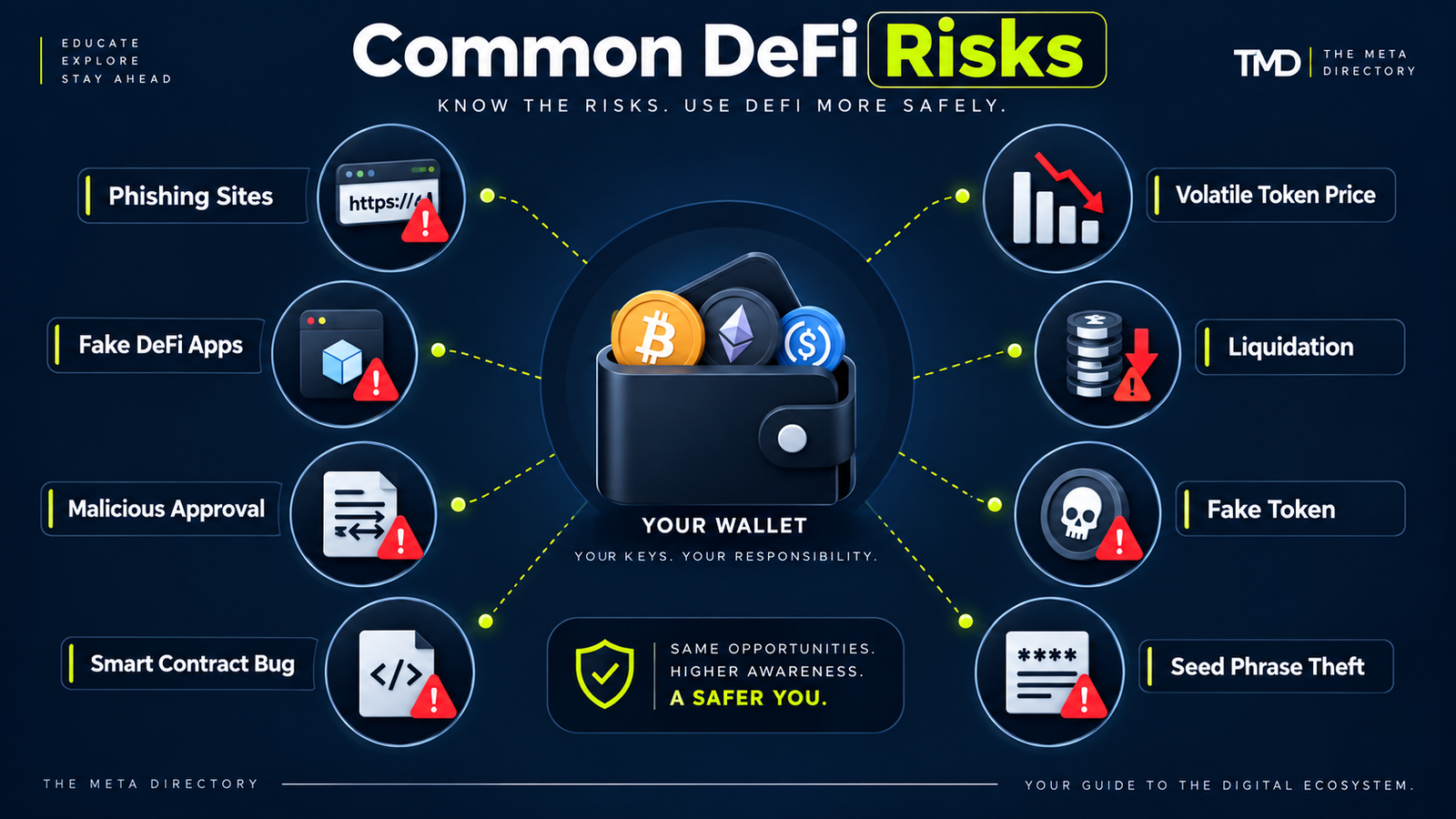
Beginners should know about risks such as:
- Smart-contract vulnerabilities
- Fake DeFi websites
- Phishing links
- Wallet-draining approvals
- Fraudulent tokens
- Impersonation scams
- Loss of private keys or seed phrases
- Volatile crypto prices
- Liquidation risk
- Protocol failure
- Liquidity risks
- Incorrect blockchain networks
- Oracle or data failures
- Malicious browser extensions or wallet apps
Liquidation can occur when a borrower’s collateral falls below a protocol’s required threshold, causing the protocol to sell or seize collateral according to its rules.
Some protocols also depend on external data, such as asset prices. This creates another layer of infrastructure that can affect how a financial smart contract operates.
Beginner Safety Note
Direct access to financial applications also means you may need to take more responsibility for protecting your assets.
Before connecting a wallet, check that you are using the correct website and network.
Private keys and seed phrases are sensitive wallet credentials that should never be entered into an unfamiliar website, message, form or support chat.
In addition, review wallet requests carefully before approving them. A request to “connect” or “verify” a wallet may involve much more than simply signing into a website.
Finally, avoid rushing because of countdown timers, promises of guaranteed returns, urgent messages, or fear of missing out.
Good crypto wallet safety includes verifying application websites, reviewing transaction requests and checking token permissions before granting access.
Author’s Tip
DeFi is easier to understand when you separate its components: the wallet provides access, the app provides the interface, smart contracts execute programmed rules, and the blockchain records transactions.
What Do You Need Before Using DeFi?
Before using decentralised financial applications, beginners should understand several related concepts.
Ideally, you should know:
- What cryptocurrency is
- How blockchain networks work
- What a crypto wallet does
- What private keys and seed phrases are
- How to check which network you are using
- What smart contracts do
- How gas fees work
- What wallet approvals mean
- Why blockchain transactions may not be reversible
- How to identify common crypto scams
You do not need to become a blockchain developer.
However, you should understand enough to recognise what a wallet request, transaction, or protocol is asking you to do.
Before You Start Checklist
Before interacting with a DeFi app, ask yourself:
- Can I explain what decentralised finance is?
- Do I understand how my crypto wallet works?
- Do I know which blockchain network I am using?
- Can I explain what a seed phrase is?
- Do I know why I should never share private wallet information?
- Do I understand what a smart contract does?
- Can I recognise a wallet approval request?
- Do I understand the gas fee before approving a transaction?
- Have I checked that the website or app is legitimate?
- Do I understand the financial risks of the specific activity?
- Am I starting with an amount I can afford to lose?
If you cannot confidently answer these questions, spend more time learning before depositing assets or approving transactions.
Pros and Cons of DeFi
Decentralised financial tools can provide greater access and flexibility, but users also need to understand the trade-offs.
| Pros | Cons |
| Can provide direct access to financial tools | Can feel complicated for beginners |
| Users may control assets through personal wallets | Wallet mistakes can result in permanent losses |
| Many services operate continuously | Smart contracts can contain vulnerabilities |
| Can support swaps, lending, borrowing, and other functions | Scams and malicious apps can target users |
| Blockchain activity can provide greater transparency | Crypto assets can be highly volatile |
| Smart contracts can automate financial processes | Some positions can face liquidation |
| Applications can interact with other blockchain protocols | One protocol failure can affect connected services |
Ultimately, the advantages depend on the protocol, the activity, and the user’s ability to manage the associated risks.
Beginner DeFi Terms to Know
You will encounter unfamiliar terminology when learning about decentralised finance.
These are some of the main terms to recognise:
| Term | Beginner meaning |
| DeFi | Short for decentralised finance |
| Protocol | A blockchain-based system with defined rules and functions |
| dApp | A decentralised application that interacts with blockchain networks or smart contracts |
| Smart contract | A program that runs on a blockchain and performs defined functions |
| DEX | A decentralised exchange used to trade digital assets through blockchain-based systems |
| Liquidity | Assets available to support trading or other financial activity |
| Liquidity pool | A collection of digital assets used by certain decentralised protocols |
| Liquidity provider | A user or entity that supplies assets to a liquidity pool |
| Collateral | Assets supplied to support or secure a borrowing position |
| Liquidation | The forced closing or sale of collateral when certain protocol conditions are met |
| Stablecoin | A digital asset designed to track the value of another asset, often a fiat currency |
| Yield | A return or reward associated with certain financial activities |
| Gas fee | A blockchain network transaction fee |
| Wallet approval | Permission that allows a smart contract or application to perform a specific interaction |
| Oracle | Infrastructure that can supply blockchain applications with external data |
| TVL | Total value locked, a metric commonly used to describe the value deposited in certain DeFi protocols |
Don’t worry about memorising every term immediately.
The important thing is understanding what a term means before you approve a transaction or use a financial product that depends on it.
How Beginners Should Start Learning DeFi
The easiest way to learn decentralised finance is to build the knowledge in stages.
A sensible beginner path looks like this:
- Understand what cryptocurrency is.
- Learn how blockchain networks work.
- Understand crypto wallets.
- Learn what private keys and seed phrases do.
- Understand smart contracts.
- Learn how gas fees work.
- Become familiar with basic DeFi terminology.
- Learn common wallet and crypto scams.
- Study the specific protocol or financial activity before using it.
Above all, avoid treating DeFi as something you need to understand all at once.
TMD’s crypto guides establish the foundations behind blockchain transactions, wallets, digital assets and security before readers move into more specialised DeFi activities.
Key Facts
- DeFi is short for decentralised finance.
- It covers blockchain-based financial apps, protocols, and services.
- Users may access DeFi through crypto wallets and decentralised applications.
- Smart contracts can automate actions such as swaps, lending, borrowing, and liquidity management.
- Many blockchain interactions require transaction or gas fees.
- DeFi can involve risks such as scams, smart-contract vulnerabilities, liquidation, volatile assets, and unsafe wallet approvals.
- Beginners should understand wallets, networks, fees, approvals, and common scams before using DeFi.
Where to Go Next
DeFi brings together financial protocols, blockchain networks, wallets and smart contracts. These guides explain the technologies behind decentralised finance and the risks involved in using them.
- DeFi Tools: Discover the different types of decentralised financial tools, from trading platforms and lending protocols to liquidity services.
- Web3 & Crypto Guide: Understand where decentralised finance sits within the wider ecosystem of blockchain technology and digital assets.
- Crypto Guides: Build the cryptocurrency knowledge needed to understand token transfers, protocol terminology and DeFi transactions.
- What Is Blockchain?: Understand how distributed networks record swaps, lending activity and other transactions generated by financial protocols.
- What Are Smart Contracts?: Examine the automated rules that manage DeFi activities such as borrowing, collateral and decentralised trading.
- What Are dApps?: Understand how application interfaces connect users to financial protocols and prepare transactions for wallet approval.
- What Is a Crypto Wallet?: Understand how wallets connect to DeFi services and allow users to authorise blockchain activity.
- Custodial vs Non-Custodial Wallets: Compare direct control of wallet keys with arrangements where a service provider manages access.
- What Are Gas Fees?: Understand the network costs involved in swaps, token approvals, lending and other on-chain activities.
- Crypto Wallet Safety Guide: Examine the precautions involved in connecting wallets, signing transactions and reviewing token permissions.
- Common Crypto Scams to Avoid: Recognise fraudulent DeFi platforms, fake tokens, impersonation and malicious wallet requests.
Safety Checklist
✓ Check the website before connecting
✓ Review every wallet request
✓ Never share your seed phrase
✓ Confirm the correct blockchain network
✓ Check fees before approving
✓ Start small while learning
Related Guides
- What Are Smart Contracts? A Beginner’s Guide to Blockchain-Based Agreements
- What Are dApps? A Beginner’s Guide to Decentralised Apps
- What Is DeFi? A Beginner’s Guide to Decentralised Finance
- What Are Gas Fees? A Beginner’s Guide to Crypto Transaction Costs
- Common Crypto Scams to Avoid: How to Spot the Warning Signs
Disclaimer: This guide is for general information and education only. It is not financial, investment, legal, or tax advice. Crypto and digital assets can be risky, and prices may change quickly. Always do your own research and consider speaking with a qualified professional before making financial decisions.
The Meta Directory may earn commissions from some links, but this does not influence our editorial content.

Author
Frequently Asked Questions
DeFi means decentralised finance. It describes financial apps and services that use blockchain networks and smart contracts for activities such as swapping, lending, borrowing, and managing digital assets.
No. Crypto refers broadly to cryptocurrencies and other digital assets, while DeFi refers to financial applications and protocols that use blockchain technology and digital assets.
DeFi applications commonly use blockchain networks and smart contracts to process financial actions. Users may connect a crypto wallet, choose an action, review a transaction, and approve it through the wallet.
Many non-custodial DeFi applications require a compatible crypto wallet. The wallet lets users connect to applications, access assets, sign transactions, and interact with smart contracts.
DeFi carries risks including scams, smart-contract vulnerabilities, volatile assets, liquidation, unsafe wallet approvals, and user mistakes. Beginners should understand the platform and transaction before depositing assets or approving any request.
People use decentralised finance for activities such as token swaps, lending, borrowing, decentralised trading, liquidity provision, stablecoins, and other blockchain-based financial services.
No. Ethereum has a large DeFi ecosystem, but decentralised financial applications also operate across other blockchain networks and layer-2 systems.
Yes. Users can lose money through market movements, liquidation, smart-contract problems, scams, wallet mistakes, protocol failures, or other risks. Never assume that a blockchain-based financial product guarantees a return.
HOW WE REVIEW & RANK
We research and compare platforms using a consistent framework: security signals, track record, product usability, feature quality, transparency of terms, and real-world usefulness.
When something changes – fees, policies, availability, or features – we update our listings and reviews.
Learn more about how we review platforms ->
STAY UPDATED
Get new crypto guides, updated rankings, and practical tips straight to your inbox — no spam, unsubscribe anytime.
NO SPAM. UNSUBSCRIBE ANYTIME.