Common Crypto Scams to Avoid: How to Spot the Warning Signs
Updated: September 2026
Written By
Table of Contents
- What Are the Most Common Crypto Scams?
- 10 Common Crypto Scams and How to Spot Them
- What Are the Biggest Crypto Scam Warning Signs?
- Why Do Crypto Scams Work?
- What Crypto Information Should You Never Share?
- How Can You Check Whether a Crypto Opportunity Is Legitimate?
- What Should You Do if You Think You’ve Been Scammed?
- Crypto Scam Safety Checklist
- Key Takeaways
- Recommended Next Guides
- Frequently Asked Questions
QUICK FACTS
Best for:
Beginners & crypto users
Difficulty: Beginner-friendly
Main topic:
Crypto scam prevention
Covers:
Phishing, fake platforms, investment scams & wallet threats
You’ll learn:
How to spot crypto scams before losing money or exposing your wallet

Common crypto scams don’t always rely on sophisticated hacking. Many work by convincing people to send cryptocurrency, reveal sensitive information, connect a wallet or approve a transaction themselves.
Scammers may impersonate legitimate companies, create convincing investment platforms, promise unrealistic returns or use phishing websites designed to steal login or wallet information. Because cryptocurrency transactions can be difficult or impossible to reverse, recognising these tactics before acting is particularly important.
Following practical ways to improve crypto wallet safety can reduce some of these risks, but protecting yourself also means learning to recognise the behaviour and warning signs commonly used in crypto scams.
What Are Common Crypto Scams?
Common crypto scams include phishing, fake investment platforms, rug pulls, giveaway scams, impersonation, pump-and-dump schemes, and fake wallets or exchanges. Most aim to steal cryptocurrency, money, private keys, or seed phrases.
What Are the Most Common Crypto Scams?
Common crypto scams include phishing, fake exchanges and wallets, impersonation, fraudulent investment schemes, fake giveaways, romance-investment scams, rug pulls, malicious dApps and recovery scams. Although the methods differ, many attempt to persuade victims to send money, reveal credentials or authorise access themselves.
The technology may change, but many of the tactics are familiar forms of social engineering.
Scammers can create urgency, imitate trusted organisations, promise unusually high rewards or establish relationships over time. Learning to recognise those patterns can help you identify new scams even if you’ve never encountered the exact method before.
This makes scam awareness an important part of learning crypto as a beginner, not just a separate safety topic.
10 Common Crypto Scams and How to Spot Them
1. Crypto Phishing Scams
Crypto phishing scams attempt to trick you into revealing sensitive information or taking an action that gives an attacker access to your account or assets.
A phishing attempt might arrive through an email, text message, social-media post, search advertisement or direct message.
The scammer may imitate a wallet provider or cryptocurrency exchange and claim that:
- Suspicious activity has been detected
- The account will be suspended
- Your wallet needs to be verified
- You need to claim an urgent security update
- A transaction requires confirmation
- You’ve qualified for a reward or airdrop
The message then directs you to a fake website designed to resemble the legitimate service.
Depending on the scam, the site might attempt to steal your exchange password, two-factor authentication code, private key or recovery phrase. It may instead encourage you to connect a wallet and approve a malicious request.
Warning signs
Be suspicious of unexpected messages that combine urgency with a link or request for sensitive action.
Rather than following the supplied link, independently navigate to the provider’s legitimate website or application and check your account there.
2. Fake Crypto Exchanges
A fake crypto exchange is a fraudulent platform designed to appear like a legitimate place to buy, sell or invest in cryptocurrency.
Understanding what a crypto exchange is can make it easier to spot when a platform’s claims, withdrawal process, or account dashboard do not make sense.
Some imitate well-known exchanges using similar names, branding and website designs. Others create entirely new platforms that appear legitimate at first.
A particularly deceptive version may show a victim a convincing account dashboard containing trades, profits and an increasing balance.
But numbers displayed on a website are not proof that the cryptocurrency or investment actually exists.
Problems often become apparent when the victim tries to withdraw. They may suddenly be told they need to:
- Pay a tax
- Make another deposit
- Upgrade their account
- Pay a verification charge
- Meet a minimum balance
- Send additional cryptocurrency to release their funds
Sending more money may simply create another loss.
Checking how to choose a crypto exchange safely before depositing can help you vet the company, security, custody arrangements, fees, withdrawals and regulatory claims rather than judging a platform by its appearance.
Warning signs
Be particularly cautious if someone you met online directs you to an unfamiliar exchange and then coaches you through making deposits.
3. Fake Crypto Wallets and Wallet Apps
Fake crypto wallets imitate legitimate wallet software or create fraudulent wallet applications in an attempt to steal cryptocurrency or sensitive wallet credentials.
This is especially risky for beginners who are still learning what a crypto wallet is and how wallet software should normally behave.
They may appear as:
- Fake wallet websites
- Malicious browser extensions
- Counterfeit mobile applications
- Cloned download pages
- Fake wallet updates
For example, a malicious application may ask you to import an existing wallet using your recovery phrase. If those words are sent to the scammer, they may gain the information necessary to control your accounts.
This is why you should verify the source of wallet software before installing it. Be especially suspicious of a website claiming that you must enter a seed phrase to “validate”, “synchronise” or “unlock” your wallet.
Warning signs
A familiar logo is not enough. Check the domain, publisher and official source independently rather than trusting a download link supplied through an advertisement, direct message or social-media post.
4. Impersonation and Fake Support Scams
Impersonation scams involve someone pretending to represent a trusted person, cryptocurrency company, wallet provider, exchange or project.
Fake support is particularly dangerous because people often look for help when they’re already stressed about a technical problem or missing transaction.
A scammer might contact you claiming to be:
- Exchange support
- Wallet support
- Project administrator
- Cryptocurrency developer
- An influencer
- Company executive
- Security specialist
They may then ask you to click a link, install software, share a verification code or provide wallet recovery information.
Some scammers also create fake support accounts underneath genuine social-media posts from people asking for help.
Warning signs
Treat unsolicited support contact as suspicious. If you need help, go straight to the company’s official website and use the support options listed there.
Don’t assume someone is legitimate just because their profile uses the correct logo, name or photograph.
5. Crypto Investment and Guaranteed-Return Scams
Crypto investment scams often promise unusually high, consistent or guaranteed returns while hiding how the investment actually works.
The scam may involve a fake trading platform, investment manager, automated trading system or cryptocurrency opportunity. Victims may initially see apparent profits.
For example, In some schemes, scammers may even allow an early small withdrawal. This can make the platform seem legitimate and encourage the victim to invest significantly more.
The problem appears later. When the victim attempts a larger withdrawal, the platform may then demand additional payments for supposed:
- Taxes
- Commissions
- Verification
- Liquidity
- Account upgrades
- Withdrawal processing
A legitimate-looking dashboard showing a growing balance doesn’t prove that genuine trading has happened or that the displayed assets exist.
Warning signs
Treat any claims of guaranteed returns, risk-free profits or unusually consistent investment performance with extreme caution. The U.S. Federal Trade Commission also warns that guaranteed profits or large guaranteed returns are common signs of cryptocurrency scams.
Cryptocurrency markets involve risk. Someone claiming they can remove that risk entirely should immediately invite further scrutiny.
6. Fake Crypto Giveaways and Airdrops
Fake crypto giveaways use the promise of free or multiplied cryptocurrency to persuade people to send funds, visit malicious websites or approve dangerous wallet requests.
One of the simplest versions says:
Send cryptocurrency to XYZ address and receive a larger amount back.
Legitimate giveaways shouldn’t require you to send cryptocurrency simply to receive more in return.
However, more sophisticated scams may imitate:
- Cryptocurrency projects
- Exchanges
- Influencers
- Celebrities
- Livestreams
- Token launches
A fake airdrop may instead direct you to a website where you’re asked to connect a wallet and approve a transaction.
The scam therefore isn’t always about sending crypto directly. In other words, the “free token” is simply the bait used to get access to your wallet.
Warning signs
Don’t rely on screenshots, follower counts, livestream footage or celebrity appearances as proof.
Verify all promotions through the organisation’s legitimate channels before interacting with them.
7. Romance and Relationship-Based Crypto Scams
Some crypto investment scams begin by building a personal or romantic relationship before cryptocurrency is ever mentioned.
For example, the scammer may spend weeks or months establishing trust. Eventually, they introduce an investment opportunity, often claiming that they:
- Have successfully traded crypto for years
- Know an expert or family member who trades
- Have access to special market information
- Can teach you their strategy
- Use an unusually profitable platform
The victim is then directed to a fraudulent website or application where apparent profits may encourage increasingly large deposits.
Because trust was established first, warning signs that would seem obvious in an unsolicited investment advertisement can become much harder to recognise.
Warning signs
Be cautious when someone you’ve met online combines a developing personal relationship with financial advice and directs you toward a specific cryptocurrency platform or investment.
The relationship itself can be part of the social engineering.
8. Rug Pulls and Fraudulent Crypto Projects
A rug pull generally involves a crypto project in which insiders abandon or manipulate the project in a way that leaves other participants with substantial losses.
However, the exact mechanism varies. It may involve project creators disappearing with funds, removing liquidity, exploiting control over a token or misleading buyers about what is actually being built.
Potential warning signs can include:
- Unrealistic promises
- Unverifiable teams
- Extreme pressure to buy quickly
- Highly concentrated control
- Unclear token mechanics
- Misleading partnerships
- Little substance beyond marketing
- Unusual liquidity arrangements
However, an important distinction needs to be made:
A cryptocurrency losing value or a project failing doesn’t automatically mean it was a rug pull.
Legitimate projects can fail. Markets can collapse. Developers can make poor decisions. Fraud requires more than simply producing a bad investment outcome.
9. Malicious dApps and Wallet Approval Scams
A malicious decentralised application can attempt to persuade users to connect a wallet and approve permissions or transactions that put their assets at risk.
Unlike a traditional phishing page that simply asks for a password, a malicious Web3 site may interact directly with a wallet.
The website could appear to offer:
- Token staking
- An NFT mint
- Airdrops
- DeFi opportunities
- Access to a game
- A token claim
DeFi can create useful financial tools, but it can also expose users to wallet approvals, smart contract risk, fake interfaces, and unfamiliar transaction prompts.
Connecting a wallet by itself is not necessarily equivalent to giving someone complete control of your assets. What matters is what you’re subsequently asked to sign or approve.
Read wallet prompts carefully and question requests that don’t make sense for the action you’re trying to perform.
This becomes especially important when interacting with dApps, where users may connect a wallet, review prompts, and approve actions through a blockchain-based application.
Warning signs
Don’t approve a wallet request just because the website tells you it’s required. Understand the transaction or permission first.
10. Crypto Recovery Scams
Crypto recovery scams target people who have already lost cryptocurrency by claiming that stolen or inaccessible funds can be recovered for a payment or sensitive information.
This makes them particularly harmful.
A victim may already be upset and urgently searching for help when someone claims to be:
- A blockchain investigator
- Recovery specialist
- Hacker
- Law-enforcement contact
- Exchange employee
- Cryptocurrency expert
The supposed recovery service might ask for an upfront payment, private key, recovery phrase, remote access to a device or additional cryptocurrency.
After payment, the scammer may disappear or invent another fee.
In some cases, details about the original loss may be used to make the recovery claim appear convincing.
Warning signs
Be extremely cautious of anyone who unexpectedly contacts you claiming they can retrieve stolen cryptocurrency. The fact that someone knows about your loss does not prove they can recover it.
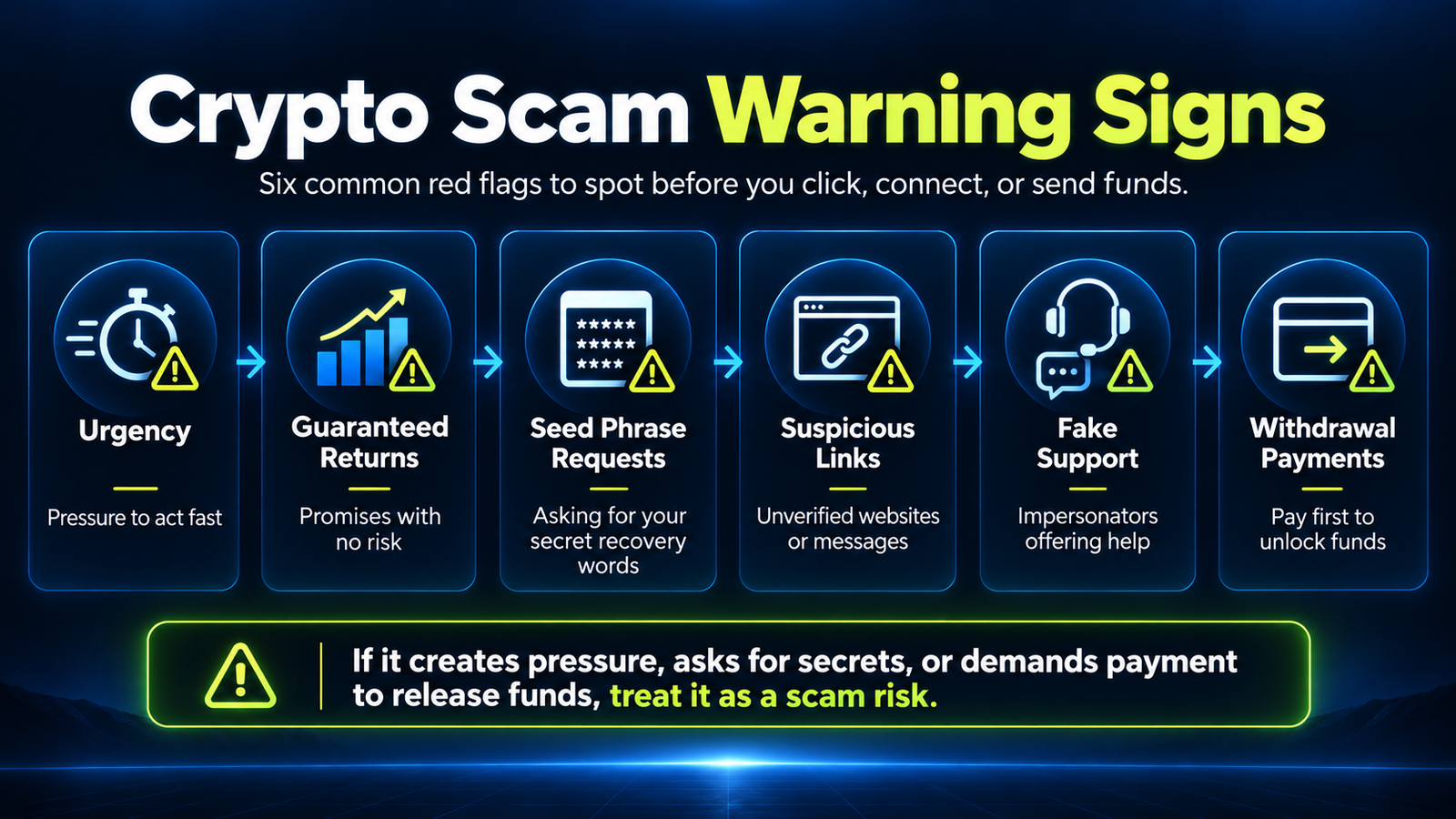
What Are the Biggest Crypto Scam Warning Signs?
Common crypto scam warning signs include guaranteed returns, pressure to act quickly, unsolicited investment opportunities, requests for private keys or seed phrases, suspicious links and demands for additional payments before withdrawals can be released.
Look for combinations of warning signs rather than expecting every scam to look identical.
🚩 Guaranteed or risk-free profits
Crypto investments involve risk.
🚩 Artificial urgency
“Act in the next ten minutes or lose access.”
🚩 Requests for private credentials
Especially private keys, recovery phrases, passwords or authentication codes.
🚩 Unsolicited support
Someone contacts you first claiming there’s a problem with your wallet or account.
🚩 Suspicious links or domains
Small spelling changes can imitate legitimate companies.
🚩 Unexpected wallet approvals
The requested action doesn’t match what you thought you were doing.
🚩 Payments required to release withdrawals
Especially repeated deposits, “taxes” or account-unlocking fees.
🚩 Unverifiable celebrity endorsements
Images and videos can be manipulated or presented out of context.
🚩 Pressure to keep the opportunity secret
Isolation makes independent verification harder.
🚩 Returns that seem disproportionately good
High reward without meaningful risk is a major reason to investigate further.
Why Do Crypto Scams Work?
Crypto scams often succeed because they exploit human behaviour rather than defeating blockchain security directly. Scammers use social engineering to influence people into making decisions they might otherwise question.
For example, several psychological pressures appear repeatedly.
Urgency
Creating a deadline reduces the amount of time someone has to investigate.
Fear
Messages about compromised wallets, frozen accounts or disappearing funds can push people into reacting before verifying the claim.
Authority
Impersonating a well-known exchange, company, celebrity or expert can make instructions appear more trustworthy.
Reward
Promises of large profits, giveaways and exclusive opportunities can encourage people to overlook warning signs.
Scarcity
A scam may claim there are only a few investment spaces, tokens or rewards remaining.
Trust
Relationship-based scams can establish trust over weeks or months before introducing money.
FOMO
Fear of missing a rapidly rising cryptocurrency or limited opportunity can encourage impulsive decisions. This is why memorising today’s scams isn’t enough.
A specific website or scam format may disappear, but the underlying manipulation techniques can be reused in entirely new ways.
Author’s Tip
I’ve worked in the crypto space for years, and one of the biggest warning signs I’ve learned to watch for is pressure. If someone is rushing you to send crypto, connect a wallet, share information, or act before you can verify the details independently, stop and check everything first.
What Crypto Information Should You Never Share?
Private keys, seed phrases, passwords and authentication codes should be treated as sensitive information and should never be shared with people claiming they need them to provide support or verify your wallet.
However, it’s also important to remember that not every piece of wallet information has the same security implications.
Public Wallet Address
A public wallet address is designed to be shared when receiving cryptocurrency.
Knowing the address alone doesn’t normally provide the private key required to authorise transactions from a conventional blockchain account.
However, public blockchain activity can reveal transaction and balance information associated with an address, so there may still be privacy considerations.
Private Key
A private key is sensitive cryptographic information used to authorise transactions. It should stay private.
Seed or Recovery Phrase
A recovery phrase can be used to restore access to accounts associated with many self-custody wallets.
Anyone who has the phrase may be able to gain control of those accounts.
Understanding what private keys and seed phrases do makes it much easier to recognise why unexpected requests for this information are so dangerous.
Passwords and Authentication Codes
Exchange passwords, one-time codes and authentication credentials should also remain private.
A legitimate support process shouldn’t require you to send your password or current authentication code to a stranger through a message.
How Can You Check Whether a Crypto Opportunity Is Legitimate?
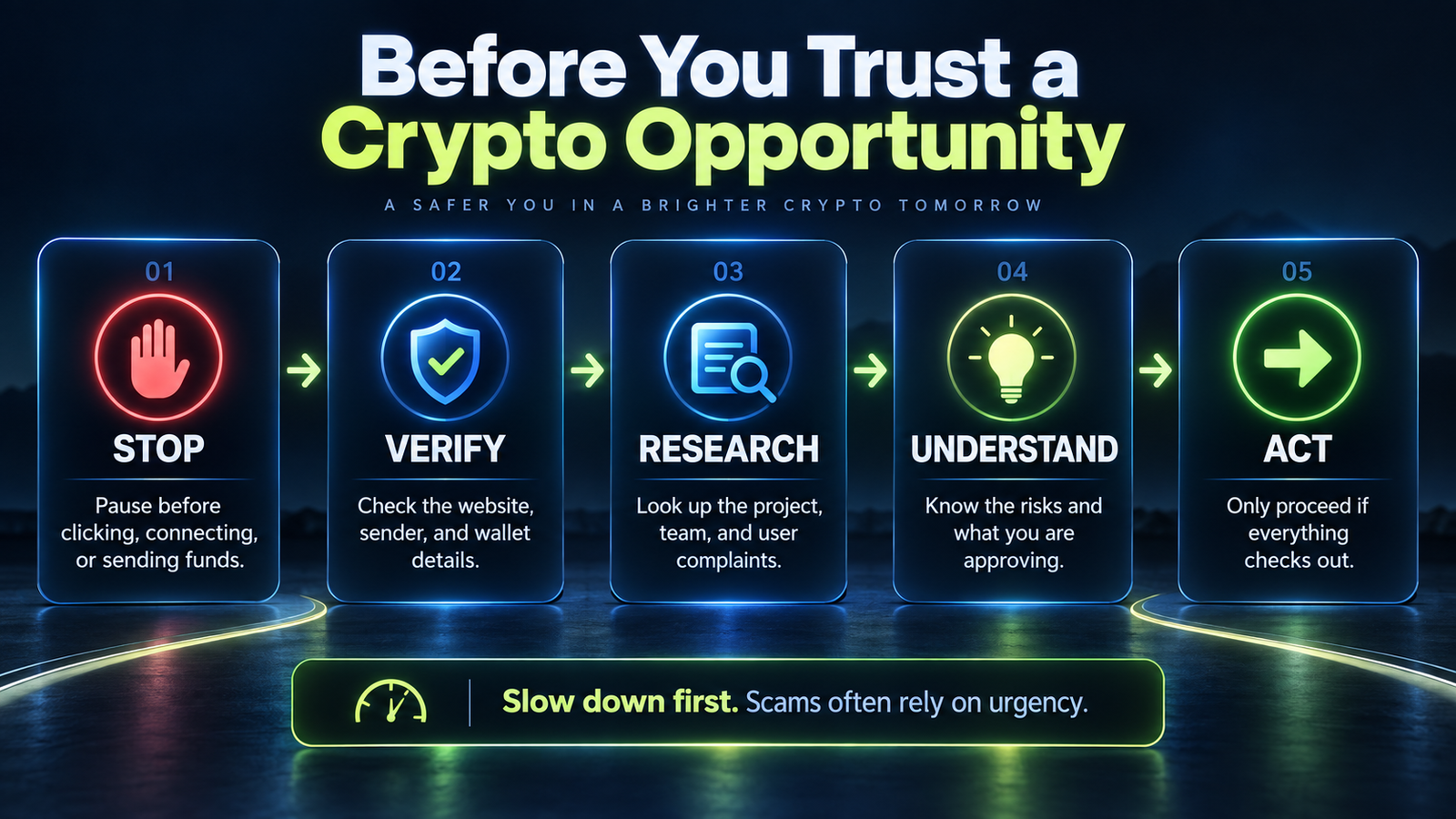
Before trusting a crypto platform, project or investment opportunity, stop and verify its claims independently rather than relying on information provided by the person promoting it alone.
For this reason, A simple verification process is:
1. Stop
Don’t let urgency determine your decision. If an opportunity disappears because you took an hour to investigate it, that is preferable to sending money you can’t recover.
2. Verify
Find the company’s official website yourself. Don’t use the link supplied in the message you’re trying to verify.
3. Research
Look into:
- The organisation or team
- Company information
- Regulatory claims where relevant
- Previous security incidents
- Independent reporting
- How the product actually works
A structured review process is useful when comparing crypto platforms because security, custody, transparency, fees, and reputation all affect user risk.
4. Understand
Before sending cryptocurrency or connecting a wallet, ask yourself: What am I being asked to do?
If you can’t explain the transaction, permission or investment easily, don’t assume it’s safe just because someone else tells you it is.
5. Act Only When You’re Comfortable
Don’t allow a promoter, “support agent”, online friend or investment coach to rush you.
STOP → VERIFY → RESEARCH → UNDERSTAND → ACT
What Should You Do if You Think You’ve Been Scammed?
If you think you’re interacting with a crypto scam, stop sending money or sharing information and determine what may already have been exposed. The appropriate next step depends on whether you revealed credentials, approved wallet access or already transferred funds.
If You Haven’t Sent Anything Yet
Stop communicating with the person or platform.
Don’t click anymore links, install software or connect a wallet while trying to “prove” whether the opportunity is legitimate. Verify the company or service yourself directly.
If You Shared an Account Password
Use the legitimate provider’s website or application to secure the account. Change compromised passwords and review available security settings, active sessions and authentication methods.
If the same password was reused elsewhere, those accounts may also need to be secured.
If You Exposed a Private Key or Recovery Phrase
This is more serious than revealing an application password. Changing the password used to open a self-custody wallet doesn’t necessarily invalidate the underlying private key or recovery phrase.
Follow the appropriate crypto wallet safety steps and treat affected recovery credentials as compromised.
If You Approved a Suspicious Wallet Permission
Review what was approved and use trusted network-appropriate tools to revoke unwanted permissions where possible.
Remember, revoking a token approval doesn’t make an exposed private key or seed phrase safe again.
If You’ve Already Sent Cryptocurrency
Preserve relevant evidence, including:
- Wallet addresses
- Transaction hashes
- Emails
- Messages
- Usernames
- Website addresses
- Screenshots
- Payment records
Contact the legitimate exchange or service involved where appropriate and report the incident to the relevant authorities or fraud-reporting services in your jurisdiction.
Don’t assume that a blockchain transaction can easily be reversed. That risk is easier to understand once you know how blockchain records transactions in a shared ledger.
Watch for Recovery Scammers
After reporting a loss publicly, you may receive messages from people claiming they can recover the funds.
Treat this as another potential scam. Losing money once can make you a target for a second fraud.
Crypto Scam Safety Checklist
Before sending cryptocurrency, investing through an unfamiliar platform or connecting your wallet:
☐ Find the website independently rather than relying on a supplied link.
☐ Verify who operates the platform or project.
☐ Nobody asks for my private key or seed phrase.
☐ Understand exactly what I’m being asked to send, sign or approve.
☐ Haven’t been pressured into acting immediately.
☐ Independently checked important claims.
☐ Understand how deposits and withdrawals work.
☐ Not relying solely on a celebrity, influencer or social-media endorsement.
☐ Checked the website address carefully.
☐ Consider why the person or company contacted you.
☐ Any promised return sounds realistic rather than guaranteed.
☐ Stop if the process doesn’t make sense.
The goal isn’t to become suspicious of every crypto service but to build the habit of verifying before trusting.
Key Takeaways
- Many crypto scams rely on social engineering rather than sophisticated technical attacks.
- Phishing can target exchange logins, wallet credentials and transaction approvals.
- A convincing website or investment dashboard does not prove that a platform is legitimate.
- Never share a private key or recovery phrase with someone claiming to provide support.
- Guaranteed returns and pressure to invest quickly are major warning signs.
- Verify cryptocurrency exchanges, wallets and projects independently before using them.
- Read wallet requests before signing or approving transactions.
- Failed crypto projects are not automatically scams; distinguish investment losses from deliberate fraud.
- If you suspect a wallet has been compromised, determine exactly what information or permissions may have been exposed.
- Be particularly cautious of people offering to recover cryptocurrency after a loss.
This guide is part of The Meta Directory’s Web3 & Crypto Guide, where beginners can explore crypto, wallets, exchanges, DeFi, blockchain, and Web3 safety topics.
Recommended Next Guides
To better understand crypto scam risks, these related guides explain the wallets, exchanges, private keys, dApps, and DeFi tools that scammers often target.
TIP: START WITH CRYPTO WALLET SAFETY GUIDE OR HOW TO CHOOSE A CRYPTO EXCHANGE SAFELY.
Safety Checklist
✓ Never share private keys or seed phrases
✓ Verify websites independently
✓ Question guaranteed returns
✓ Ignore unsolicited support
✓ Check wallet requests before approving
✓ Never rush a crypto payment
Related Guides
- What Are Smart Contracts? A Beginner’s Guide to Blockchain-Based Agreements
- What Are dApps? A Beginner’s Guide to Decentralised Apps
- What Is DeFi? A Beginner’s Guide to Decentralised Finance
- What Are Gas Fees? A Beginner’s Guide to Crypto Transaction Costs
- Common Crypto Scams to Avoid: How to Spot the Warning Signs
Disclaimer: This guide is for general information and education only. It is not financial, investment, legal, or tax advice. Crypto and digital assets can be risky, and prices may change quickly. Always do your own research and consider speaking with a qualified professional before making financial decisions.
The Meta Directory may earn commissions from some links, but this does not influence our editorial content.

Author
Frequently Asked Questions
Common warning signs include guaranteed returns, pressure to act quickly, requests for sensitive wallet information, unsolicited investment advice and instructions to send additional money before funds can be withdrawn.
However, scammers continually change their methods. Verify the person, company and claims independently rather than relying on one warning sign alone.
Knowing a public wallet address alone doesn’t normally give someone the private key required to authorise transactions from a conventional blockchain account.
Public addresses are intended to be shared when receiving cryptocurrency.
Private keys and recovery phrases are different. Those should remain secret because they may provide control over the associated accounts.
You shouldn’t provide a seed phrase or private key to someone claiming they need it for customer support, account verification or wallet synchronisation.
These credentials can provide control over a self-custody wallet and should be treated as secret. Be suspicious of anyone who contacts you and asks for them.
Recovery can sometimes be possible depending on what happened, which services were involved and whether funds can be identified or frozen, but cryptocurrency recovery isn’t guaranteed.
Blockchain transactions themselves are generally designed to be difficult to reverse once confirmed. Be especially cautious of people who promise guaranteed recovery in exchange for an upfront payment or wallet credentials.
No. A new cryptocurrency or Web3 project is not automatically a scam simply because it’s new, risky or ultimately unsuccessful. Legitimate projects can fail, tokens can lose value and teams can make poor decisions without committing fraud.
HOW WE REVIEW & RANK
We research and compare platforms using a consistent framework: security signals, track record, product usability, feature quality, transparency of terms, and real-world usefulness.
When something changes – fees, policies, availability, or features – we update our listings and reviews.
Learn more about how we review platforms ->
STAY UPDATED
Get new crypto guides, updated rankings, and practical tips straight to your inbox — no spam, unsubscribe anytime.
NO SPAM. UNSUBSCRIBE ANYTIME.