
What Is Crypto? A Beginner’s Guide to Cryptocurrency
Updated: September 2026
Written By
Table of Contents
- Understand the Fundamentals of Crypto
- Crypto vs Traditional Money (Fiat)
- Why Do People Use Crypto?
- What Are the Main Types of Crypto?
- What Do You Need Before Using Crypto?
- Before You Start Checklist
- Is Crypto Safe?
- Pros and Cons of Crypto
- Beginner Crypto Terms to Know
- How Beginners Should Start Learning Crypto
- Recommended Next Guides
QUICK FACTS
Best for: Beginners
Difficulty: Beginner-friendly
Main topic: Crypto basics
Covers: Wallets, blockchain, exchanges, safety
You’ll learn:
What crypto is,
How crypto works,
Key risks to know,
Where to go next

Crypto is a type of digital asset that uses blockchain technology to record and transfer value online. Cryptocurrency can feel confusing at first, but the basic idea is easier to understand than most people think once you separate the technology, the assets, and the risks.
In this beginner guide, you’ll learn how it works, why people use it, what the risks are, and what to understand before using it yourself.
This article is part of The Meta Directory’s Web3 & Crypto Guide, aimed to help beginners understand crypto, wallets, blockchain, web3, exchanges, DeFi, and digital asset safety.
What is Crypto?
Crypto, short for cryptocurrency, is a type of digital asset that uses blockchain technology to record transactions without needing a traditional bank or payment company to manage every transfer.
Understand The Fundamentals Of Crypto
Before looking at wallets, exchanges, Bitcoin, Ethereum, or Web3, it helps to start with beginner crypto guides that explain the basic meaning first. At its core, it’s a way to own and transfer digital value using technology instead of relying only on banks or payment companies.
In this section, you’ll get a simple explanation of cryptocurrency without going too deep into technical details.
What Does Crypto Mean?
In simple terms, a cryptocurrency is a digital currency that uses cryptography, which is a type of secure code, to help verify transactions and protect information.
You may also see crypto described as a digital asset, especially when people are talking about tokens, wallets, platforms, and blockchain-based tools. This is because not every token is used like money.
For instance, a token might be used to pay blockchain transaction fees, connect to an app, support a game, or provide access to a specific platform or service. For this reason, beginners should focus on what a token does before assuming it works like money.
The easiest way to think about it is this:
- Crypto: digital value that can be stored, sent, received, or used online through blockchain-based systems.
- Bitcoin: the most famous example.
- Ethereum: another major crypto network that also supports smart contracts, tokens, and apps.
However, digital currency is not the same as money in your bank account because it doesn’t work through the same systems, and it doesn’t always come with the same protections.
How Do Crypto, Blockchain, Wallets and Exchanges Fit Together?
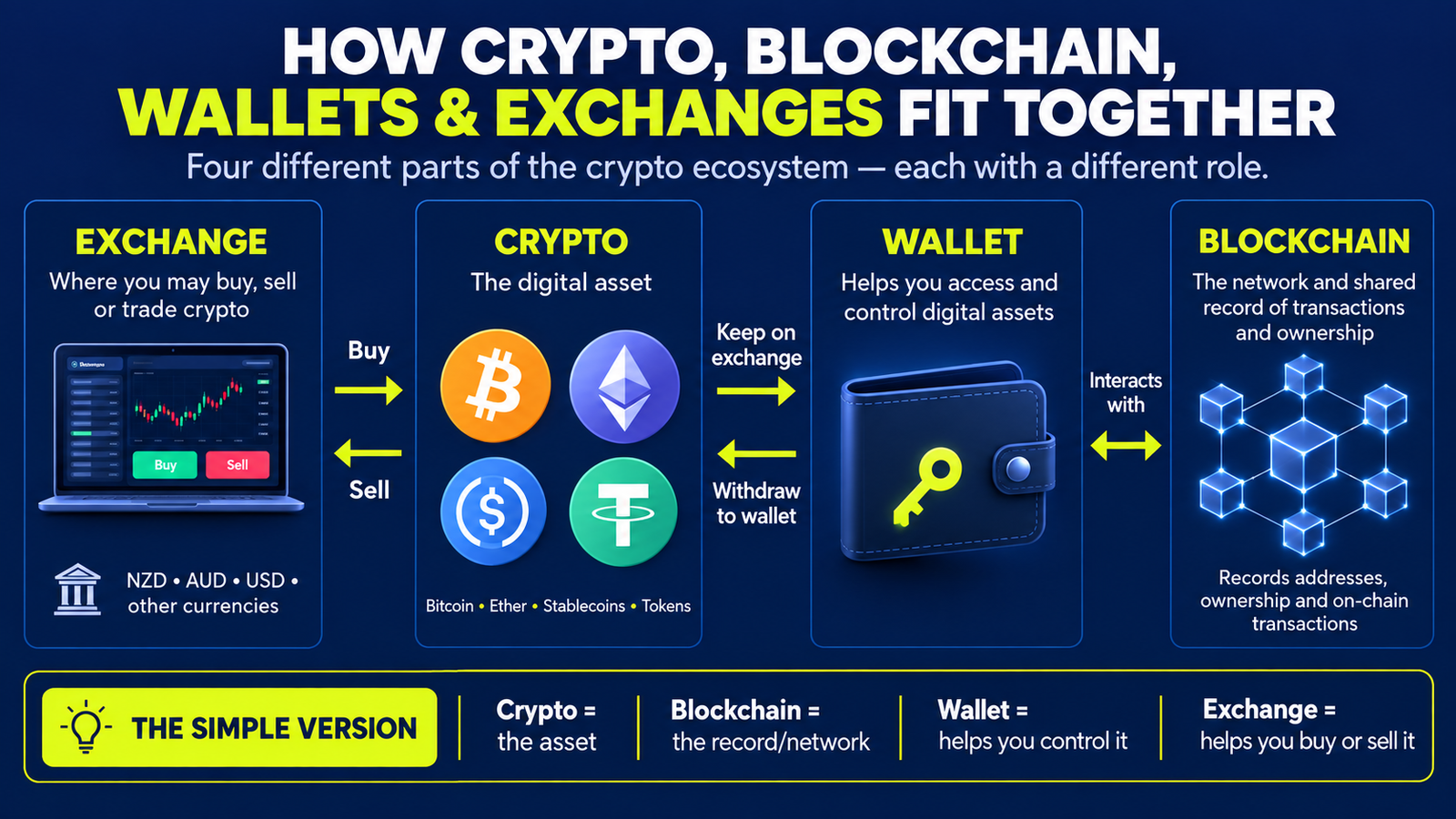
Crypto, blockchain, wallets, and exchanges are closely connected, but they each do something different.
The easiest way to separate them is:
- Crypto: is the digital asset, such as Bitcoin or Ether.
- Blockchain: is the network and shared digital record that tracks transactions and ownership.
- Crypto wallets: are tools that help users access and control digital assets through private keys.
- Crypto exchanges: are platforms where people can buy, sell, trade, or convert digital assets.
For example, someone might use a crypto exchange to buy Bitcoin and then withdraw it to a personal wallet. The Bitcoin does not physically move into the wallet. Instead, the Bitcoin blockchain records the transaction, while the wallet gives the user the tools needed to control the assets associated with their blockchain address.
In simple terms, the blockchain keeps the record, the crypto is the asset, the wallet helps you control it, and the exchange can help you buy or sell it.
How Does Crypto Work?
In practice, this digital asset works through blockchain networks. To understand digital currency, it helps to know what blockchain is and how it works.
Put simply, a blockchain is a shared digital record that keeps track of transactions.
When someone sends cryptocurrency, for instance, the transaction is sent to a blockchain network. Then, the network checks the transaction and records it. Once confirmed, the transaction becomes part of the public record for that blockchain.
Beginners should understand that transactions are usually recorded differently from normal bank payments.
For example, if you send Bitcoin to another person, you do not hand them a physical coin. You send a transaction from your digital wallet to their wallet address. The Bitcoin network then records that transaction.
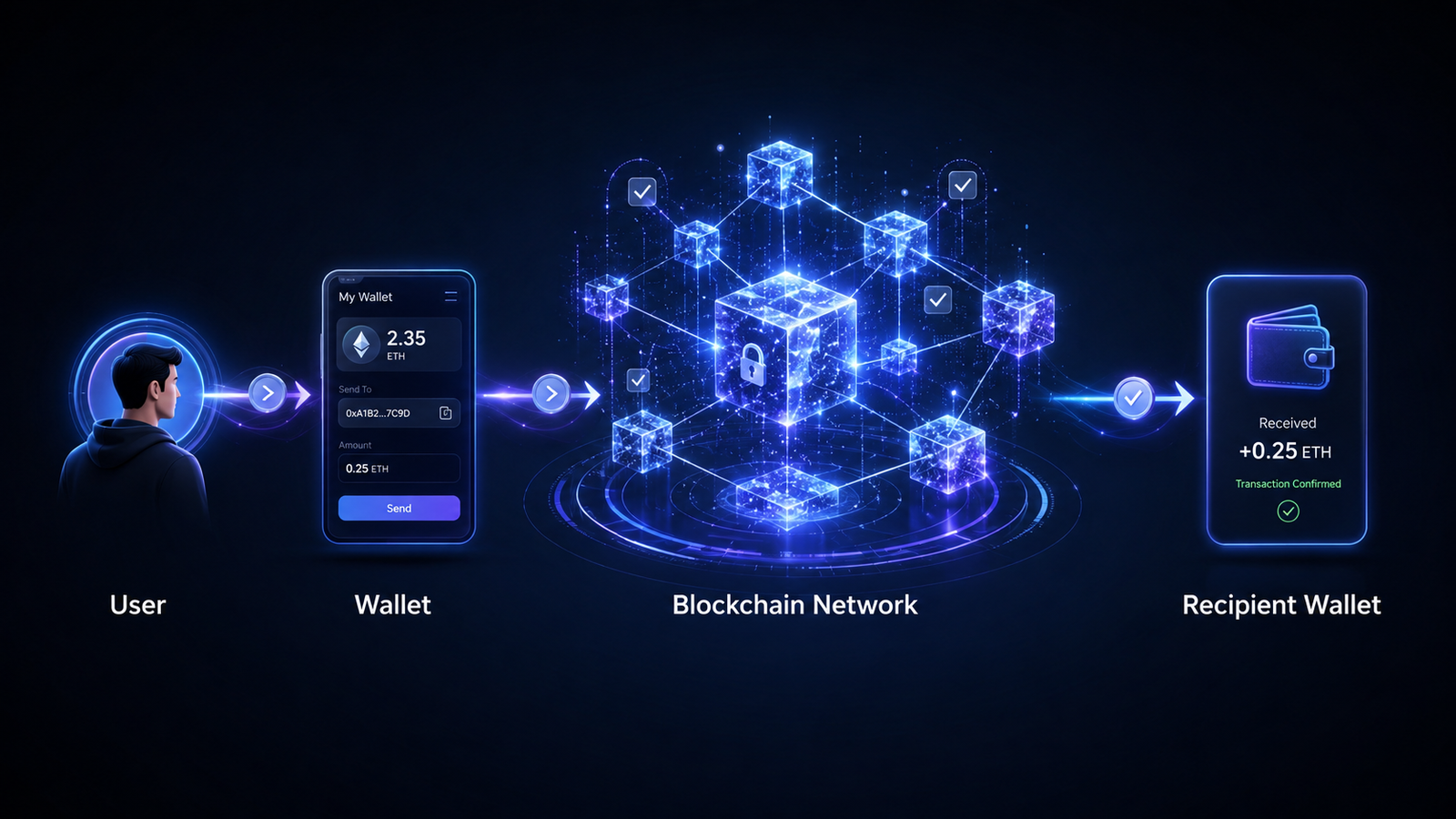
In most cases, blockchains are decentralized because they are not controlled by one single company, bank, or government. Instead, they are maintained by a network of computers that follow the same rules.
This is one reason people are interested in the technology. As a result, it allows digital value to move without depending only on traditional financial intermediaries.
What Happens When You Buy Crypto?
Buying cryptocurrency can sound more complicated than it really is. In many cases, a beginner will start by using a crypto exchange.
A typical process looks like this:
- Create an account with a crypto exchange.
- Add traditional money, such as USD, EUR or another supported currency.
- Choose the cryptocurrency you want to buy.
- Place the order.
- Keep the cryptocurrency on the exchange or withdraw it to a personal wallet.
One important detail is that buying crypto on a centralised exchange doesn’t always create a blockchain transaction immediately.
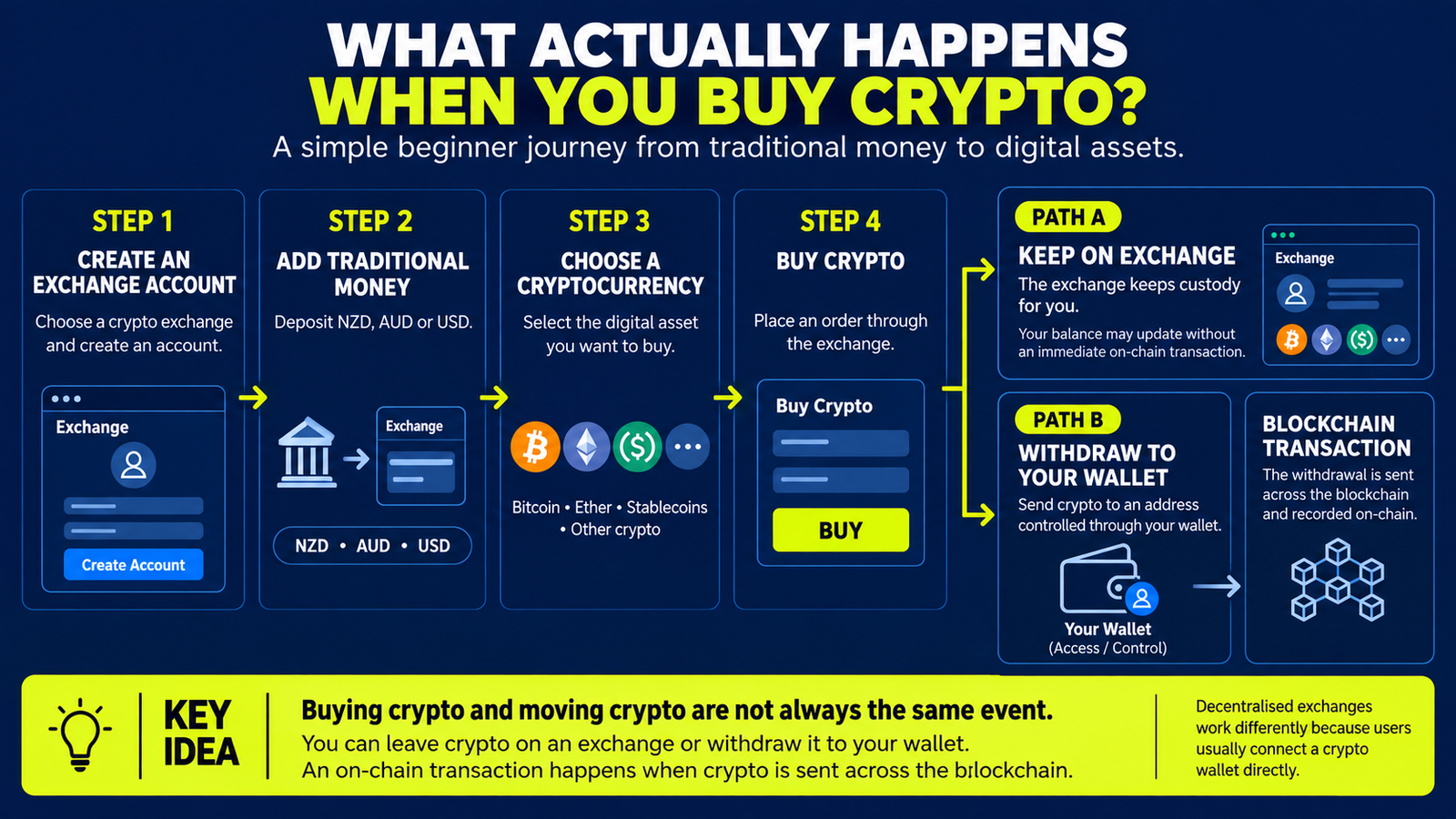
For example, if you buy Bitcoin and leave it in your exchange account, the exchange may simply update your balance within its own system. If you later withdraw that Bitcoin to a personal wallet, the exchange sends an on-chain transaction to your wallet address, which the Bitcoin network records.
Decentralised exchanges work differently because users normally connect a crypto wallet directly before making a trade.
Beginners don’t need to understand every technical detail at first. The main thing to remember is that an exchange can help you buy or sell crypto, while a wallet can give you more direct control over digital assets.
Where Is Cryptocurrency Stored?
Despite the name, cryptocurrency is not literally stored inside a crypto wallet like cash inside a physical wallet.
Instead, a blockchain keeps the record of which digital assets are associated with different blockchain addresses. A crypto wallet manages the private keys that allow a user to access and control assets connected to those addresses.
For example, if you own Bitcoin through a self-custody wallet, the Bitcoin remains recorded on the Bitcoin blockchain. Your wallet gives you the tools needed to prove control of the relevant address and authorise transactions.
If your crypto is held through an exchange, the exchange may control the private keys on your behalf instead.
This difference is important because it affects who controls the assets and what happens if access to an account, wallet, private key, or seed phrase is lost.
Who Controls Cryptocurrency?
There is no single answer because different cryptocurrencies and blockchain networks work in different ways.
Some blockchain networks are designed to operate without one company, bank, or government controlling the entire system. Instead, transactions and network rules may depend on distributed groups of computers, validators, miners, developers, users, or other participants.
However, this does not mean every cryptocurrency or crypto platform is fully decentralised.
For example, a cryptocurrency may have a company or foundation closely involved in its development. A stablecoin may depend on an issuer. A crypto exchange can also control user accounts and withdrawals even when the cryptocurrency being traded runs on a decentralised blockchain.
For this reason, beginners should avoid assuming that crypto automatically means decentralised. The level of control can vary significantly between blockchains, tokens, exchanges, and platforms.
Why Does Cryptocurrency Have Value?
There is no single reason why every cryptocurrency has value.
Like many assets, crypto prices are influenced by supply and demand. However, the reasons people want a particular cryptocurrency can vary widely.
Some digital assets may attract demand because of:
- Limited or controlled supply
- Usefulness within a blockchain network
- Adoption by users, developers, or businesses
- Access to apps, services, or platform features
- The ability to transfer value digitally
- Expectations about future use or adoption
- Investor demand and market speculation
For example, Bitcoin is often valued for its scarcity, network, and ability to transfer and hold digital value. Ether is also used within the Ethereum ecosystem to pay transaction fees and interact with blockchain-based applications.
Stablecoins work differently again. Many are designed to maintain a value close to another asset, such as the US dollar, although the way they attempt to maintain that value can differ between stablecoins.
It is also important to separate price from usefulness. A cryptocurrency can rise sharply in price because of speculation, hype, or market demand even if it has limited practical use. Prices can also fall quickly if demand disappears.
For beginners, the important question is not simply, “How much is this crypto worth?” It is also, “Why does anyone want or use it?”
Crypto vs Traditional Money (Fiat)
Cryptocurrencies are often compared to traditional money (fiat), but they are not the same. For example, traditional money usually depends on banks, governments, payment apps, and card networks. By comparison, digital assets depend on blockchain networks, wallets, and private keys.
| Feature | Traditional money (fiat) | Crypto |
| How the System is Governed | Central banks, governments, banks and payment providers | Varies by blockchain, protocol, issuer or platform |
| Stored in | Bank accounts, payment apps, cash | Digital wallets or exchange accounts |
| Transfers | Usually processed by banks or payment networks | Sent through blockchain networks |
| Access | NormallyF linked to identity and bank systems | Usually linked to wallet access and private keys |
| Risk | Bank fees, fraud, inflation, account restrictions | Scams, volatility, wallet loss, platform risk |
Traditional money is usually easier for beginners because the systems are familiar. If you forget your bank password, your bank can often help you recover access.
However, cryptocurrency is different. If you lose access to a self-custody wallet, send funds to the wrong address, or share your seed phrase with a scammer, it may be impossible to recover the funds.
Of course, that doesn’t mean the technology is bad. Instead, It means beginners need to understand the basics before using it.
Author’s Tip
At first, cryptocurrency can feel confusing because people often use one word to describe many things. For example, it can be a currency, an investment, a token, a payment tool, or part of a Web3 app. I find it easier to understand when each use case is separated.
Why Do People Use Crypto?
People use crypto for many reasons. Some are practical, others are speculative, and many are connected to new online platforms and digital ownership. Popular reasons people use cryptocurrency include:
- Sending online payments
- Investing or speculating on price changes
- Accessing Web3 apps
- Using DeFi platforms
- Buying or selling NFTs
- Playing blockchain games
- Sending international transfers
- Owning digital assets directly
- Using platforms that run on blockchain networks
In addition, digital assets are also closely connected to Web3, a broader vision of the internet that gives users greater control over their digital assets, identities, and blockchain-based apps. While cryptocurrency is often the first thing people encounter, it’s just one part of a much larger Web3 ecosystem built on blockchain technology.
For example, a Web3 game might use tokens or NFTs, while dApps can allow people to lend, borrow, swap, play games, or interact with blockchain-based services. A digital marketplace might also use wallets to prove ownership of an asset.
What Are the Main Types of Crypto?
Although there are thousands of cryptocurrencies and tokens, beginners don’t need to understand all of them at once. Instead, start with the main categories:
Bitcoin
Bitcoin (BTC) was the first major digital currency. It’s often described as digital money or a store of value.
In simple terms, Bitcoin is mainly used to send and hold value. It doesn’t have the same app ecosystem as Ethereum, but altogether, it’s still the best-known asset.
Ethereum
Ethereum (ETH) is a cryptocurrency and also a blockchain network. Its native asset is called Ether.
More importantly, this network supports smart contracts. These are blockchain-based programs that can run apps, tokens, NFTs, DeFi platforms, and other Web3 tools.
Stablecoins
Stablecoins are digital currencies designed to track the value of another asset, often the US dollar.
For example, a stablecoin may try to stay close to $1. As a result, this can make stablecoins useful for trading, transfers, or reducing exposure to crypto price swings.
However, stablecoins still carry risks as they still depend on the issuer, reserves, blockchain, platform, and market conditions.
Tokens
A token is a digital asset built on an existing blockchain. Many tokens are created on networks like Ethereum.
For example, tokens can be used for payments, rewards, voting, app access, gaming, DeFi, or other platform features. Some tokens have strong use cases, while others are highly speculative.
Author’s Tip
I wouldn’t try to learn every digital currency at once. Start with the big categories first: Bitcoin, Ethereum, stablecoins, and tokens. Once those make sense, the rest of the market becomes much easier to sort into place.
What Do You Need Before Using Crypto?
Before using any digital asset, beginners should understand a few basic tools and safety concepts. In general, the two most common tools are wallets and exchanges.
Crypto Wallets
A crypto wallet is a tool that helps you access, send, receive, and control digital assets through blockchain networks. Depending on the type, wallets can be mobile apps, desktop programs, browser extensions, or hardware devices.
Although people often say that crypto is “stored” in a wallet, the digital assets themselves remain recorded on the blockchain. Instead, the wallet manages the keys needed to access and control assets associated with your blockchain addresses.
Understanding what a crypto wallet is, is one of the most important first steps for anyone getting started with cryptocurrency.
Exchanges
An exchange is a platform where people can buy, sell, or trade digital assets. Some exchanges are designed for beginners, while others are built for active traders. Before choosing a platform, it helps to understand what a crypto exchange is and how exchanges differ from wallets.
You also need to understand private keys and seed phrases because they affect how wallet access, recovery, and self-custody work.
Private Keys and Seed Phrases
Private keys are secret cryptographic information that can be used to control digital assets associated with a blockchain address.
A seed phrase, also known as a recovery phrase, is different. Many wallets use a seed phrase as a backup that can restore the wallet and regenerate the keys associated with it.
Private keys and seed phrases are closely related, but they are not the same thing.
Anyone who gains access to your private key or seed phrase may be able to control your assets. For this reason, this information should never be shared with another person or entered into an untrusted website or app.
Before You Start Checklist
Before using crypto, make sure you can answer the following questions:
- Do I understand what crypto is?
- Can I explain what a blockchain does?
- Do I know the difference between a wallet and an exchange?
- Am I clear on what a seed phrase is?
- Can I spot the basic signs of crypto scams?
- Am I aware that prices can rise and fall quickly?
- Do I understand that transactions may not be reversible?
- Am I starting small enough that a mistake would not cause serious financial harm?
If the answer is no to any of these, spend some more time learning before sending funds or connecting a wallet to any platform.
Is Crypto Safe?
Digital assets are not automatically unsafe, but beginners can lose money through scams, risky platforms, volatility, bad wallet habits, or sending funds to the wrong address.
Although the technology can be secure, the user experience can be unforgiving. For example, a bank may be able to reverse some card payments or help with account access. In general, a blockchain transaction is often final once confirmed.
Common risks include:
- Fake exchanges
- Scam tokens
- Phishing links
- Fake wallet support accounts
- Malware
- Seed phrase theft
- Price volatility
- Risky platforms
- Sending digital assets to the wrong address
- Using the wrong blockchain network
Beginner Safety Note
Digital asset transactions can be difficult or impossible to reverse. Before using any wallet, exchange, or platform, make sure you understand seed phrases, withdrawal addresses, scams, and platform risk.
A good beginner rule is to slow down. For example, scammers often create urgency. They may tell you an offer is limited, your wallet is at risk, or you need to act now. Real safety starts with checking everything carefully and following proven crypto wallet safety practices before sending funds.
Many beginner mistakes happen because users trust the wrong website, click a fake link, or respond to a scammer pretending to be customer support. Learning about common crypto scams to avoid can help you recognise warning signs before they become expensive mistakes. In addition, checking links, wallet addresses, and platform details slowly can help reduce avoidable mistakes.
Pros and Cons of Crypto
Although digital assets have real advantages, they also carry serious risks. So, beginners should understand both sides before using it.
| Pros | Cons |
| Gives users direct control over digital assets | Mistakes can be hard or impossible to reverse |
| Can support global transfers | Prices can be highly volatile |
| Powers Web3 apps, DeFi, NFTs, and blockchain tools | Scams and fake platforms are common |
| Can reduce reliance on traditional intermediaries | Wallet security can be confusing for beginners |
| Open 24/7 | Regulation and platform rules can change |
Digital assets may be useful for some people, but it’s not something beginners should rush into. Learning first can help you reduce avoidable mistakes.
Beginner Crypto Terms to Know
Crypto has a lot of new terms. Although you don’t need to memorise everything, these are just useful starting points.
| Term | Beginner meaning |
| Crypto | Short for cryptocurrency. Also referred to as digital assets |
| Blockchain | Shared digital record of transactions |
| Wallet | Tool used for storing or accessing your digital assets |
| Exchange | Platform where people buy, sell, or trade digital assets |
| Private key | The secret access code behind a wallet |
| Seed phrase | A backup phrase used to recover a wallet |
| Gas fees | Blockchain transaction fee |
| DeFi | Apps that offer financial services without traditional banks |
How Beginners Should Start Learning Crypto
The best way to learn digital assets is to move in stages. Don’t start with complicated trading strategies, meme coins, leverage, or random tokens promoted online.
A better beginner learning path looks like this:
Crypto → Blockchain → Wallets → Exchanges → Safety → DeFi/Web3
First, start with the basics:
- Understand what cryptocurrency is.
- Learn what blockchain is.
- Understand wallets and exchanges.
- Know basic digital asset safety.
- Compare beginner-friendly platforms.
- Start small.
This approach helps you build context before making decisions. It also helps when you understand the difference between owning a digital asset in a wallet, holding a digital asset on an exchange, using a DeFi app, or connecting to a Web3 platform.
Before choosing any platform, it helps to understand how to choose a crypto exchange safely, including fees, custody, withdrawals, security settings, and platform reputation.
Recommended Next Guides
Once the basics of cryptocurrency are clear, these related guides can help you understand the technology, tools, and risks that sit around crypto.
- Web3 & Crypto Guide: Use this as your broader roadmap for exploring crypto, blockchain, wallets, exchanges, Web3, DeFi, and safety topics.
- What Is Blockchain?: See how transactions are recorded, checked, and added to blockchain networks.
- What Is Web3?: Discover how crypto fits into decentralised apps, digital ownership, gaming, finance, and online platforms.
- What Is a Crypto Wallet?: Find out how people access, receive, send, and manage crypto and other digital assets.
- What Is a Crypto Exchange?: See how platforms allow users to buy, sell, trade, and convert cryptocurrency.
- Crypto Wallet Safety Guide: Get familiar with the habits that can reduce avoidable mistakes when handling digital assets.
- Common Crypto Scams to Avoid: Spot common warning signs linked to fake platforms, phishing attempts, impersonation, and other crypto scams.
Safety Checklist
✓ Learn before buying
✓ Never share your seed phrase
✓ Double-check every wallet address
✓ Avoid links from DMs or ads
Related Guides
- What Are Smart Contracts? A Beginner’s Guide to Blockchain-Based Agreements
- What Are dApps? A Beginner’s Guide to Decentralised Apps
- What Is DeFi? A Beginner’s Guide to Decentralised Finance
- What Are Gas Fees? A Beginner’s Guide to Crypto Transaction Costs
- Common Crypto Scams to Avoid: How to Spot the Warning Signs
Disclaimer: This guide is for general information and education only. It is not financial, investment, legal, or tax advice. Crypto and digital assets can be risky, and prices may change quickly. Always do your own research and consider speaking with a qualified professional before making financial decisions.
The Meta Directory may earn commissions from some links, but this does not influence our editorial content.

Author
Frequently Asked Questions
Finally, these FAQs answer some of the most common beginner questions about digital assets, wallets, and Web3.
It can be used like traditional money (fiat), but it’s not the same as government-issued currency. Some businesses, platforms, and people also accept digital asset payments.
No, it’s not the same as Bitcoin. Instead, Bitcoin is one type of cryptocurrency, while the wider market includes Ethereum, stablecoins, tokens, and other blockchain-based assets.
Yes, beginners can use crypto more safely if they learn the basics, start small, use trusted platforms, protect their seed phrases, and avoid suspicious links or offers. Overall, the safest approach is to understand the risks before sending money.
No, you won’t always need a separate wallet to buy crypto because many exchanges let users hold it in an exchange account. However, a personal wallet is needed if you want direct control over your assets or want to use Web3 apps.
In general, the safest way to start is to learn the basics. Understand blockchain, wallets, exchanges, seed phrases, scams, and volatility before choosing a platform or sending funds.
Yes, you can lose money. For example, people can lose money through price drops, scams, hacked accounts, risky platforms, lost seed phrases, or sending funds to the wrong address.
Yes. Bitcoin can be divided into much smaller units, with one Bitcoin containing 100 million satoshis. This means people can usually buy a small amount rather than purchasing an entire Bitcoin, although exchanges may set their own minimum transaction amounts.
Yes. Many cryptocurrencies can be sold through exchanges or other supported services and converted back into traditional currencies such as USD, EUR etc.
HOW WE REVIEW & RANK
We research and compare platforms using a consistent framework: security signals, track record, product usability, feature quality, transparency of terms, and real-world usefulness.
When something changes – fees, policies, availability, or features – we update our listings and reviews.
Learn more about how we review platforms ->
STAY UPDATED
Get new crypto guides, updated rankings, and practical tips straight to your inbox — no spam, unsubscribe anytime.
NO SPAM. UNSUBSCRIBE ANYTIME.