What Are Gas Fees? A Beginner’s Guide to Crypto Transaction Costs
Updated: September 2026
Written By
Table of Contents
- What Are Gas Fees in Crypto?
- Why Do Blockchains Charge Transaction Fees?
- How Do Gas Fees Work?
- How Are Ethereum Gas Fees Calculated?
- Why Are Gas Fees Sometimes So High?
- Do All Crypto Transactions Have Gas Fees?
- Who Gets the Gas Fee?
- Can You Reduce Gas Fees?
- What Happens if You Don’t Have Enough Crypto for Gas?
- Do DeFi and Web3 Apps Charge Gas Fees?
- Gas Fees vs Exchange Fees: What’s the Difference?
- Gas Fee Safety Checklist
- Key Takeaways
- Where to Go Next
- Frequently Asked Questions
QUICK FACTS
Best for:
Crypto & Web3 beginners
Difficulty: Beginner-friendly
Main topic:
Blockchain transaction fees
Covers:
Gas, network fees, Ethereum & transaction costs
You’ll learn:
Why gas fees exist, how they work and why costs change

Gas fees are costs associated with processing transactions or performing certain actions on blockchain networks. They help pay for the computational resources required to process activity while also making it more expensive to overwhelm a network with unnecessary transactions.
You may encounter a network fee when sending cryptocurrency, swapping tokens or interacting with a decentralised application (dApp). However, the amount you pay can vary depending on the blockchain, the type of transaction and current network conditions.
Understanding how blockchain works can make it easier to see why these fees exist and what happens after you approve a transaction.
What Are Gas Fees in Crypto?
Quick Answer
Gas fees are blockchain transaction costs that pay for the computing resources needed to process certain transactions and operations. The amount can change depending on the network, transaction complexity and current demand.
Gas fees are charges associated with processing transactions or executing operations on certain blockchain networks. They account for the computational work required to perform an action and can also help manage demand for limited network resources.
The term gas is particularly associated with Ethereum. On Ethereum, gas measures the computational effort required to perform an operation, while the gas fee represents the amount paid for that work.
Ethereum is the best-known example of a gas-fee system, but it’s not the only blockchain that charges users to process transactions. Different networks use different fee mechanisms and terminology, so you may see costs described as gas fees, transaction fees, network fees or other network-specific charges.
Because Ethereum has one of the most widely documented gas systems, this guide uses it frequently as an example while explaining the broader concept of blockchain transaction fees.
Ethereum’s gas documentation defines gas as the unit used to measure the computational effort required to perform operations on the network, with transaction fees calculated from the gas consumed and the price paid per unit.
For example, you may need to pay a fee when:
- Sending cryptocurrency to another wallet
- Transferring certain tokens
- Swapping tokens through a decentralised exchange
- Interacting with a smart contract
- Carrying out certain actions through a dApp
However, not every blockchain calls these costs gas fees. Depending on the network or platform you’re using, you may instead see terms such as network fee or transaction fee.
The underlying idea is similar: using a blockchain’s resources can come at a cost.
Why Do Blockchains Charge Transaction Fees?
Blockchain networks need resources to process and record activity. As a result, transaction fees can serve several purposes.
Paying for network resources
A blockchain transaction isn’t simply sent from one person to another in the same way that you might send an email.
Instead, the transaction has to be processed according to the rules of the network. More complicated operations may also require additional computation.
On Ethereum, gas specifically measures this computational effort. Therefore, an operation that requires more work can consume more gas than a relatively simple transaction.
Supporting network participants
Fees can also form part of the incentives for participants responsible for processing and including transactions.
Exactly how this works depends on the blockchain.
For example, Ethereum’s current fee system includes a base fee, which is burned, and a priority fee, which can go to the validator that proposes the block containing the transaction.
Discouraging spam
Transaction fees can also make it more expensive to flood a network with large numbers of unnecessary operations.
Ethereum’s documentation specifically identifies spam prevention and protection against infinite computational loops as reasons for charging for computational resources.
In other words, transaction fees aren’t simply an extra charge added at checkout. Instead, they help a blockchain manage its limited network resources.
How Do Gas Fees Work?
When you initiate an on-chain transaction, your wallet will usually estimate the network fee before asking you to approve it.
A simplified process looks like this:
Transaction requested → Wallet estimates fee → User reviews and approves → Transaction enters the network → Validator includes transaction → Network state is updated
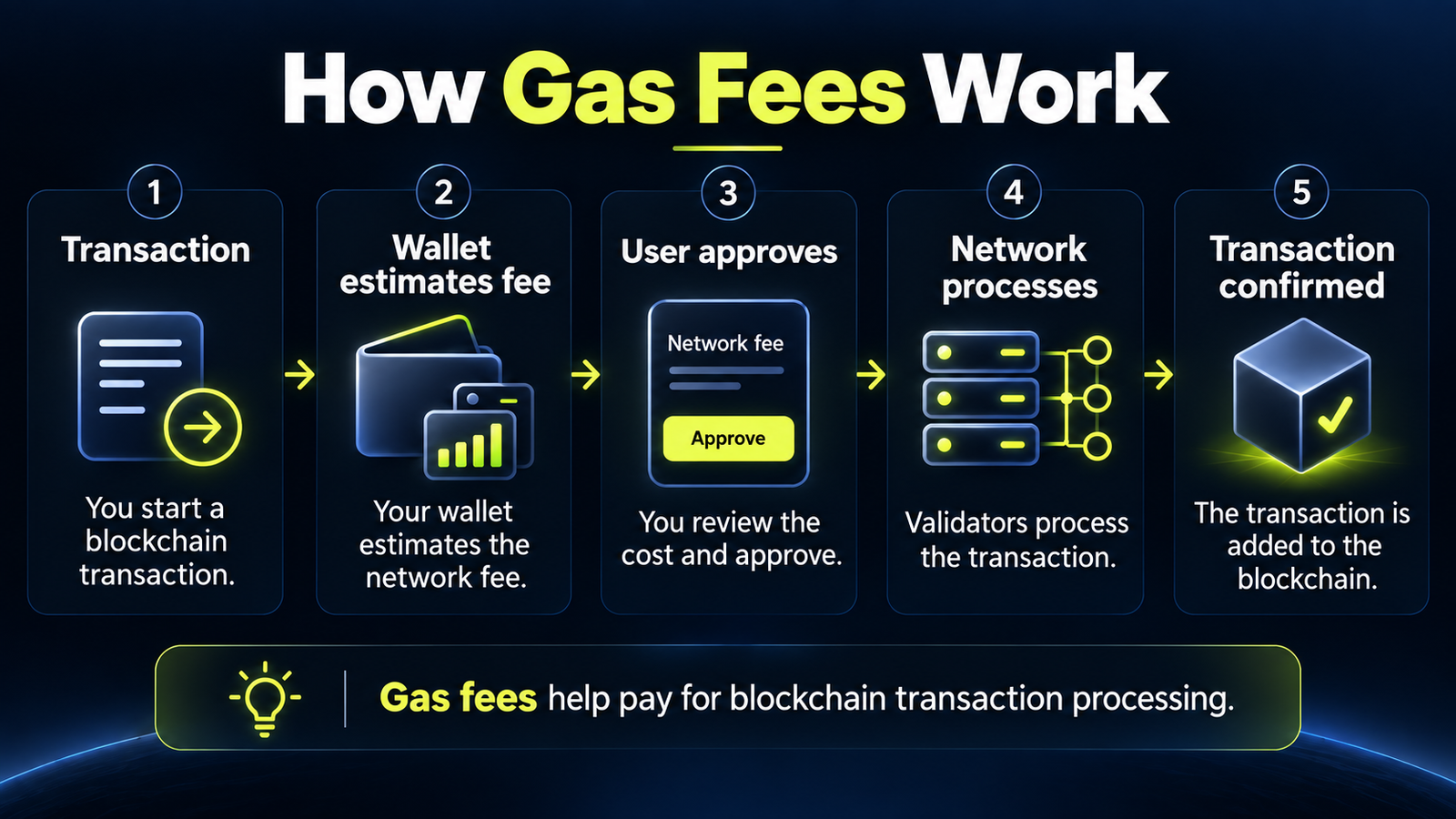
For example, imagine you’re sending ETH from one address to another.
Your crypto wallet may show the amount you’re sending alongside an estimated network fee. Once you approve the transaction, it can be broadcast to the network and wait for inclusion in a block.
Ethereum validators select transactions for inclusion in blocks, after which confirmed blocks become part of the blockchain’s history.
The fee isn’t necessarily fixed, though. Instead, it can depend on both the amount of computational work required and the cost of gas at that time.
How Are Ethereum Gas Fees Calculated?
Ethereum provides one of the best-known examples of a blockchain gas system.
A simplified version of the calculation is:
Gas used × (base fee + priority fee) = gas fee
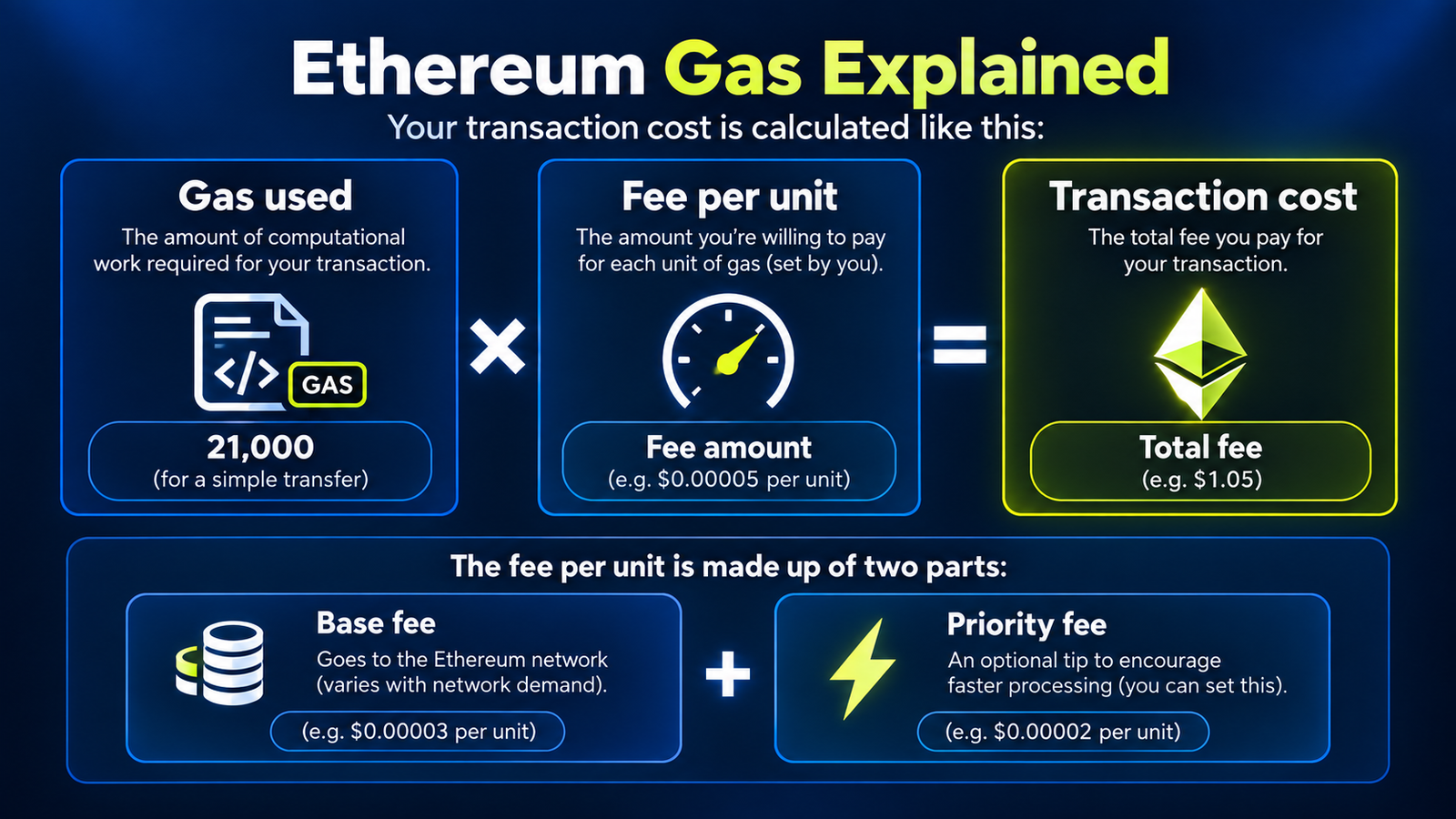
Most users won’t need to calculate this manually because wallets can estimate transaction fees automatically. Nevertheless, understanding the components can help explain why one transaction may cost more than another.
What are gas units?
Gas units measure how much computational work an Ethereum operation requires.
For instance, sending ETH requires less gas than many complex smart-contract interactions. Therefore, two transactions submitted at the same time can still have different total fees.
Think of gas units as measuring how much work is required, rather than the monetary price of that work.
What is the base fee?
The base fee is a protocol-determined amount that a transaction must cover to be eligible for inclusion in a block.
It can change as network demand changes. When blocks exceed Ethereum’s target gas usage, the protocol increases the base fee for the following block. Conversely, it can decrease when usage falls below the target.
Importantly, Ethereum’s base fee is burned, meaning it is removed from circulation rather than paid to the validator.
Ethereum’s current fee-market structure was introduced through EIP-1559, which established the protocol-level base fee that changes with block demand and is burned rather than paid to the block proposer.
What is the priority fee?
A priority fee, sometimes described as a tip, can provide an additional incentive for a validator to include a transaction.
Consequently, the total amount actually paid per unit of gas can include both the base fee and a priority fee, subject to the transaction’s maximum fee settings.
For most beginners, however, the wallet handles much of this complexity automatically.
What is gwei?
Gwei is a smaller denomination of ETH commonly used to express Ethereum gas prices.
One ETH contains:
1,000,000,000 gwei
Using gwei makes small gas prices easier to display and discuss than writing long strings of decimal places in ETH.
Why Are Gas Fees Sometimes So High?
Gas fees can increase when demand for network resources rises or when a transaction requires more computational work.
Imagine a limited amount of space becoming available in each new block while many users are trying to transact at once. Increased competition for those resources can contribute to higher fees.
However, network demand isn’t the only factor.
The complexity of the transaction also matters.
For example, sending ETH directly to another address generally requires less computational work than interacting with more complex smart contracts. Ethereum’s own gas guidance illustrates that smart-contract operations such as token swaps can use substantially more gas than a basic ETH transfer.
Therefore:
Network demand affects the price of gas.
Transaction complexity affects how much gas you use.
Together, those factors help determine the final transaction cost.
Do All Crypto Transactions Have Gas Fees?
No. Not every cryptocurrency transaction uses Ethereum-style gas fees.
Different blockchain networks can have different methods for pricing, processing and prioritising transactions. As a result, the terminology and fee structure you encounter can vary.
You might see:
- Gas fee
- Transaction fee
- Network fee
- Another network-specific term.
In addition, some applications may subsidise certain transaction costs or present them in a way that makes the underlying network fee less obvious to the user.
This distinction matters because saying all crypto transactions require gas would be inaccurate. Gas is one approach to pricing blockchain computation and transaction activity, not a universal term for every cryptocurrency fee.
Who Gets the Gas Fee?
Who receives a gas fee depends on the blockchain and its fee mechanism.
Ethereum provides a useful example because many people assume miners or validators receive the entire gas fee. However, Ethereum’s current fee mechanism works differently.
The Ethereum protocol burns the base fee, permanently removing that ETH from circulation. Meanwhile, the validator proposing the block can receive the priority fee as an incentive for including the transaction.
Ethereum also switched from proof-of-work to proof-of-stake with The Merge. As a result, validators now propose blocks rather than miners, making references to Ethereum miners receiving current transaction fees outdated.
Other blockchain networks calculate and distribute their fees differently, so always consider the specific network when looking at where transaction fees go.
That’s the full replacement. It preserves everything important from your original section while reducing passive voice and improving the flow and transition-word usage.
Can You Reduce Gas Fees?
Sometimes. However, your options depend on the blockchain, transaction and current network conditions.
Before approving a transaction, consider:
- Checking the estimated network fee
- Waiting for lower network demand if the transaction isn’t urgent
- Understanding whether a more complex action is necessary
- Considering suitable scaling networks where appropriate
- Reviewing the network you’re using before transferring assets
Author’s Tip
If a transaction isn’t urgent, check the estimated fee before approving it rather than assuming the current cost is normal. Don’t switch to an unfamiliar network purely to save on gas.
Ethereum, for example, points users towards layer-2 networks as one way of accessing lower transaction fees for activity that doesn’t need to take place directly on Ethereum’s main network.
However, the cheapest option isn’t automatically the best option.
Don’t move assets onto an unfamiliar network, bridge or platform simply because it promises lower fees. First, understand what you’re using, whether your intended wallet or platform supports that network and what risks are involved.
Similarly, manually changing advanced transaction settings without understanding them can cause problems.
For most beginners, reviewing the fee estimate presented by a reputable wallet is more sensible than trying to optimise every transaction manually.
What Happens if You Don’t Have Enough Crypto for Gas?
You may be unable to complete a transaction if your wallet doesn’t contain enough of the required asset to pay the network fee.
On Ethereum, gas fees are paid in ETH.
That means holding another token in an Ethereum wallet doesn’t necessarily mean you can move it.
For example, imagine your wallet contains a token but no ETH. If transferring that token requires an Ethereum transaction, you’ll generally need enough ETH to cover the required gas.
This is one reason beginners can sometimes see assets in a wallet yet still be unable to send or interact with them.
Before moving tokens, check:
- Which blockchain they’re on
- Which native asset is used to pay network fees
- Whether your wallet contains enough of that asset for the transaction
Do DeFi and Web3 Apps Charge Gas Fees?
Many DeFi and Web3 applications involve blockchain transactions, which means certain actions can require network fees. However, whether you pay a fee depends on the application, network and action you’re performing.
This is particularly relevant when using decentralised finance (DeFi). Activities such as swapping tokens, lending assets or interacting with a DeFi protocol may involve smart contracts and on-chain transactions.
On Ethereum, transactions involving smart contracts require gas. However, some read-only interactions that don’t change blockchain state can be performed without an on-chain gas charge to the user.
Gas costs are also part of the wider Web3 ecosystem, where applications can allow users to interact directly with blockchain networks through a wallet.
As a result, understanding network fees becomes increasingly important as you move beyond simply buying and holding cryptocurrency.
Gas Fees vs Exchange Fees: What’s the Difference?
Gas fees are associated with blockchain activity, while exchange fees are charges set by a cryptocurrency exchange or other service provider.
They’re related to different parts of the transaction process.
| Gas or Network Fee | Exchange Fee |
|---|---|
| Associated with blockchain activity | Charged by a platform or service |
| Based on the network’s fee mechanism | Based on the platform’s pricing |
| May change with network conditions | Depends on the exchange’s fee structure |
| Can apply to on-chain transactions | Can apply to trading, withdrawals or other services |
| Not generally set by a centralised exchange | Set by the exchange |
However, withdrawals can make the distinction less obvious.
A centralised exchange may charge users a withdrawal fee when crypto is moved off its platform. That charge doesn’t necessarily equal the precise network fee for an individual transaction because exchanges can determine how their own withdrawal pricing works.
Therefore, when comparing costs, check whether you’re looking at a network fee, trading fee, withdrawal fee or another platform charge.
Gas Fee Safety Checklist
Good crypto wallet safety also includes checking the network, receiving address, transaction details and estimated fee before approving an on-chain action.
Before approving a crypto transaction:
☐ Check the network you’re using.
☐ Review the estimated fee before confirming.
☐ Verify the receiving address carefully.
☐ Understand the transaction you’re approving.
☐ Keep enough of the required native asset available for fees.
☐ Avoid unfamiliar networks or platforms simply because they promise cheaper transactions.
☐ Check token and network compatibility before transferring assets.
☐ Don’t change advanced fee settings unless you understand the consequences.
Key Takeaways
- Gas fees help pay for computational resources used by certain blockchain networks.
- The term gas is especially associated with Ethereum, but not every blockchain uses the same terminology or fee mechanism.
- On Ethereum, transaction costs depend partly on the amount of gas used and the fee paid per unit of gas.
- More complex smart-contract interactions can require more gas than simple transactions.
- Ethereum’s base fee is burned, while a priority fee can go to the validator proposing the block.
- Gas prices can change as demand for network resources changes.
- Ethereum fees are paid in ETH, so holding another token doesn’t necessarily mean you have enough funds to move it.
- Gas fees and centralised exchange fees are not the same thing.
- Always review the network, address, transaction and estimated fee before approving an on-chain action.
Gas fees are one of the transaction concepts covered across TMD’s crypto guides, alongside blockchain networks, wallets, exchanges and security. They also become increasingly relevant across the wider Web3 and crypto ecosystem as users interact directly with blockchain-based applications and services.
Where to Go Next
Gas fees connect blockchain transactions with wallets, smart contracts and the applications built on top of blockchain networks. These guides explain the concepts that sit around those transaction costs:
- Crypto Guides: Build out the broader fundamentals behind crypto transactions, networks, wallets, fees and digital-asset activity.
- What Is Blockchain?: Understand the network infrastructure that processes transactions and creates the need for network-level fees.
- What Is a Crypto Wallet?: See how wallets estimate transaction costs, request approval and submit transactions to blockchain networks.
- What Are Smart Contracts?: Learn why more complex blockchain operations can require additional computation and consume more gas.
- What Are dApps?: Understand the wallet-connected applications where users may encounter transaction fees, signatures and on-chain actions.
- What Is DeFi?: Explore why token swaps, lending and other decentralised financial activities can trigger smart-contract transactions and network fees.
- What Is Web3?: See how transaction costs fit into the wider system of wallet-connected blockchain applications and digital ownership.
- What Is a Crypto Exchange?: Understand the difference between blockchain network fees and the trading or withdrawal charges set by an exchange.
- Crypto Wallet Safety Guide: Review the network, address, transaction and approval checks that matter before paying a fee and submitting an on-chain action.
- Web3 & Crypto Guide: Explore how gas fees fit within the broader relationship between crypto, blockchain networks, wallets and Web3 applications.
Safety Checklist
✓ Check the correct network
✓ Review fees before approving
✓ Verify the receiving address
✓ Understand the transaction
✓ Keep enough native crypto for fees
✓ Don’t chase low fees blindly
Related Guides
- What Are Smart Contracts? A Beginner’s Guide to Blockchain-Based Agreements
- What Are dApps? A Beginner’s Guide to Decentralised Apps
- What Is DeFi? A Beginner’s Guide to Decentralised Finance
- What Are Gas Fees? A Beginner’s Guide to Crypto Transaction Costs
- Common Crypto Scams to Avoid: How to Spot the Warning Signs
Disclaimer: This guide is for general information and education only. It is not financial, investment, legal, or tax advice. Crypto and digital assets can be risky, and prices may change quickly. Always do your own research and consider speaking with a qualified professional before making financial decisions.
The Meta Directory may earn commissions from some links, but this does not influence our editorial content.

Author
Frequently Asked Questions
Gas fees can become more expensive when demand for network resources increases. In addition, complex transactions may consume more gas than simple transfers. Therefore, the final cost can depend on both current network conditions and the type of transaction being performed.
Usually, the sender pays the network fee for a standard blockchain transfer. However, moving or interacting with the assets later may require you to hold enough of the network’s required fee asset.
Not usually in the same way you change a password. How However, moving or interacting with the assets later may require you to hold enough of the network’s required fee asset.
It depends on what you mean by refunded. On Ethereum, unused gas from a transaction’s gas limit isn’t charged in the same way as gas actually consumed. However, a transaction that fails during execution can still consume gas because the network has already performed computational work. Therefore, a failed Ethereum transaction doesn’t necessarily mean you get the transaction fee back.
There isn’t one cryptocurrency or blockchain that can be described as permanently having the cheapest transaction fees. Costs can vary by network, transaction type, demand and fee mechanism. Furthermore, transaction cost shouldn’t be the only factor when choosing a network. Security, decentralisation, compatibility, liquidity and the applications available on the network can also matter.
HOW WE REVIEW & RANK
We research and compare platforms using a consistent framework: security signals, track record, product usability, feature quality, transparency of terms, and real-world usefulness.
When something changes – fees, policies, availability, or features – we update our listings and reviews.
Learn more about how we review platforms ->
STAY UPDATED
Get new crypto guides, updated rankings, and practical tips straight to your inbox — no spam, unsubscribe anytime.
NO SPAM. UNSUBSCRIBE ANYTIME.