What Is a Crypto Exchange? A Beginner’s Guide to Buying and Selling Crypto
Updated: SEPTEMBER 2026
Written By
Table of Contents
- Understand The Fundamentals Of Crypto Exchanges
- Crypto Exchange vs Crypto Wallet
- Centralised vs Decentralised Crypto Exchanges
- What Can You Use a Crypto Exchange For?
- What Fees Do Crypto Exchanges Charge?
- What Is Custody on a Crypto Exchange?
- What Do You Need Before Using a Crypto Exchange?
- Before You Start Checklist
- Are Crypto Exchanges Safe?
- Pros and Cons of Crypto Exchanges
- Beginner Crypto Exchange Terms to Know
- How Beginners Should Start Learning Exchanges
- Where to Go Next
- FAQs About Crypto Exchanges
QUICK FACTS
Best for: Beginners
Difficulty: Beginner-friendly
Main topic: Crypto exchanges
Covers: Buying crypto, selling crypto, fees, custody, exchange risks
You’ll learn: What exchanges do, how they work, key fees, and what to check before using one

A crypto exchange is a platform where people can buy, sell, trade, or sometimes store digital assets like Bitcoin, Ethereum, stablecoins, and tokens. Some exchanges let people use bank transfers, cards, or other payment methods to buy digital assets, while others are designed for trading one crypto asset for another.
For beginners, the easiest way to think about an exchange is this: A crypto exchange is the marketplace or platform where people go to buy and sell crypto.
Some exchanges are run by companies, while others are blockchain-based tools that connect directly to a crypto wallet. Although both can be useful, they work in different ways and can expose users to different risks.
For that reason, this beginner guide explains how exchanges work, how they differ from wallets, which fees to look for, and what risks users should understand before choosing a platform.
What is a Crypto Exchange?
A crypto exchange is a platform that helps users buy, sell, trade, or convert cryptocurrencies.
Understand The Fundamentals Of Crypto Exchanges
Before choosing a platform, creating an account, or buying digital assets, it helps to understand what exchanges are designed to do. Crypto exchanges are one of the core tools covered across beginner crypto guides because they provide a common route between traditional money and digital assets.
A crypto exchange is a service or tool that connects buyers and sellers. For example, some exchanges are simple platforms where beginners can buy crypto using local currency. Others, however, offer additional features like price charts, order books, advanced trading tools, staking options, or wallet withdrawals.
With that in mind, this section gives you a simple crypto exchange overview without turning the topic into a complex trading lesson.
What Does a Crypto Exchange Do?
A crypto exchange lets users buy, sell, trade, or convert digital assets. These assets may include Bitcoin, Ethereum, stablecoins, tokens, or other cryptocurrencies supported by the platform.
Some exchanges are built for beginners. They may offer simple buy and sell buttons, local payment methods, and basic account dashboards. Others are designed for active traders and include more advanced tools, charts, order types, and market data.
Understanding what crypto is provides useful context for why these assets can be bought, sold, traded, and transferred between different services. Once withdrawn from an exchange, digital assets can also move across blockchain networks to compatible wallet addresses.
How Does a Crypto Exchange Work?
A crypto exchange usually works by giving users a place to create an account, deposit funds, place orders, and manage balances.
A simple version looks like this:
User → Exchange account → Buy or sell crypto → Hold, trade, or withdraw
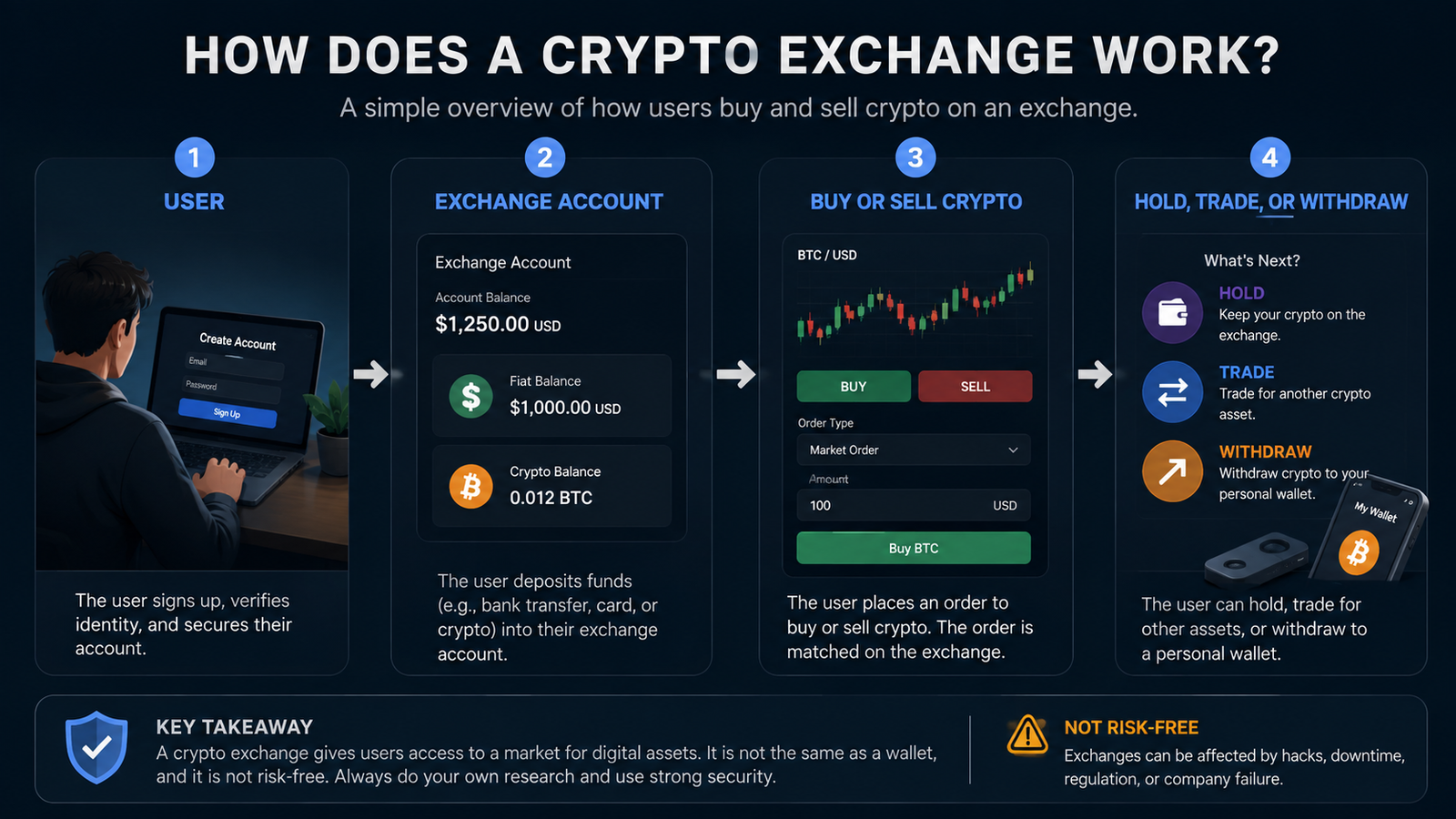
For example, a beginner might sign up to a centralised exchange, verify their identity, deposit money, and buy a small amount of Bitcoin. The Bitcoin may then appear in their exchange balance. From there, the user may choose to keep it on the platform, sell it later, trade it for another asset, or withdraw it to a personal wallet.
Not every exchange works the same way. For example, some platforms are account-based, while others connect directly to a crypto wallet. Similarly, some support local bank transfers, whereas others only allow crypto-to-crypto trading.
Ultimately, the key point is that an exchange helps users access a market for digital assets. However, it’s not the same as a wallet, and it is not risk-free.
Crypto Exchange vs Crypto Wallet
A crypto exchange and a crypto wallet play different roles.
A crypto exchange helps users buy, sell, trade, or convert digital assets. A crypto wallet provides tools for accessing, receiving, sending, or managing crypto across blockchain networks.
Many beginners first encounter crypto through an exchange because the experience can feel more familiar. You create an account, add security settings, deposit money, and buy an asset. A personal crypto wallet works differently because it focuses more directly on blockchain access and control.
An exchange account can be useful, especially for buying or selling. A wallet can become relevant when someone wants more direct control over assets or wants to interact with blockchain-based applications. Understanding both makes it easier to decide how and where digital assets should be managed.
| Feature | Crypto exchange | Crypto wallet |
| Main purpose | Buy, sell, trade, or convert crypto | Access, send, receive, or manage digital assets |
| Access | Account login, security settings, platform rules | Wallet app, device, private key, or seed phrase |
| Control | Often depends on the exchange | Depends on whether the wallet is custodial or self-custody |
| Used for | Buying crypto, trading, converting assets, withdrawals | Holding assets, sending funds, Web3 apps, NFTs, DeFi |
| Main risk | Platform failure, hacks, scams, withdrawal limits, account restrictions | Seed phrase loss, wrong address, malicious approvals, fake wallet apps |
An exchange account can be useful, especially for buying or selling. A wallet can be useful when someone wants more direct control or wants to use Web3 apps. Beginners should understand both before moving funds around.
Centralised vs Decentralised Crypto Exchanges
There are two main types of crypto exchanges: centralised exchanges and decentralised exchanges.
A centralised exchange is usually run by a company. A decentralised exchange usually runs through blockchain-based tools and wallet connections.
Both can help users trade digital assets, but the experience is very different.
Centralised Exchanges
A centralised exchange, often called a CEX, is a company-run platform. Users usually create an account, set up login details, and may need to complete identity checks before buying, selling, or withdrawing.
Centralised platforms can feel easier for beginners because the layout may be similar to other online accounts. They may support bank transfers, cards, customer support, account recovery, and simple buy or sell features.
However, centralised exchanges also create platform risk. If funds stay on the exchange, the user depends on the platform’s security, withdrawal rules, custody setup, and business stability.
Decentralised Exchanges
A decentralised exchange, often called a DEX, is usually a blockchain-based trading tool that connects to a wallet.
Decentralised exchanges are also a common part of DeFi, where users can trade digital assets through blockchain-based financial applications rather than a traditional centralised exchange.
Decentralised exchanges work differently from conventional account-based platforms because users commonly interact through a crypto wallet. Ethereum.org’s token-swap guide shows this model in practice, with users connecting a wallet to a decentralised exchange before swapping Ethereum-based tokens.
Instead of creating a normal account, the user may connect a wallet and interact with smart contracts that help execute trades on the blockchain. This can give users more direct control, but it also makes mistakes easier for beginners.
A decentralised exchange may involve token approvals, gas fees, liquidity pools, and wallet permissions. Fake DEX websites, scam tokens, and malicious approvals are common risks.
The difference between custodial and non-custodial wallets becomes especially relevant when using a DEX because the user generally keeps control of the wallet used to interact with the platform.
| Feature | Centralised exchange | Decentralised exchange |
| Also called | CEX | DEX |
| Operated by | A company or platform | Smart contracts and blockchain tools |
| Login | Usually account-based | Usually wallet-based |
| Custody | Platform may hold assets for users | User usually keeps wallet control |
| Ease for beginners | Often easier | Often more technical |
| Main risks | Platform failure, hacks, withdrawal limits, account restrictions | Fake DEX sites, bad tokens, malicious approvals, liquidity issues |
Author’s Tip
I think beginners should separate “easy to use” from “safe to use”. A platform can look simple and still carry risk. Before trusting an exchange, it helps to look beyond the design and check fees, withdrawals, custody, account security, and how the platform handles risk.
What Can You Use a Crypto Exchange For?
A crypto exchange can be used for several different actions, depending on the platform.
Common uses include:
- Buying crypto
- Selling crypto
- Trading one asset for another
- Converting crypto to local currency where supported
- Sending crypto to a wallet
- Receiving crypto from a wallet
- Checking market prices
- Using stablecoins
- Accessing platform tools such as staking, earn products, or card features where offered
For beginners, the most common use is buying crypto for the first time. For example, someone might create an account, deposit money, buy a small amount of Bitcoin or Ethereum, and decide later whether to keep it on the platform or move it to a wallet.
It is important not to confuse buying crypto with understanding crypto. An exchange can make the process easier, but it does not remove the need to understand risk, fees, custody, and wallet safety.
What Fees Do Crypto Exchanges Charge?
Crypto exchanges can charge fees in different ways. Beginners should check the final cost before confirming any buy, sell, trade, or withdrawal.
Common exchange fees include:
- Trading fees
- Spreads
- Deposit fees
- Withdrawal fees
- Network fees
- Card payment fees
- Currency conversion fees
- Inactivity or account fees where applicable
A trading fee is charged when you buy, sell, or trade. A spread is the difference between the buying price and selling price. A withdrawal fee may apply when moving funds off the platform.
However, the price shown on a platform may not be the full cost. A simple buy screen might include fees or a spread that is less obvious than a separate trading fee.
Some withdrawal costs can also be affected by blockchain network activity. On networks such as Ethereum, transaction costs are commonly known as gas fees and can change depending on network conditions.
What Is Custody on a Crypto Exchange?
Custody means who controls access to the digital assets.
When crypto stays on an exchange, the platform may control the private keys behind those assets. The user sees a balance inside their account, but the platform is often responsible for managing the underlying wallet access.
This can make the experience feel easier. If a user forgets a password, the platform may offer recovery options. However, it also means the user is relying on the exchange.
Crypto exchanges can also perform several roles at once, including trading and custody. The Bank for International Settlements describes centralised crypto exchanges as service providers that can hold customer assets and settle transactions within their own systems, while larger platforms may combine trading, custody, lending, derivatives, and other financial services.
Platform custody can involve risks such as account restrictions, withdrawal delays, business failure, hacks, or changes to terms. Self-custody can give users more direct control, but it also places more responsibility on the user.
The relationship between private keys and seed phrases helps explain why exchange custody differs from self-custody. With self-custody, the user takes direct responsibility for protecting the credentials that control wallet access.
Author’s Tip
I think custody becomes easier to understand when you ask one question: who controls access? An exchange may feel convenient, but if the platform manages custody, you are also relying on its security, rules, and withdrawal process.
What Do You Need Before Using a Crypto Exchange?
Before using a crypto exchange, beginners should understand the basics of crypto, platform risk, account security, fees, custody, and withdrawals.
It helps to know:
- What you want to use the platform for
- Which assets the platform supports
- What fees may apply
- Whether identity checks are required
- How withdrawals work
- Who controls custody
- What security features are available
- Whether the platform has a clear reputation
- Whether the platform is available in your location
- How to avoid pressure from ads, influencers, DMs, or social media comments
Choosing a crypto exchange safely involves checking factors such as fees, custody arrangements, security features, withdrawal rules, platform reputation, and availability before depositing funds.
Before You Start Checklist
Before using a crypto exchange, make sure you can answer these questions:
- Do I understand what the exchange is used for?
- Do I know whether it is centralised or decentralised?
- Have I checked the fees before buying, selling, or withdrawing?
- Do I understand who controls custody while assets are on the platform?
- Have I turned on strong account security?
- Do I know whether withdrawals are allowed and how they work?
- Have I checked whether the platform is legitimate?
- Am I avoiding links from ads, DMs, or social media comments?
- Am I starting small enough that a mistake would not cause serious financial harm?
If the answer is no to any of these, spend more time learning before depositing funds, trading assets, or connecting a wallet.
Are Crypto Exchanges Safe?
A crypto exchange can be useful, but beginners shouldn’t assume that every platform is safe. In fact, risks can come from several sources, including scams, hacked accounts, fake exchange websites, unclear fees, platform failure, misleading promotions, risky tokens, withdrawal limits, or weak personal security.
Common Crypto Exchange Risks
Some exchange risks come from the platform. Others come from the user’s own account security or the way the platform was found.
Common risks include:
- Fake exchange websites
- Phishing emails and login pages
- Account takeover
- Weak passwords
- Missing two-factor authentication
- Platform hacks
- Withdrawal freezes
- Unclear fees
- Risky tokens
- Misleading promotions
- Fake support accounts
- Pressure from influencers, ads, or social media messages
Beginner Safety Note
A crypto exchange can make buying and selling digital assets easier, but every platform carries risk. Check the exchange carefully, protect your login details, use strong account security, understand fees and withdrawals, and avoid platforms promoted through pressure, urgency, or suspicious links.
Common crypto scams involving exchanges can include fake trading websites, phishing login pages, impersonation, fake customer support, guaranteed-return claims, and platforms designed to prevent users from withdrawing funds.
Pros and Cons of Crypto Exchanges
Crypto exchanges can make digital assets easier to access, but they are not risk-free. Beginners should understand both sides before creating an account or depositing funds.
| Pros | Cons |
| Can make it easier to buy and sell crypto | Platform risk can affect access to funds |
| Often supports bank transfers, cards, or local payment methods | Fees and spreads can vary between platforms |
| Can provide price charts, order tools, and asset lists | Beginner trading can lead to rushed decisions |
| Centralised exchanges may feel easier for new users | Accounts can be hacked if security is weak |
| Some platforms allow withdrawals to personal wallets | Withdrawal limits, rules, or delays may apply |
An exchange can be helpful when it is used carefully. The risk increases when beginners rush, follow hype, ignore fees, or trust a platform without checking how it works.
Beginner Crypto Exchange Terms to Know
Crypto exchanges use terms that may feel confusing at first. Therefore, it helps to understand the main ones before using a platform.
| Term | Beginner meaning |
| Crypto exchange | A platform used to buy, sell, trade, or convert digital assets |
| Centralised exchange | A company-run platform where users usually create an account |
| Decentralised exchange | A blockchain-based tool that usually lets users trade through a wallet |
| Trading pair | Two assets that can be traded against each other, such as BTC/USD or ETH/BTC |
| Market order | An order to buy or sell at the current available market price |
| Limit order | An order that only completes if the price reaches a chosen level |
| Spread | The difference between the buy price and sell price |
| Trading fee | A fee charged when buying, selling, or trading |
| Withdrawal fee | A fee charged when moving funds off the platform |
| KYC | Identity checks a platform may require before account use |
| Custody | Who controls access to the digital assets |
| Two-factor authentication | An extra account security step beyond a password |
You don’t need to understand advanced trading before learning what an exchange does. Start with the basic terms, then move into platform comparisons later.
How Beginners Should Start Learning Exchanges
The best way to learn about crypto exchanges is to move through the topic in stages. In other words, beginners don’t need to start with advanced charts, leverage, margin, or active trading. Instead, it makes more sense to understand the basics first before moving on to more complex features.
Start with the basics:
- Learn what crypto is.
- Understand the difference between exchanges and wallets.
- Learn how custody works.
- Compare centralised and decentralised exchanges.
- Understand basic fees.
- Learn common scam signs.
- Review platform security and withdrawal rules.
- Start small if choosing to buy or sell digital assets.
Crypto exchanges form one part of the wider Web3 and crypto ecosystem, connecting traditional payment methods, digital assets, wallets, blockchain networks, and trading platforms.
Where to Go Next
Crypto exchanges connect buying and selling with several other parts of the digital asset ecosystem, making these guides the most relevant next steps:
- Web3 & Crypto Guide: Covers the wider ecosystem of cryptocurrency, blockchain, wallets, exchanges, Web3, digital assets, and safety.
- Crypto Guides: Brings together TMD’s beginner guides covering cryptocurrency, transactions, wallets, exchanges, fees, custody, and common risks.
- What Is Crypto?: Explains the digital assets bought, sold, and traded through cryptocurrency exchanges.
- What Is Blockchain?: Covers the networks used to record crypto transactions and transfers between compatible addresses.
- What Is a Crypto Wallet?: Explains how personal wallets differ from holding digital assets through an exchange account.
- How to Choose a Crypto Exchange Safely: Covers the security, fees, custody, withdrawals, reputation, and platform factors that matter when comparing exchanges.
- Custodial vs Non-Custodial Wallets: Explains the difference between relying on a platform to manage access and controlling digital assets through a personal wallet.
- Private Keys and Seed Phrases: Covers the private credentials behind self-custody and why they matter when assets move away from an exchange.
- What Are Gas Fees?: Explains the blockchain transaction fees that may apply when digital assets are withdrawn or transferred.
- Crypto Wallet Safety Guide: Covers safer habits for handling assets after withdrawing them from an exchange to a personal wallet.
- Common Crypto Scams to Avoid: Covers fake exchanges, phishing, impersonation, fraudulent platforms, malicious links, and other common crypto scams.
Safety Checklist
✓ Check the platform is legitimate
✓ Review fees before buying or selling
✓ Turn on two-factor authentication
✓ Understand withdrawal rules
✓ Avoid links from DMs, ads, or comments
✓ Start small while learning
Related Guides
- What Are Smart Contracts? A Beginner’s Guide to Blockchain-Based Agreements
- What Are dApps? A Beginner’s Guide to Decentralised Apps
- What Is DeFi? A Beginner’s Guide to Decentralised Finance
- What Are Gas Fees? A Beginner’s Guide to Crypto Transaction Costs
- Common Crypto Scams to Avoid: How to Spot the Warning Signs
Disclaimer: This guide is for general information and education only. It is not financial, investment, legal, or tax advice. Crypto and digital assets can be risky, and prices may change quickly. Always do your own research and consider speaking with a qualified professional before making financial decisions.
The Meta Directory may earn commissions from some links, but this does not influence our editorial content.

Author
Frequently Asked Questions
A crypto exchange is a platform where people can buy, sell, trade, or convert digital assets such as Bitcoin, Ethereum, stablecoins, and tokens.
No. An exchange is mainly used for buying, selling, or trading crypto, while a wallet is used to access, send, receive, or manage digital assets.
A crypto exchange works by creating an account or connecting a wallet, choosing an asset, placing a buy or sell order, and managing the transaction.
A centralised exchange is usually run by a company, while a decentralised exchange usually lets users trade through blockchain-based tools and wallet connections.
Beginners can use crypto exchanges more safely if they protect their account, understand fees and withdrawals, avoid suspicious links, and start small.
Crypto exchanges may charge trading fees, spreads, deposit fees, withdrawal fees, network fees, card payment fees, currency conversion fees, or inactivity fees.
Some crypto exchanges hold assets through exchange accounts, and may control custody while the assets remain there.
Yes, you can lose money through price drops, scams, hacked accounts, risky tokens, unclear fees, platform failure, withdrawal issues, or rushed trading decisions.
HOW WE REVIEW & RANK
We research and compare platforms using a consistent framework: security signals, track record, product usability, feature quality, transparency of terms, and real-world usefulness.
When something changes – fees, policies, availability, or features – we update our listings and reviews.
Learn more about how we review platforms ->
STAY UPDATED
Get new crypto guides, updated rankings, and practical tips straight to your inbox — no spam, unsubscribe anytime.
NO SPAM. UNSUBSCRIBE ANYTIME.