What Is Blockchain? A Beginner’s Guide to How It Works
Updated: September 2026
Written By
Table of Contents
- Understand The Fundamentals Of Blockchain
- Blockchain vs Traditional Databases
- Why Does Blockchain Matter?
- What Is Blockchain Used For?
- What Do You Need Before Using Blockchain-Based Tools?
- Before You Start Checklist
- Is Blockchain Safe?
- Pros and Cons of Blockchain
- Beginner Blockchain Terms to Know
- How Beginners Should Start Learning Blockchain
- Where to Go Next
- FAQs About Blockchain
QUICK FACTS
Best for: Beginners
Difficulty: Beginner-friendly
Main topic: Shared digital records
Covers: Crypto, Web3, wallets, smart contracts, safety
You’ll learn: What it is, how it works, why it matters, and what to know before using related tools

What is blockchain? Blockchain is a type of digital recordkeeping system. It stores information in groups called blocks, then links those blocks together in order creating a kind of chain, hence the name.
It’s used for cryptocurrency, smart contracts, digital assets, and some Web3 apps because It’s difficult to change information without the network noticing.
The easiest way to think about it is this:
One company or organisation usually controls a traditional database. A shared ledger (blockchain) can be copied, checked, and maintained by many computers on the same network.
This beginner guide explains how the technology works, why it matters, how it connects to crypto and Web3, and what beginners should know before trusting any app, platform, or digital asset.
What is Blockchain?
It is a shared digital record that stores information across a network instead of keeping it in one central place.
Understand The Fundamentals Of Blockchain
Before you explore crypto wallets, exchanges, Web3 apps, DeFi, or smart contracts, it helps to understand the basic technology behind many of them. Blockchain sits at the centre of the wider Web3 and crypto ecosystem, providing an underlying recordkeeping system used by many digital assets, applications, and networks.
At its core, this system is a way to record information across a network. Instead of relying on one central company to control the record, so, many computers can help check and maintain it.
This section gives you a simple blockchain explained overview without going too deep into technical detail.
What Does Blockchain Mean?
A block is a group of data. A chain is the link between each block in order. Together, they form a record that can show what happened, when it happened, and how each new entry connects to earlier entries.
For example, in a cryptocurrency network, one block may include a list of recent transactions. Once that block is accepted by the network, it’s linked to the previous block which creates a chain of records.
This is why people often describe blockchain technology as a shared digital ledger. A ledger is simply a record of activity. In this case, it’s kept across a network instead of in one private location.
For readers who want a more technical explanation, NIST’s Blockchain Technology Overview explains how distributed digital ledgers work and covers concepts such as cryptographic hashing, consensus and network validation.
To understand where this fits into the wider beginner journey, it helps to start with what crypto is before exploring wallets, tokens, and Web3 tools.
How Does Blockchain Work?
It works by grouping information into blocks, checking that information through a network, and adding each confirmed block to a shared record.
A simple version looks like this:
User action → Network check → New block → Shared record updated
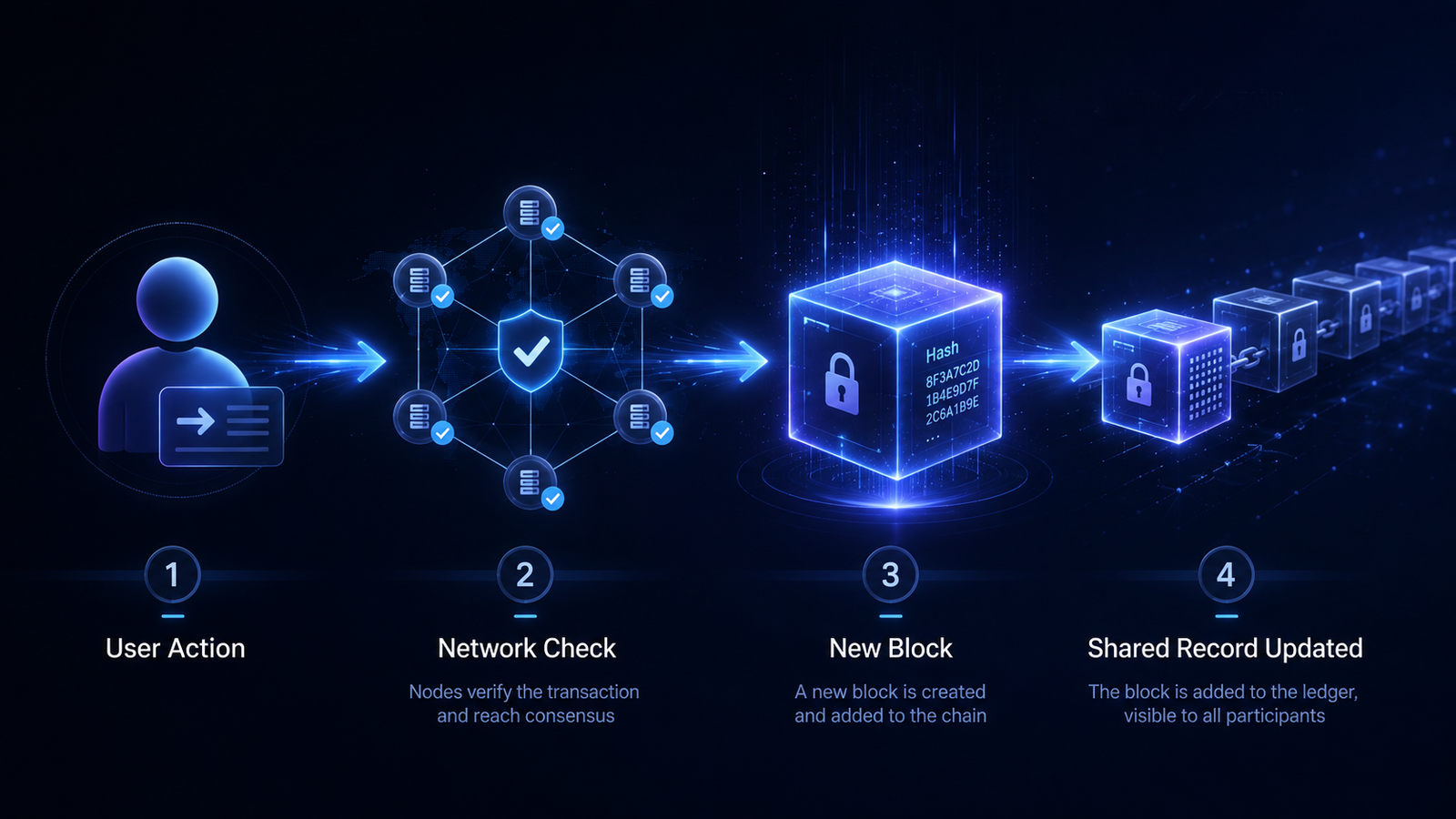
For example, when someone sends Bitcoin, the network checks that the sender has the funds and that the transaction follows the rules. The transaction’s included in a block and added to the public record after approval.
Networks use a consensus when deciding what should be added. This helps the network decide which records are valid without needing one central company to approve every action.
Not every shared ledger works the same way though. Some are public, some are private, some are faster, and some are built for specific uses like payments, apps, supply chains, or digital identity.
If you are learning this because of Web3, it also helps to understand what Web3 is and how decentralised apps use wallets, tokens, and smart contracts.
Blockchain vs Traditional Databases
A traditional database is usually controlled by one organisation. For example, a bank, app, company, or government department may manage its own private records.
A shared ledger works differently because copies of the record can exist across multiple computers. The network follows rules to check and update the record.
| Feature | Traditional database | Blockchain-based record |
| Controlled by | Usually one company or organisation | A network, protocol, or approved group |
| Stored in | Central servers or private systems | Shared across connected computers |
| Updates | Controlled by the database owner | Checked using network rules |
| Transparency | Usually private | Can be public, private, or partly visible |
| Changes | Can often be edited by admins | Confirmed records can be difficult to change |
| Common uses | Banking, websites, apps, business systems | Crypto, smart contracts, Web3 apps, digital assets |
This doesn’t mean one is better than the other. Normal databases are often faster, cheaper, and easier to manage. Shared records can be useful when different people or organisations need to verify information without relying on one central authority.
Author’s Tip
I find this easier to understand when I stop thinking of it as “the internet” and start seeing it as a recordkeeping system. The key idea is not that every database should use it, but that some records become more useful when many participants can verify them.
Why Does Blockchain Matter?
This technology matters because it introduced a different way to record and verify digital activity.
Before Bitcoin, digital money usually relied on a trusted intermediary, such as a bank or payment company, to help prevent the same funds from being spent twice. Bitcoin’s original paper proposed a peer-to-peer electronic cash system designed to allow online payments to move directly between parties without relying on a financial institution to process every transaction.
Bitcoin helped demonstrate how a distributed network could maintain a shared transaction history using cryptographic proof and agreed network rules.
Today, it’s used across crypto networks, digital assets, smart contracts, DeFi apps, NFTs, supply chain projects, gaming platforms, and other Web3 tools.
In simple terms, it can help with:
- Recording transactions
- Verifying ownership
- Supporting digital assets
- Running smart contracts
- Reducing reliance on a single middleman in some use cases
- Creating public or shared records
- Powering parts of Web3
For beginners, the main thing to understand is that the technology is not only about coins. It’s also about how information, ownership, and permissions can be recorded online.
What is Blockchain Used for?
The most famous use is cryptocurrency, but there are other examples too:
1. Cryptocurrency
Crypto networks use shared ledgers to record transactions. For example, Bitcoin uses one to track Bitcoin transfers, while Ethereum uses one to support transactions, tokens, and apps.
This is why many people first hear about the technology through digital assets.
2. Smart Contracts
Smart contracts are programs deployed to a blockchain that can perform actions according to their code when users or other contracts interact with them. They can support apps, tokens, DeFi platforms, NFTs, and other digital tools. For a deeper beginner explanation, it’s important to understand what smart contracts are.
Ethereum’s smart contract documentation also explains how smart contracts operate on Ethereum, including how users can interact with them through blockchain transactions.
3. Web3 Apps
Many Web3 apps use wallets, tokens, and smart contracts. These blockchain-based applications are often described as decentralised applications, or dApps. Some are highly decentralised, while others combine blockchain technology with more traditional systems and infrastructure.
Examples can include DeFi apps, NFT marketplaces, blockchain games, DAO tools, and digital identity platforms.
4. Digital Ownership
Some projects use tokens, NFTs, and other digital assets to represent access, membership, collectibles, game items, or other forms of digital ownership within blockchain-based systems.
NFTs and digital assets can also be used to represent unique items, rights, or access in certain Web3 platforms.
This doesn’t automatically make every project valuable or safe. You should always look at what the asset does, who is behind it, and the risks involved.
5. Supply Chains and Records
Some companies explore shared ledgers for tracking goods, documents, certificates, or records between different organisations.
In these cases, the goal is usually verification, traceability, or shared access to information.
What Do You Need Before Using Blockchain-Based Tools?
Before using apps, wallets, exchanges, or digital assets, beginners should understand a few basics.
A crypto wallet is used to access digital assets and Web3 apps. It can help users send, receive, store, or connect to certain platforms.
Understanding what a crypto wallet is is an important step before using any wallet-connected tool.
You also need to understand private keys and seed phrases which are linked to wallet access and recovery, before you begin storing or moving any funds. If someone gets your seed phrase, they may be able to access your assets.
Some networks also charge transaction fees (gas fees), especially on networks like Ethereum. Before approving transactions, you should know what gas fees are and why fees can change depending on network activity.
Author’s Tip
I think this is the point where beginners should slow down. Learning how the technology works is one thing, but using wallets, apps, fees, and approvals requires more knowledge and care.
Before You Start Checklist?
Before using a blockchain-based app, wallet, or platform, make sure you can answer these questions:
- What is the use of blockchain?
- Is the network public, private, or controlled by a specific platform?
- What does a wallet do in this process?
- What is a seed phrase, and why does it matter?
- Could this transaction be hard or impossible to reverse?
- How can I check whether the app or platform is legitimate?
- Are there fees to understand before approving the transaction?
- Is the amount small enough that a mistake would not cause serious financial harm?
If you can’t answer any of these questions, spend some time learning before connecting a wallet, approving a transaction, or sending any funds.
Is Blockchain Safe?
The technology can be secure, but that doesn’t mean every app, token, platform, or project using it is safe.
Beginners can still lose money through scams, fake platforms, risky tokens, hacked websites, wallet mistakes, malicious approvals, or sending funds to the wrong address.
The shared record may work as designed, while the platform built around it may still be risky. This is an important difference.
Common risks include:
- Fake apps and websites
- Scam tokens
- Wallet-draining links
- Unsafe smart contracts
- Seed phrase theft
- Sending assets to the wrong address
- High or unexpected fees
- Misleading project claims
- Platform failure
- Price volatility
Beginner Safety Note
Blockchain-based transactions can be difficult or impossible to reverse. Before using any wallet, exchange, app, or platform, make sure you understand wallet access, seed phrases, transaction approvals, scams, and platform risk.
Good crypto wallet safety habits can reduce the risk of exposing sensitive information, approving malicious requests, or connecting a wallet to an unsafe platform.
Beginners should become familiar with common crypto scams, including phishing, fake websites, impersonation, and wallet-draining links, before using any real funds.
Pros and Cons of Blockchain
This technology has useful strengths, but it also has limits. Beginners should understand both sides.
| Pros | Cons |
| Creates shared records that many participants can verify | Can be difficult for beginners to understand |
| Reduces reliance on a single recordkeeper in some use cases | Transactions may be hard or impossible to reverse |
| Supports crypto, smart contracts, Web3 apps, and digital assets | Scams and misleading projects are common |
| Improves transparency for certain types of records | Some networks have high fees or slow transactions |
| Supports digital ownership and programmable tools | Not every use case needs this technology |
A shared ledger is most useful when verification, shared access, transparency, or reduced reliance on one central party matters.
Beginner Blockchain Terms to Know
Don’t worry if these terms feel unfamiliar at first. The goal is to understand the basic role each one plays, not to memorise every technical detail.
| Term | Beginner meaning |
| Blockchain | A shared digital record that stores information in linked blocks |
| Block | A group of data added to the record |
| Ledger | A record of transactions or activity |
| Node | A computer that helps support or check a network |
| Transaction | An action recorded on the network |
| Consensus | The process used to agree on valid records |
| Wallet | A tool used to access crypto, tokens, and some Web3 apps |
| Private key | Secret information linked to wallet access |
| Seed phrase | A backup phrase used to recover a wallet |
| Smart contract | Code that runs on a network when certain conditions are met |
| Gas fee | A transaction fee paid to use some networks |
| Decentralisation | Control is spread across participants instead of one central authority |
How Beginners Should Start Learning Blockchain
The best way to learn is to move in stages.
Start with the basics:
- Learn what the shared record does.
- Understand why Bitcoin made it famous.
- Find out how blockchain networks record crypto transactions.
- Understand wallets, private keys, and seed phrases.
- Learn how smart contracts work.
- Explore how Web3 apps use wallets and tokens.
- Learn safety habits before using real funds.
- Compare platforms carefully before signing up or connecting a wallet.
This order helps you build context before moving into more complex topics like DeFi, NFTs, DAOs, tokenomics, or on-chain analytics.
Where to Go Next
Now that you understand the role blockchain plays, these guides can help you explore how people use the technology across crypto, Web3, wallets, and blockchain-based applications.
- Web3 & Crypto Guide: Covers the wider ecosystem, including blockchain, cryptocurrency, wallets, exchanges, Web3, DeFi, digital assets, and safety.
- What Is Crypto?: Explains how cryptocurrencies and other digital assets use blockchain networks to record transactions and ownership.
- What Is Web3?: Looks at how blockchain technology supports digital ownership, decentralised applications, wallets, tokens, and other Web3 tools.
- What Is a Crypto Wallet?: Explains how wallets interact with blockchain networks and help users access and control digital assets.
- What Are Smart Contracts?: Covers how blockchain-based programs can carry out actions according to their code.
- What Are dApps?: Explains how decentralised applications use blockchain networks and smart contracts as part of how they operate.
- What Is DeFi?: Covers how decentralised finance uses blockchains, wallets, tokens, and smart contracts to provide financial services.
- NFTs & Digital Assets: Covers blockchain-based ownership, NFTs, digital collectibles, tokenised assets, and related technologies.
- Crypto Wallet Safety Guide: Covers wallet security, seed phrases, suspicious approvals, phishing, and safer ways to interact with blockchain-based platforms.
- Common Crypto Scams to Avoid: Covers phishing, impersonation, fake platforms, malicious links, wallet-draining scams, and other common risks.
Safety Checklist
✓ Check what the network is used for
✓ Understand fees before approving
✓ Confirm the app or platform is legitimate
✓ Treat transactions as hard to reverse
Related Guides
- What Are Smart Contracts? A Beginner’s Guide to Blockchain-Based Agreements
- What Are dApps? A Beginner’s Guide to Decentralised Apps
- What Is DeFi? A Beginner’s Guide to Decentralised Finance
- What Are Gas Fees? A Beginner’s Guide to Crypto Transaction Costs
- Common Crypto Scams to Avoid: How to Spot the Warning Signs
Disclaimer: This guide is for general information and education only. It is not financial, investment, legal, or tax advice. Crypto and digital assets can be risky, and prices may change quickly. Always do your own research and consider speaking with a qualified professional before making financial decisions.
The Meta Directory may earn commissions from some links, but this does not influence our editorial content.

Author
Frequently Asked Questions
Here are answers to some of the most common questions beginners have about blockchain.
Blockchain is a shared digital record used for recording crypto transactions, supporting smart contracts, and powering some Web3 apps that also stores information in linked blocks across a network.
Blockchain is not the same as crypto. Crypto is one use of the technology, while the underlying recordkeeping system can also support smart contracts, digital assets, Web3 apps, and other tools.
Blockchain records information and checks it across a network instead of relying only on one central recordkeeper. It’s useful for crypto, digital ownership, and certain shared records.
Some records can be very difficult to change once confirmed, especially on public networks with many participants. However, rules vary between networks, and not every system has the same level of decentralisation or security.
Blockchain can be safe when you are careful. Most risks come from scams, wallet mistakes, unsafe platforms, and misunderstanding transaction approvals.
Most cryptocurrencies use some type of shared ledger to record transactions. When you buy, send, or receive crypto, the transaction is usually recorded on a network behind the scenes.
Bitcoin is the best-known example. Ethereum is another major example because it supports transactions, tokens, smart contracts, and many Web3 apps.
No, It’s also used for smart contracts, digital ownership, NFTs, DeFi apps, records, gaming tools, supply chain tracking, and other digital systems.
After the basics, beginners should learn about crypto, wallets, seed phrases, smart contracts, Web3 apps, gas fees, and common scams.
HOW WE REVIEW & RANK
We research and compare platforms using a consistent framework: security signals, track record, product usability, feature quality, transparency of terms, and real-world usefulness.
When something changes – fees, policies, availability, or features – we update our listings and reviews.
Learn more about how we review platforms ->
STAY UPDATED
Get new crypto guides, updated rankings, and practical tips straight to your inbox — no spam, unsubscribe anytime.
NO SPAM. UNSUBSCRIBE ANYTIME.