What Is Web3? A Beginner’s Guide to the Next Version of the Internet
Updated: September 2026
Written By
Table of Contents
QUICK FACTS
Best for: Beginners
Difficulty: Beginner-friendly
Main topic: Crypto basics
Covers: Wallets, blockchain, exchanges, safety
You’ll learn:
What crypto is,
How crypto works,
Key risks to know,
Where to go next

What is Web3? Web3 is a newer version of the internet built around blockchain technology, digital ownership and greater user control.
This beginner guide to Web3 explains how Web3 works, how it differs from the internet you use today, and what you should understand before connecting a wallet or trying a Web3 app.
If you are completely new to the topic, the full Web3 & Crypto Guide can also help you work through the wider ecosystem step by step.
What is Web3?
Web3 is a broad term for internet services and applications that use technology like blockchains, crypto wallets, tokens and smart contracts.
Understand The Fundamentals Of Web3
You may have heard Web3 described as the decentralised internet, a user-owned internet or the next stage of the web.
Those descriptions can be useful, but they can also make Web3 for beginners sound more complicated than it needs to be.
The easiest place to start is by understanding what people mean when they use the term and the technologies that make these applications possible.
What Does Web3 Mean?
The Web3 meaning centres on the idea that people could have greater control over parts of their online identity, money and digital belongings.
On most traditional web2 sites, the company operating the platform controls your account and the information stored within it. If you buy something inside an online game, for example, that item usually remains part of the game’s own system.
Web3 introduces a different internet ownership model.
For example, some blockchain-based platforms allow assets to exist as tokens held through your crypto wallet rather than only as entries inside a company’s private database. Depending on the application, those tokens might represent money, membership, voting rights, access or a digital collectible.
This concept is often called digital ownership.
However, that doesn’t mean every user-owned internet service is completely decentralised or that users control every part of it. Many modern platforms combine blockchain technology with traditional websites, companies, servers and customer accounts.
How Does Web3 Work?
If you are wondering how Web3 works, think of several technologies working together rather than one new version of your web browser.
For example, at the base of this system could be a blockchain network like Ethereum. A blockchain provides the shared network and record keeping system that Web3 applications can use.
If blockchain itself is new to you, learning what blockchain is and how it works will make the rest much easier to understand.
A typical interaction might look like this:
User → Crypto wallet → Web3 app → Blockchain network
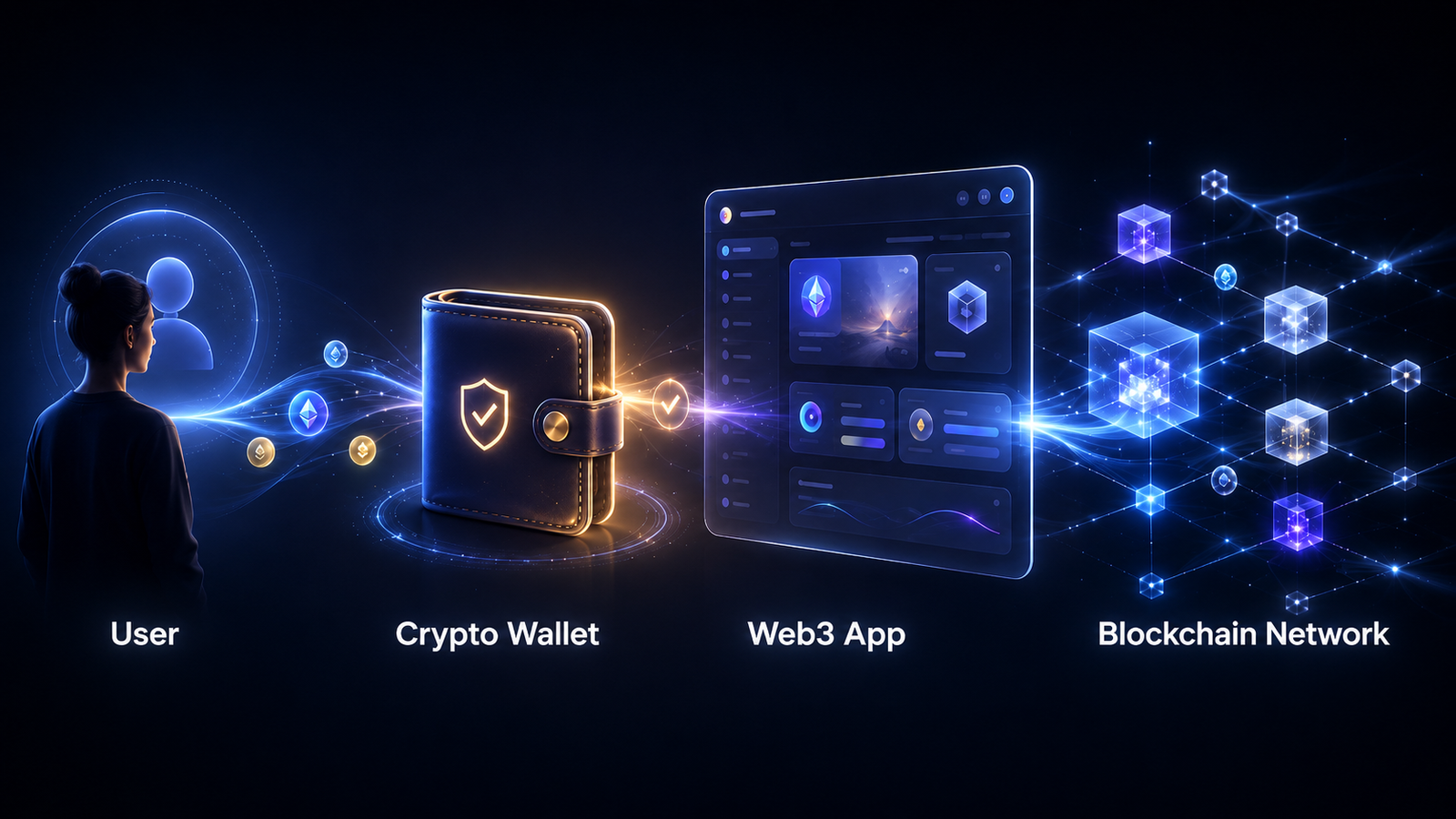
Your crypto wallet can act as a tool for accessing a Web3 application. Instead of creating a traditional username and password, some apps let you connect a wallet and approve specific actions.
Behind the application, smart contracts can perform functions on the blockchain. These are programs that execute according to their code. For example, Ethereum’s documentation explains that smart contracts are programs that run on the Ethereum blockchain and can receive transactions and carry out predefined functions.
Web3 applications may also use tokens for payments, ownership, rewards, access or governance.
Note* connecting a wallet does not automatically make an application trustworthy. You still need to understand what you are approving and which websites you’re interacting with.
Web2 vs Web3
The easiest way to understand Web2 vs Web3 is to compare Web3 ideas with the mainstream internet most people already use. However, Web2 and Web3 aren’t completely separate worlds. Many applications use elements of both.
| Feature | Web2 | Web3 |
| Main idea | Platforms own and manage most data and accounts | Users can connect through wallets and own certain digital assets |
| Login method | Email, password or social login | Crypto wallet, wallet address or platform account |
| Ownership | Usually controlled within a platform | Can include user-held tokens, NFTs or other digital assets |
| Payments | Cards, banks and payment apps | Crypto, tokens, stablecoins or traditional payments |
| Apps | Primarily centralised websites and apps | Decentralised apps, blockchain apps and hybrid platforms |
| Control | Platform operators set most rules | Control may be shared between developers, users, token holders or protocols |
| Risk | Privacy, data collection, account restrictions and platform control | Wallet loss, scams, smart contract risk, transaction mistakes and crypto volatility |
Overall, the latest version is therefore better understood as another way of building certain online services rather than a replacement for every website, app or Web2 platform.
Author’s Tip
I find the whole concept easier to understand when I stop thinking of it as a replacement for the internet and start seeing it as a new layer built around wallets, ownership, and blockchain-based access.
Why Does Web3 Matter?
One of the biggest ideas behind the decentralised internet is digital ownership.
In practice, blockchains can allow digital assets to be associated with a wallet controlled by a user rather than existing only within a company’s internal account system.
This has created new approaches to areas such as:
- Online identity
- Digital payments
- Creator communities
- Blockchain gaming
- Decentralised finance
- NFTs and digital assets
- DAOs and online communities
- Token-based memberships
- Decentralised applications
This version of the internet reduces the need for traditional intermediaries in certain situations. For example, In decentralised finance, smart contracts can provide financial functions that would traditionally involve a central platform or financial institution.
Crypto is closely connected to many of these systems. Before going much deeper, it helps to understand what crypto is and why blockchain-based digital assets are used within the Web3 ecosystem.
None of this means decentralisation is automatically better. Centralised services can offer benefits such as customer support, password recovery, simpler interfaces and clear responsibility when something goes wrong.
Ultimately, Web3 introduces a different set of trade-offs.
What Are Web3 Apps?
Web3 apps are applications that use blockchain technology as part of how they operate.
More specifically, these applications are often called decentralised applications (dApps). A dApp can look similar to an ordinary website or mobile app from the user’s perspective, but some of its functions interact with a decentralised network or smart contract rather than depending entirely on a traditional centralised backend.
Ethereum’s technical documentation describes a dApp as an application built on a decentralised network using a smart contract together with a frontend interface.
Examples of these applications can include:
- Decentralised exchanges
- Lending and borrowing platforms
- NFT marketplaces
- Blockchain games
- DAO voting tools
- Web3 social networks
- Token-based membership platforms
Financial applications are one major category. Understanding what DeFi is can help you see how decentralised finance uses blockchain networks and smart contracts to provide certain financial services.
Not every application marketed as “Web3” is fully decentralised. In fact, some have centralised companies, websites or infrastructure behind them while using a blockchain for selected features.
Likewise, not every Web3 app is legitimate, secure or useful.
What Do You Need Before Using Web3?
You can learn about Web3 without buying crypto or setting anything up. That said, if you eventually want to interact with blockchain-powered apps, there are a few important concepts worth understanding first.
What Do You Need Before Using Web3?
A crypto wallet
A wallet is usually used to access digital assets and connect to Web3 applications. Learn what a crypto wallet is before creating or funding one.
A wallet address
Your wallet address is the public address that can be used to receive compatible blockchain assets. It is different from the private information used to control your wallet.
Private keys and seed phrases
Wallet security depends heavily on protecting the credentials that give access to it. Understanding private keys and seed phrases is essential before storing valuable assets in a self-custody wallet.
Tokens
For example, some Web3 applications use crypto tokens for transactions, access, voting, rewards or ownership.
Gas fees
Certain blockchain actions require transaction fees. These are often called gas fees. Learning what gas fees are can help you understand why completing an action on a blockchain may cost money.
Basic security habits
You should also know how to verify website addresses, recognise suspicious links, review wallet requests and avoid sharing sensitive wallet information.
Author’s Tip
I treat Web3 access like giving a website permission to interact with my wallet, not just logging into another app. Before I connect, I want to know what the app does and what it is asking me to approve.
Before You Start Checklist?
When using any digital asset, you should understand a few basic tools and safety concepts.
Before using a Web3 app, make sure you can answer yes to the following before connecting a wallet, approving permissions or sending funds:
- Do I understand what Web3 is?
- Am I aware of what a blockchain does?
- Do I understand what a crypto wallet is?
- Could I recognise a seed phrase?
- Do I know why I should never share my seed phrase?
- How clearly do I understand that some blockchain transactions may not be reversible?
- Am I able to check whether an app appears legitimate?
- Do I understand what I am approving when connecting my wallet?
- Am I starting small enough that a mistake would not cause serious financial harm?
Is Web3 Safe?
Web3 isn’t automatically safe or unsafe. The level of risk depends on what you are using, how the application works and what actions you take.
It can be particularly unforgiving for beginners because applications may involve tokens, wallet approvals, smart contracts and transactions that can be difficult or impossible to reverse.
For this reason, beginners should be aware of risks such as:
- Fake Web3 websites
- Phishing links
- Wallet-draining scams
- Fake NFT projects
- Risky DeFi platforms
- Smart contract vulnerabilities
- Malicious wallet approvals
- Seed phrase theft
- Sending assets to the wrong address
- Connecting a wallet to an unsafe website
- Crypto price volatility
Beginner Safety Note
These apps can involve wallets, crypto assets, smart contracts and irreversible transactions. Never share your seed phrase or private keys. Verify websites carefully and understand what a wallet request is asking you to approve before accepting it.
Before connecting a wallet to unfamiliar applications, read the crypto wallet safety guide.
Scammers also create fake crypto platforms and impersonate legitimate services, so recognising common crypto scams to avoid should be part of learning Web3, not something you leave until later.
Pros and Cons of Web3
Web3 creates new possibilities, but it also transfers some responsibilities and risks from platforms to users.
| Pros | Cons |
| Can give users greater control over certain digital assets | Wallet mistakes may be difficult or impossible to reverse |
| Supports digital ownership through blockchain-based tokens and NFTs | Scams and fake projects are common |
| Powers DeFi, blockchain games, DAOs and other Web3 applications | Some applications are difficult for beginners to understand |
| Can reduce reliance on centralised platforms in certain use cases | Smart contracts and wallet approvals can introduce new risks |
| Creates new ways for creators and communities to organise | Regulation and technology continue to change |
| Can allow wallet-based access across different services | Losing wallet credentials can mean losing access to assets |
Ultimately, the important point is balance. Web3 can provide more control in some situations, but at the same time, greater control can mean greater personal responsibility.
Beginner Web3 Terms to Know
Learning a few core terms makes Web3 explained content much easier to follow.
| Term | Meaning |
| Web3 | Blockchain-based internet technologies involving concepts such as wallets, digital ownership, tokens and decentralised apps |
| Web2 | Mainstream internet built around websites, apps, user accounts and centralised platforms |
| Blockchain | Shared digital record maintained across a network |
| Crypto wallet | Tool used to manage access to crypto assets and interact with Web3 applications |
| dApp | Decentralised application that uses blockchain technology |
| Smart contract | Code stored and executed on a blockchain |
| Token | Digital asset created on a blockchain |
| NFT | Unique blockchain token that can represent ownership, membership or other rights |
| DeFi | Decentralised finance applications built using blockchain technology |
| DAO | Decentralised autonomous organisation using blockchain tools for coordination or governance |
| Gas fee | Fee paid to carry out certain blockchain transactions |
| Seed phrase | Series of words that can be used to recover access to your crypto wallet |
| Private key | Secret cryptographic information used to control blockchain assets |
| Wallet connection | A connection that allows a website or app to request information or actions from your crypto wallet |
Fortunately, you don’t need to memorise all of these terms before continuing. Instead, understand blockchain, wallets, seed phrases and transaction safety.
How Beginners Should Start Learning Web3
The best way to learn Web3 for beginners is to build your knowledge in layers rather than trying to understand everything at once.
A sensible learning order is:
- Know what Web3 is and what the term represents.
- Understand the basics of blockchain technology.
- Find out what cryptocurrencies and tokens are.
- Understand how crypto wallets work.
- Learn seed phrase, private key and wallet safety fundamentals.
- Explore how basic Web3 apps work without immediately committing money.
- Learn about DeFi, NFTs, DAOs and smart contracts as separate topics.
- If you choose to use Web3 tools, start cautiously and understand every action before approving it.
Don’t rush into buying tokens, connecting a wallet or investing money simply because you are learning about Web3. Understanding the technology comes first.
Where to Go Next
Now that you understand the basic idea behind Web3, these guides can help you explore the technologies, tools, and digital assets that make up the wider ecosystem:
- Web3 & Crypto Guide: Use the main hub to navigate beginner guides across crypto, blockchain, wallets, DeFi, NFTs, exchanges, and safety.
- What Is Crypto?: Get a clearer picture of the digital assets commonly used across Web3 platforms and applications.
- What Is Blockchain?: See how blockchain networks provide the shared infrastructure behind many Web3 tools and services.
- What Is a Crypto Wallet?: Understand how wallets can be used to access digital assets and connect with Web3 apps.
- What Are Smart Contracts?: Explore how blockchain-based programs can automatically carry out actions when certain conditions are met.
- What Is DeFi?: Find out how decentralised finance uses blockchain networks, wallets, and smart contracts for financial services.
- What Are NFTs? : Learn how unique digital assets can represent ownership, access, collectibles, and other items on blockchain networks.
- Crypto Wallet Safety Guide: Review safer habits before connecting a wallet to Web3 apps or approving requests.
- Common Crypto Scams to Avoid: Become familiar with common tactics involving fake websites, phishing, impersonation, and suspicious wallet requests.
- What Are dApps?: Learn how decentralised applications use blockchain networks and smart contracts to provide services without relying entirely on a traditional centralised platform.
Safety Checklist
✓ Understand the app’s purpose
✓ Check the project behind it
✓ Review wallet approvals first
✓ Avoid fake Web3 apps
Related Guides
- What Are Smart Contracts? A Beginner’s Guide to Blockchain-Based Agreements
- What Are dApps? A Beginner’s Guide to Decentralised Apps
- What Is DeFi? A Beginner’s Guide to Decentralised Finance
- What Are Gas Fees? A Beginner’s Guide to Crypto Transaction Costs
- Common Crypto Scams to Avoid: How to Spot the Warning Signs
Disclaimer: This guide is for general information and education only. It is not financial, investment, legal, or tax advice. Crypto and digital assets can be risky, and prices may change quickly. Always do your own research and consider speaking with a qualified professional before making financial decisions.
The Meta Directory may earn commissions from some links, but this does not influence our editorial content.

Author
Frequently Asked Questions
TMD has answered some of the most common questions beginners have about Web3 below.
No, Web3 and crypto are not the same. Cryptocurrency is part of the wider decentralised internet – used for payments, tokens, incentives or other functions within blockchain-based applications.
No, Web3 and blockchain are related but different concepts. Blockchain is a type of technology, while Web3 is a broader term for systems that may use blockchains.
The main difference between Web2 and Web3 is how accounts, applications and digital ownership can be managed. Web2 primarily relies on centralised companies and user accounts, while the latest version can use blockchains and wallets to give users more control over digital assets.
You don’t always need crypto to use Web3. You can learn about Web3 and use some blockchain-based services without owning cryptocurrency, although many of the applications require crypto or tokens for transactions and fees.
You don’t need a crypto wallet for every Web3 service, but many of the applications use wallets to identify users and approve blockchain interactions.
Beginners can use Web3, but they should learn basic wallet and scam safety before putting any money at risk.
Examples of apps include decentralised exchanges, DeFi lending platforms, NFT marketplaces, blockchain games, DAO tools and Web3 social platforms, but the amount of decentralisation differs between applications.
Yes, Web3 remains relevant as a term for blockchain applications, digital ownership and decentralised technology, although the technology continues to evolve.
HOW WE REVIEW & RANK
We research and compare platforms using a consistent framework: security signals, track record, product usability, feature quality, transparency of terms, and real-world usefulness.
When something changes – fees, policies, availability, or features – we update our listings and reviews.
Learn more about how we review platforms ->
STAY UPDATED
Get new crypto guides, updated rankings, and practical tips straight to your inbox — no spam, unsubscribe anytime.
NO SPAM. UNSUBSCRIBE ANYTIME.