What Is a Crypto Wallet? A Beginner’s Guide to How Wallets Work
Updated: September 2026
Written By
Table of Contents
- Understand The Fundamentals Of Crypto Wallets
- What Does a Crypto Wallet Do?
- How Does a Crypto Wallet Work?
- Crypto Wallet vs Crypto Exchange
- Custodial vs Self-Custody Wallets
- What Are the Main Types of Crypto Wallets?
- What Can You Use a Wallet For?
- What Do You Need Before Using a Crypto Wallet?
- Before You Start Checklist
- Are Crypto Wallets Safe?
- Pros and Cons of Crypto Wallets
- Beginner Crypto Wallet Terms to Know
- How Beginners Should Start Learning Wallets
- Where to Go Next
- FAQs About Crypto Wallets
QUICK FACTS
Best for: Beginners
Difficulty: Beginner-friendly
Main topic: Wallet access and digital assets
Covers: Wallets, exchanges, seed phrases, wallet types, safety
You’ll learn: What a wallet does, how wallets work, wallet risks, and what to know before using one

A crypto wallet is a digital tool used to access crypto, tokens, NFTs, and some Web3 apps. It can help you receive funds, send transactions, view balances, and connect to blockchain-based platforms.
However, a wallet doesn’t usually store crypto the same way a physical wallet stores cash. Instead, it helps manage access to digital assets recorded on a blockchain.
The most important thing for beginners to understand is this: a wallet can give you more control, but it also gives you more responsibility.
This beginner guide explains how wallets work, how they are different from exchanges, the main wallet types, and what to understand before using one.
What is a Crypto Wallet?
A crypto wallet is a tool that helps you access, send, receive, and manage digital assets on blockchain networks.
Understand The Fundamentals Of Crypto Wallets
Before using a wallet app, sending funds, buying tokens or connecting to Web3 apps, it helps to understand what a wallet actually does. In particular, crypto wallets connect several of the core concepts covered across beginner crypto guides, including blockchain transactions, digital assets, exchanges and self-custody.
However, a crypto wallet is not simply an app with a balance inside it. Instead, it acts as a tool for interacting with blockchain networks. Depending on the type of wallet, it may help you access digital assets, approve transactions, connect to apps or manage your wallet address.
With those basics in mind, this section explains crypto wallets in beginner-friendly terms without going too deeply into the technical details.
What Does a Crypto Wallet Do?
A wallet helps you access, send, receive, and manage digital assets. These assets may include crypto, tokens, NFTs, or other blockchain-based items.
In effect, the wallet acts as the tool that lets you interact with assets recorded on the blockchain.
For example, it can show your balance, wallet address, transaction history, and connection options. Some wallets are used mainly for holding crypto, while others are used for Web3 apps, DeFi platforms, NFT marketplaces, or blockchain games.
However, a wallet doesn’t usually hold coins inside the app itself. In many cases, the assets are recorded on the blockchain, while the wallet helps you access and manage them.
Understanding what crypto is also makes wallet mechanics easier to follow because wallets are designed to interact with cryptocurrency and other blockchain-based assets.
How Does a Crypto Wallet Work?
A crypto wallet works by helping you interact with a blockchain network using wallet addresses, private access details, and transaction approvals.
A simple version looks like this:
User → Wallet → Blockchain network → Recipient wallet
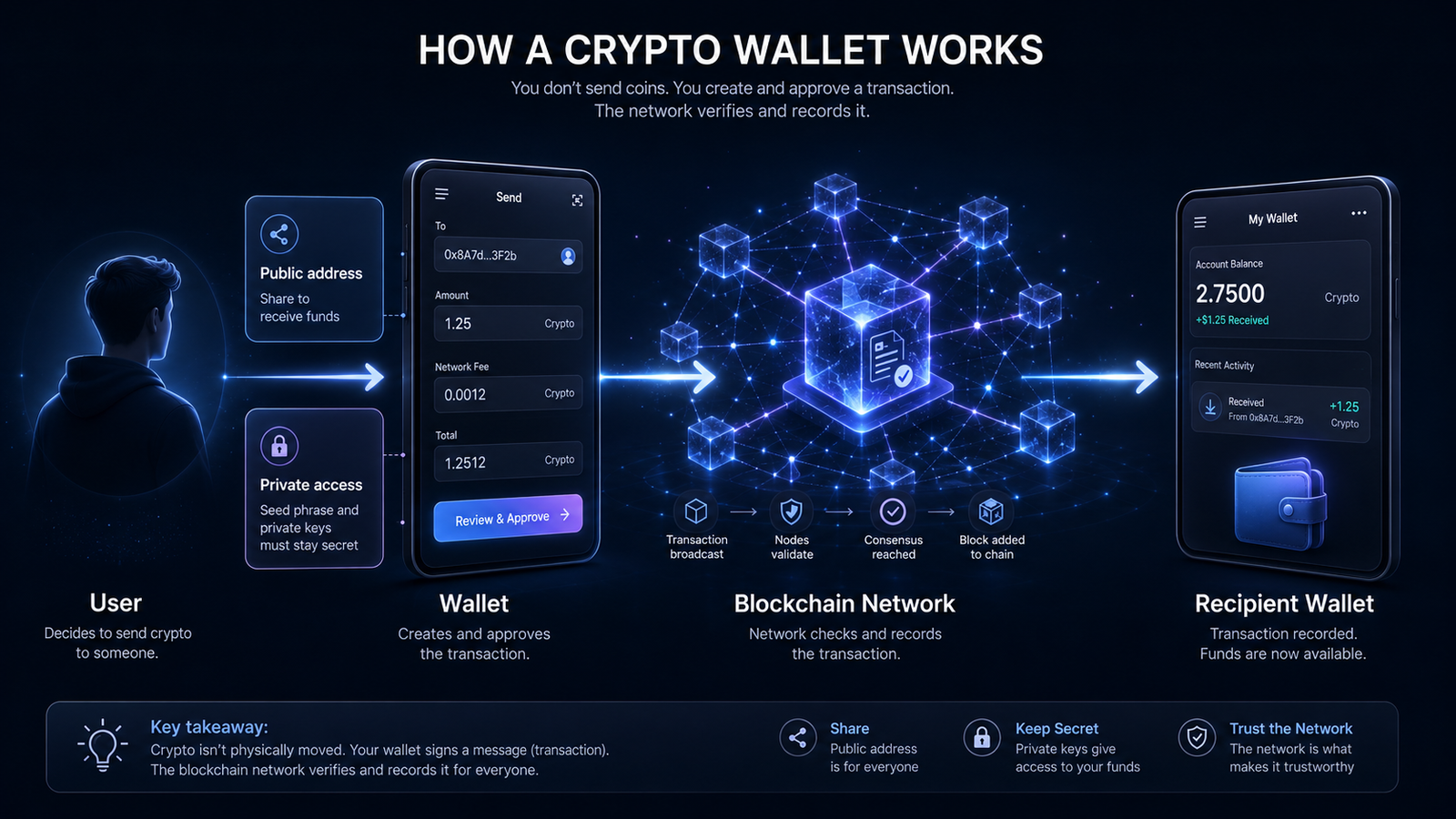
For example, if you send Bitcoin (BTC) or Ether (ETH) to someone, you don’t physically move a coin from one app to another. Instead, your wallet creates and approves a transaction, while the blockchain network records the resulting transfer.
Crypto wallets also use public-facing addresses, which you can share with someone who wants to send you compatible funds.
However, behind that public information are the private credentials used to authorise transactions. Because of this, private keys and seed phrases need to be protected carefully, because exposing them can give someone else control over the assets associated with the wallet.
In simple terms, your wallet address can be shared for receiving compatible assets, while private access information must remain secret.
Crypto Wallet vs Crypto Exchange
Crypto wallets and crypto exchanges are not the same thing.
A crypto exchange is primarily a platform for buying, selling, trading, or converting digital assets, while a wallet provides tools for accessing, receiving, sending, or managing assets across blockchain networks.
Some exchanges provide account balances or custodial wallets. This can feel easier for beginners because the platform manages much of the experience. However, it also means the user depends on the exchange’s systems, rules, withdrawals, and security.
A personal wallet can give users more direct control, but it also requires stronger safety habits.
The distinction between a crypto exchange and a personal wallet therefore largely comes down to their purpose and who controls access to the assets.
| Feature | Crypto wallet | Crypto exchange |
| Main purpose | Access, send, receive, or manage digital assets | Buy, sell, trade, or hold crypto through a platform |
| Control | Depends on wallet type | Usually controlled through an exchange account |
| Access | Wallet app, private key, seed phrase, or device | Login details, account security, and platform rules |
| Used for | Holding assets, sending funds, Web3 apps, NFTs, DeFi | Buying, selling, trading, and converting crypto |
| Main risk | Losing access, seed phrase theft, wrong address, malicious approvals | Platform risk, account hacks, withdrawal limits, exchange failure |
So, neither option is automatically better for every person. Beginners should first understand how each one works before moving funds.
Custodial vs Self-Custody Wallets
One of the most important wallet differences is custody.
Custody is about who controls access. For example, with a custodial wallet, a platform helps manage access for you. With a self-custody wallet, you are responsible for protecting the recovery details yourself.
Custodial Wallet
A custodial wallet means a platform usually manages access for the user. This setup is popular with exchanges and some apps. As a result, the user logs into an account, and the platform handles much of the technical side.
Self-custody Wallet
A self-custody wallet gives the user control over the credentials associated with the wallet. Understanding private keys and seed phrases is especially important here because the user, rather than a central platform, is responsible for protecting access and recovery information.
This can provide more direct control, but it’s also less forgiving. If recovery information is lost or exposed to a scammer, there may be no support team that can restore access.
| Feature | Custodial wallet | Self-custody wallet |
| Who controls access? | Usually the exchange or platform | The user |
| Recovery | Platform may help with account recovery | User must protect seed phrase or private keys |
| Ease of use | Often easier for beginners | Can feel more technical |
| Control | Less direct control | More direct control |
| Main risk | Platform failure, account restrictions, hacks | Lost seed phrase, scams, wrong approvals |
Author’s Tip
I find wallets easier to understand when I separate “using crypto” from “controlling crypto”. A platform account may let you buy or hold digital assets, but a self-custody wallet gives you more direct responsibility for access, recovery, and mistakes.
What Are the Main Types of Crypto Wallets?
There are several types of crypto wallets, but beginners don’t need to understand every technical variation at once.
Start with the main categories such as hot wallets, cold wallets, hardware wallets, and software wallets.
Hot Wallets
A hot wallet is connected to the internet. It may be a mobile app, browser extension, web wallet, or desktop wallet.
Hot wallets are convenient because they are easier to use for regular activity. For example, someone might use a hot wallet to connect to Web3 apps, send smaller transactions, or manage tokens.
On the negative side, online access can increase exposure to phishing links, fake apps, unsafe downloads, and wallet-draining scams.
Cold Wallets
A cold wallet is kept offline or mostly offline. As a result, this can make it useful for stronger long-term protection because cold storage is often used by people who want to reduce online exposure.
It still requires careful backup habits. If the seed phrase is lost, damaged, or exposed, the wallet may still be at risk.
However, cold wallets are not magic protection and are only as safe as the way they are set up, stored, and used.
Hardware Wallets
A hardware wallet is a physical device used to help protect wallet access. Specifically, it can be useful for people holding larger amounts or wanting stronger protection than a normal app-based wallet.
However, hardware wallets are not risk-free. Beginners still need to protect the seed phrase, buy devices from safe sources, check transaction details, and avoid fake support messages.
Software Wallets
A software wallet is an app, browser extension, or desktop program. These wallets are often used for everyday activity and Web3 access.
These wallets can be convenient, but they need strong safety habits. For example, a fake extension, unsafe download, or malicious website can create serious risk.
What Can You Use a Wallet For?
A wallet can be used for more than holding crypto.
Depending on the wallet and network, users may use it for:
- Receiving crypto
- Sending crypto
- Accessing tokens
- Connecting to Web3 apps
- Using DeFi platforms
- Holding NFTs
- Checking transaction history
- Managing digital assets
- Approving or rejecting wallet requests
Wallets are used across Web3 because they can connect users and their blockchain addresses to compatible applications.
Many of these blockchain-based services are decentralised applications (dApps), which can use wallet connections to request transactions or other interactions.
DeFi platforms are another common use case, with wallets providing a way to interact with blockchain-based financial applications.
Some wallets can also display or interact with NFTs and digital assets associated with the user’s blockchain addresses.
What Do You Need Before Using a Crypto Wallet?
Before using a wallet, beginners should understand a few basics.
First, you need to understand what crypto is and why assets are recorded on blockchain networks. Then you need to understand what type of wallet you are using.
You should also know:
- What a seed phrase is
- What a private key is
- Which network you are using
- How to check a wallet address
- Why transactions may not be reversible
- How gas fees work
- Why suspicious links are dangerous
- Why starting small matters
Some blockchain networks charge transaction fees when users send funds or interact with applications. On networks such as Ethereum, these are known as gas fees, and the amount can change depending on network conditions and the action being performed.
Author’s Tip
I think beginners should treat a wallet less like a normal app and more like a key to digital assets. Before using one, it helps to understand what each action means, from choosing a network to checking an address or approving a request.
Before You Start Checklist?
Before using a wallet, make sure you can answer these questions:
- Can I understand what a wallet does?
- Do I know whether I am using a custodial or self-custody wallet?
- Can I explain what a seed phrase is?
- Do I know why I should never share my seed phrase?
- Do I understand what network I am using?
- Can I check a wallet address?
- Do I understand gas fees before approving a transaction?
- Do I know how to avoid suspicious wallet links?
- Am I starting small enough that a mistake would not cause serious financial harm?
If you aren’t able to answer any of these questions, it would be a good idea to spend some extra time learning before storing funds, connecting your wallet, sending a transaction or approving permissions.
Are Crypto Wallets Safe?
A wallet can be safe when used carefully, but beginners can lose access or funds through scams, seed phrase mistakes, fake apps, malicious links, wrong addresses, risky approvals, or poor backup habits.
Many wallet risks happen because the user is tricked into giving access away. For example, a scam website may ask someone to connect a wallet, approve a transaction, or enter a seed phrase. As a result, funds may be difficult or impossible to recover.
The biggest risks include:
- Fake wallet apps
- Phishing links
- Wallet-draining scams
- Seed phrase theft
- Malicious transaction approvals
- Sending funds to the wrong address
- Using the wrong network
- Losing a recovery phrase
- Downloading unsafe browser extensions
- Connecting to fake Web3 apps
- Storing backups insecurely
Beginner Safety Note
A crypto wallet can give you more direct control over digital assets, but that control comes with responsibility. Above all, never share your seed phrase, check addresses carefully, review every wallet request, and avoid connecting to apps or links you don’t trust.
Good crypto wallet safety reduces the risk of exposing recovery information, approving malicious requests, downloading fake software, or connecting to unsafe platforms.
Common crypto scams also frequently target wallet users through phishing links, fake support accounts, impersonation, malicious approvals, and wallet-draining websites, making these warning signs an important part of wallet security.
Pros and Cons of Crypto Wallets
Wallets can be useful, but they also carry risks. Beginners should understand both sides before using one.
| Pros | Cons |
| Can give users direct access to digital assets | Mistakes can be hard or impossible to reverse |
| Can be used to send and receive crypto | Seed phrase loss can mean losing access |
| May connect to Web3 apps, DeFi, and NFTs | Fake apps and phishing links are common |
| Self-custody wallets can reduce reliance on platforms | Wallet security can feel confusing for beginners |
| Some wallet types offer stronger long-term protection | Wrong addresses, wrong networks, and malicious approvals can cause losses |
A wallet isn’t automatically safe just because it’s popular, so the safest approach is to understand the wallet type, protect access, and move slowly.
Beginner Crypto Wallet Terms to Know
Crypto wallets come with a lot of unfamiliar terms. However, you don’t need to memorise everything at once, these are the main words to know.
| Term | Beginner meaning |
| Crypto wallet | Tool used to access, send, receive, or manage digital assets |
| Wallet address | Public address used to receive crypto or tokens |
| Private key | Secret information linked to wallet access |
| Seed phrase | Backup phrase used to recover a wallet |
| Public address | A shareable address used to receive funds |
| Custodial wallet | Wallet where a platform manages access for the user |
| Self-custody wallet | A wallet where the user controls the recovery phrase or private keys |
| Hot wallet | Wallet connected to the internet |
| Cold wallet | Wallet kept offline or mostly offline |
| Hardware wallet | Physical device used to help protect wallet access |
| Gas fee | Blockchain transaction fee |
| Wallet approval | A request that gives an app permission to interact with a wallet |
Don’t worry if these terms feel unfamiliar at first. The goal is to understand what each term means before spending/using any money.
How Beginners Should Start Learning Wallets
The best way to learn wallets is to move in stages, so don’t start by downloading random wallet apps, connecting to unknown websites, or sending large amounts.
Start with the basics:
- Learn what crypto is.
- Learn how blockchain records transactions.
- Understand what a wallet does.
- Learn the difference between custodial and self-custody wallets.
- Know about seed phrases and private keys.
- Understand wallet safety habits.
- Understand gas fees and wallet approvals.
- Start small if choosing to use a wallet.
This order helps beginners build context before moving into more complex topics such as DeFi, NFTs, dApps, hardware wallets, or multi-chain activity.
Wallets form one part of the wider Web3 and crypto ecosystem, connecting users with blockchain networks, digital assets, exchanges, applications, and other blockchain-based tools.
Where to Go Next
Crypto wallets connect to several parts of the wider blockchain ecosystem, so these guides provide the most logical next steps:
- Web3 & Crypto Guide: Covers the wider ecosystem of cryptocurrency, blockchain, wallets, exchanges, Web3, DeFi, digital assets, and safety.
- Crypto Guides: Brings together TMD’s beginner cryptocurrency guides covering the concepts, tools, transactions, and risks surrounding digital assets.
- What Is Crypto?: Explains the digital assets that wallets are commonly used to access, send, receive, and manage.
- What Is Blockchain?: Covers the networks and shared records behind wallet transactions and digital assets.
- What Is a Crypto Exchange?: Explains how exchanges differ from personal wallets when buying, selling, holding, or moving cryptocurrency.
- Private Keys and Seed Phrases: Covers the access and recovery information associated with self-custody wallets.
- What Is Web3?: Explains how wallets can be used for identity, access, digital ownership, and blockchain-based applications.
- What Are dApps?: Covers the blockchain applications that users can interact with through compatible wallets.
- What Is DeFi?: Explains how wallets interact with decentralised financial applications and blockchain-based services.
- What Are Gas Fees?: Covers the transaction fees users may encounter when sending assets or interacting with blockchain applications.
- Crypto Wallet Safety Guide: Covers seed phrase protection, wallet approvals, phishing, backups, fake apps, and other wallet security risks.
- Common Crypto Scams to Avoid: Covers phishing, impersonation, wallet drainers, fake platforms, malicious links, and other common crypto scams.
Safety Checklist
✓ Never share your seed phrase
✓ Check wallet addresses carefully
✓ Review every wallet approval
✓ Avoid links from DMs or ads
✓ Start with small test transactions
Related Guides
- What Are Smart Contracts? A Beginner’s Guide to Blockchain-Based Agreements
- What Are dApps? A Beginner’s Guide to Decentralised Apps
- What Is DeFi? A Beginner’s Guide to Decentralised Finance
- What Are Gas Fees? A Beginner’s Guide to Crypto Transaction Costs
- Common Crypto Scams to Avoid: How to Spot the Warning Signs
Disclaimer: This guide is for general information and education only. It is not financial, investment, legal, or tax advice. Crypto and digital assets can be risky, and prices may change quickly. Always do your own research and consider speaking with a qualified professional before making financial decisions.
The Meta Directory may earn commissions from some links, but this does not influence our editorial content.

Author
Frequently Asked Questions
A crypto wallet is a tool that helps you access, send, receive, and manage digital assets on blockchain networks.
A crypto wallet doesn’t store crypto like a physical wallet stores cash. For example, assets are recorded on the blockchain, while the wallet manages access to them.
No, crypto wallets aren’t the same as exchanges. Wallets help you access or manage digital assets but exchanges are platforms used to buy, sell, trade, or convert crypto.
Beginners may need a crypto wallet to send or receive crypto, use Web3 apps, hold NFTs, or control digital assets directly.
The safest wallet depends on how it’s used and how it’s protected. For example, cold wallets and hardware wallets may reduce some online risks.
If you lose your seed phrase, you may lose access to the wallet permanently. For this reason, seed phrases should be backed up, kept private, and stored offline.
Yes, someone can steal crypto if they know the seed phrase, private key, device, or account.
Yes, you can have more than one wallet. For example, people may use separate wallets for long-term storage, testing apps, or other purposes.
HOW WE REVIEW & RANK
We research and compare platforms using a consistent framework: security signals, track record, product usability, feature quality, transparency of terms, and real-world usefulness.
When something changes – fees, policies, availability, or features – we update our listings and reviews.
Learn more about how we review platforms ->
STAY UPDATED
Get new crypto guides, updated rankings, and practical tips straight to your inbox — no spam, unsubscribe anytime.
NO SPAM. UNSUBSCRIBE ANYTIME.