Custodial vs Non-Custodial Wallets: What’s the Difference?
Updated: September 2026
Written By
Table of Contents
- What Is a Custodial Wallet?
- What Is a Non-Custodial Walle?
- What’s the Difference Between Custodial and Non-Custodial Wallets?
- Are Custodial or Non-Custodial Wallets Safer?
- Which Type of Crypto Wallet Is Better for Beginners?
- Can You Use Both Custodial and Non-Custodial Wallets?
- What Should You Check Before Choosing a Crypto Wallet?
- Key Takeaways
- Recommended Next Guides
- Frequently Asked Questions
QUICK FACTS
Best for:
Crypto beginners
Difficulty: Beginner-friendly
Main topic:
Crypto wallets
Covers:
Custody, private keys, wallet recovery, security, self-custody
You’ll learn:
How custodial and non-custodial wallets differ, who controls the keys, and which may suit you

Choosing a crypto wallet isn’t only about finding somewhere to manage your cryptocurrency. One of the most important decisions is who controls the private keys associated with your assets.
With a custodial service, a company or platform manages the keys on your behalf. With a non-custodial wallet, you control them yourself and are responsible for keeping access secure.
This distinction affects account recovery, security and what happens if something goes wrong, creating an important trade-off between convenience and direct control. It’s also one of the main differences beginners notice when comparing wallets and exchanges.
Understanding how a crypto wallet works can make these differences much easier to follow, particularly if you’re completely new to storing or managing cryptocurrency.
The Custodial and Non-Custodial Difference
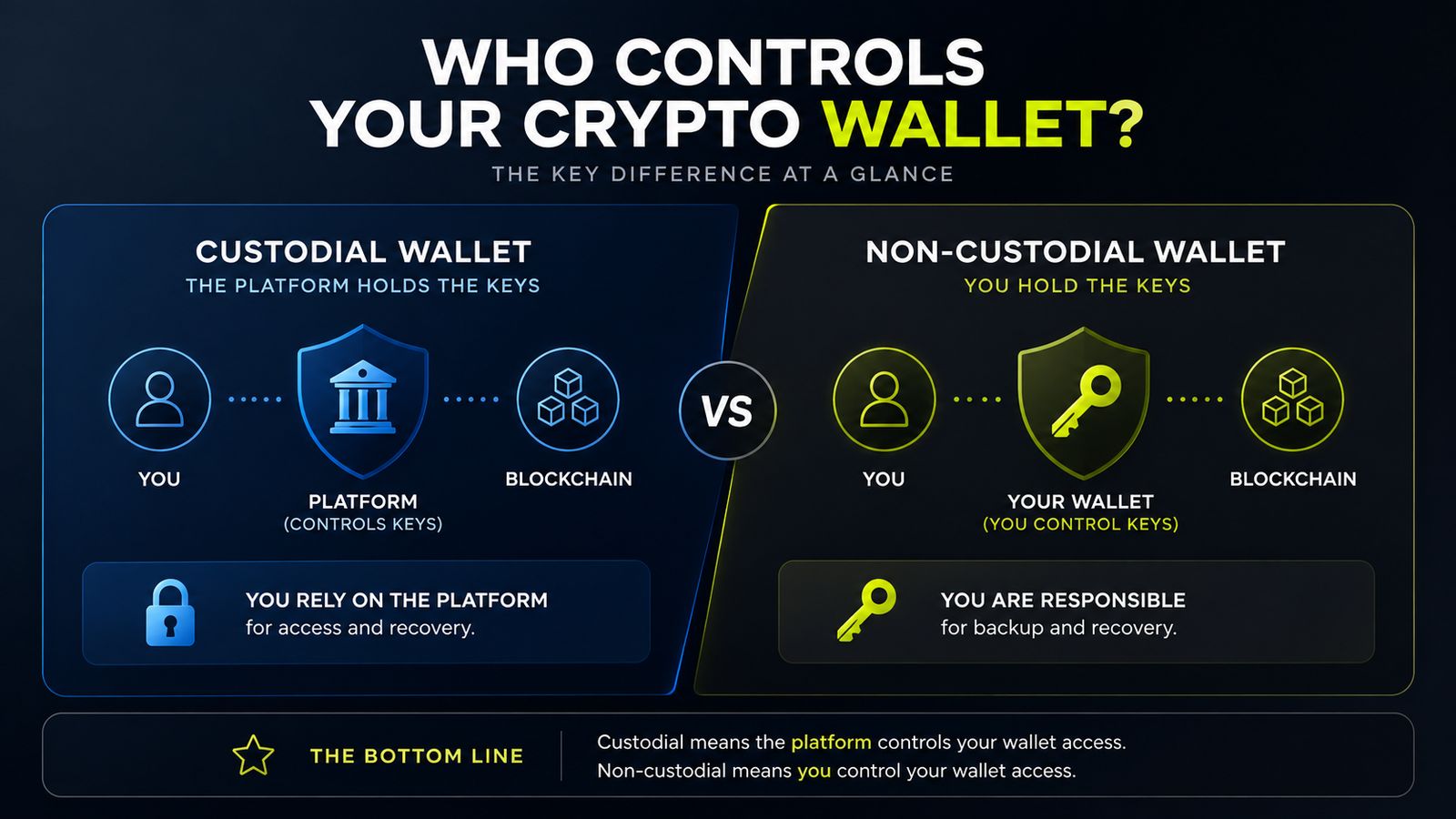
With a custodial wallet or account, a third party manages the private keys on your behalf. With a non-custodial wallet, also known as a self-custody wallet, you retain control of them yourself.
Custodial services can be easier for beginners because they often provide familiar account features such as password resets and customer support.
Non-custodial wallets remove some reliance on a third-party custodian, but losing the credentials needed to recover a traditional self-custody wallet can mean permanently losing access.
Here is a comparison of both:
| Custodial | Non-Custodial | |
| Who controls the private keys? | Third-party custodian | User |
| Account recovery | Often available through provider | Usually depends on user’s recovery method |
| Ease of use | Often more beginner-friendly | Requires greater understanding |
| Reliance on third party | Higher | Lower for custody |
| Web3 access | Varies by service | Often designed for direct dApp interaction |
| Main responsibility | Protecting account access and choosing a trustworthy provider | Protecting keys/recovery credentials and using the wallet safely |
| Main trade-off | Convenience vs reliance on custodian | Control vs personal responsibility |
Neither approach is automatically the best choice for every user.
The important question is whether you understand where control sits and what could cause you to lose access.
What Is a Custodial Wallet?
A custodial crypto wallet is a wallet or account where a third party controls the private keys on your behalf. You’d normally accesses your crypto through an account provided by the custodian rather than managing the underlying keys directly.
Centralised cryptocurrency exchanges are a popular example. When you use a crypto exchange to buy, sell or hold cryptocurrency, the exchange may provide a custodial account where you can access your assets without managing the private keys yourself.
You might log in using an email address, password and additional security measures such as two-factor authentication. Behind the scenes, however, the platform manages the key infrastructure used to control the crypto it holds for customers.
Crypto custodians and exchanges can also perform several financial functions at once. The Bank for International Settlements describes cryptoasset service providers as intermediaries that may combine services such as trading, custody, lending, derivatives and other activities.
How Does a Custodial Wallet Work?
When you use a custodial service, you are trusting the provider to safeguard the keys and infrastructure that control the crypto associated with your account.
Instead of signing every blockchain transaction directly with a private key you control, you typically instruct the platform to perform an action through your account.
For example, you might:
Log in → choose an asset → enter a recipient address → request a withdrawal
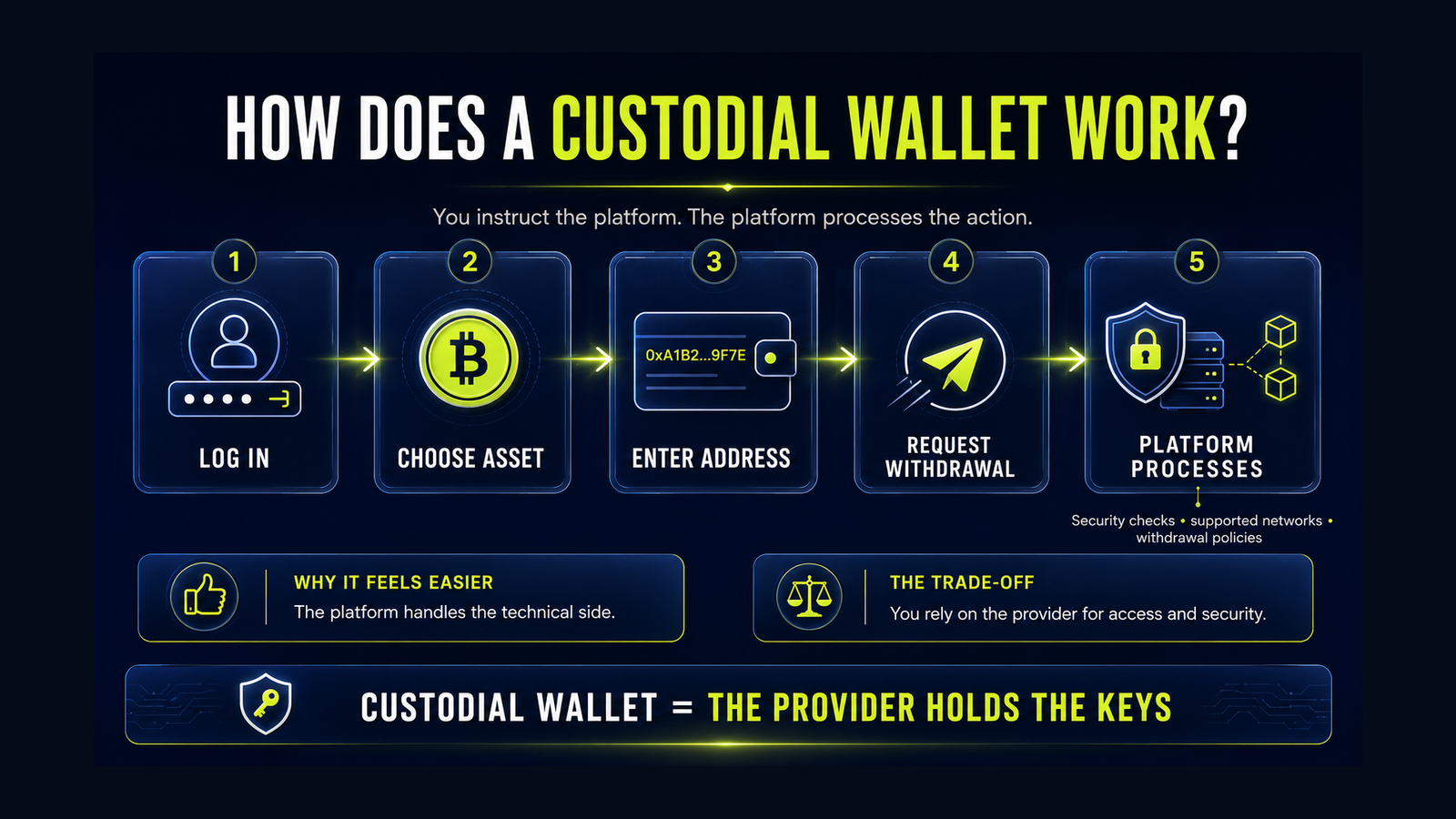
The provider then processes the request according to its systems, security checks, supported networks and withdrawal policies.
This arrangement can make crypto easier to use because the platform handles much of the technical complexity.
The trade-off is that you are relying on that custodian to maintain secure systems and continue providing access to your assets.
What Are the Advantages and Disadvantages of Custodial Wallets?
The biggest advantage is convenience.
Depending on the provider, custodial accounts may offer:
- Password or account recovery
- Customer support
- Built-in buying and selling
- Simple asset management
- Additional account-security features
That can reduce the technical burden for someone encountering crypto for the first time. However, convenience introduces risk.
Because another organisation controls the private keys, your access also depends on that organisation and its systems. Security breaches, account compromise, withdrawal restrictions or serious problems affecting the custodian can potentially affect users.
Using a custodial service therefore doesn’t remove responsibility. It changes what you are responsible for. Instead of protecting a seed phrase yourself, you need to protect your account and carefully assess the organisation you are trusting with custody.
What Is a Non-Custodial Wallet?
A non-custodial wallet is a crypto wallet that gives the you direct control of the keys used to manage your assets. It’s also called a self-custody or self-custodial wallet.
Rather than relying on an exchange or another custodian to manage those keys, the responsibility sits with you. Understanding private keys and seed phrases is particularly important because they can play a critical role in controlling and recovering access to a self-custody wallet.
Crypto isn’t literally stored inside a wallet in the same way that cash sits inside a physical wallet. Instead, a wallet provides the tools needed to interact with your accounts and blockchain networks while helping you manage the credentials required to authorise transactions.
How Does a Non-Custodial Wallet Work?
When setting up a traditional non-custodial wallet, the wallet creates or manages the cryptographic information required to control your account.
Many wallets provide a recovery phrase, sometimes called a seed phrase, that can be used to recover access. Anyone who obtains the necessary recovery credentials may potentially gain control of the associated accounts, which is why they must be protected carefully.
When you start a transaction, your wallet uses the relevant private key to sign it. The network can then verify that the transaction was authorised without exposing the private key itself. Ethereum’s account documentation explains how public and private key pairs control externally owned Ethereum accounts and how private keys are used to sign transactions.
A simplified flow looks like this:
You → Wallet → Sign transaction → Blockchain network
That direct control is one of the defining characteristics of self-custody.
What Are the Advantages and Disadvantages of Non-Custodial Wallets?
The main advantage is direct control.
You don’t need to rely on a centralised exchange to hold your private keys, and many non-custodial wallets can connect directly to decentralised applications and other Web3 services. But direct control comes with greater responsibility.
Depending on the wallet design, losing the only recovery credentials for your wallet can result in permanent loss of access. With a traditional self-custody wallet, there may be no central party capable of resetting a password and restoring access for you.
Self-custody users also need to recognise threats such as phishing, malicious websites, compromised recovery phrases and dangerous transaction or smart-contract approvals.
That means self-custody shouldn’t be confused with automatic security. You have removed one type of risk, the need to trust a custodian, but taken responsibility for managing others yourself.
What’s the Difference Between Custodial and Non-Custodial Wallets?
Although both can provide a way to manage cryptocurrency, the underlying model is fundamentally different.
Who Controls the Private Keys?
This is the most important distinction. With a custodial service, the custodian controls the private keys. With a non-custodial wallet, you control them.
Private keys are used to authorise activity associated with blockchain accounts, which is why control of them is such an important part of crypto ownership and custody.
You don’t need to understand the underlying cryptography before using crypto, but you do need to understand what private keys and recovery phrases allow someone to do.
Account Recovery
Custodial platforms can often provide familiar account-recovery processes. If you forget a password, for example, you may be able to verify your identity and regain access through the provider. Traditional self-custody works differently.
If your wallet uses a recovery phrase and you lose the device containing your wallet, the phrase may allow you to restore access using compatible wallet software. If you lose both access to the wallet and the only valid recovery method, however, there may be nobody capable of restoring it for you.
Newer smart-account and social-recovery designs can work differently, so “non-custodial always means no recovery options whatsoever” is becoming too simplistic.
Security and Responsibility
The two models have different security risks.
- A custodial user: Needs to consider the security and reliability of the provider as well as the security of their own login credentials.
- A non-custodial user: Takes responsibility for protecting their keys or recovery method and safely interacting with blockchain applications.
This is why asking: Which wallet is safer? isn’t quite the right question. A better question is: Which risks am I prepared and equipped to manage?
Strong crypto wallet security matters regardless of the custody model you decide to go with. Custodial users need to protect account access, while self-custody users also need to protect recovery credentials and understand the transactions or approvals they authorise.
Ease of Use
Custodial platforms are often easier for complete beginners because they can feel more like conventional online financial accounts.
You create an account, secure your login and use the platform’s interface.
Non-custodial wallets require some additional concepts to be understood, particularly:
- Private keys
- Recovery phrases
- Blockchain networks
- Wallet addresses
- Transaction approvals
- Scams and phishing
None of these concepts is impossibly difficult, but skipping them can lead to costly mistakes.
Access to Web3 and dApps
Non-custodial wallets are commonly used to connect directly to decentralised applications (dApps). These applications form an important part of the broader Web3 ecosystem, where compatible wallets can allow users to interact with blockchain-based services without relying entirely on a traditional account controlled by the application provider.
When interacting with a dApp, a compatible wallet can be used to prove control of an address, sign messages and approve blockchain transactions directly from the wallet.
This makes self-custody particularly relevant for people who want to explore areas such as decentralised finance, NFT platforms and blockchain gaming ecosystems.
That additional access also creates additional responsibility. Never approve a wallet request or transaction you don’t understand.
Are Custodial or Non-Custodial Wallets Safer?
Neither custodial nor non-custodial wallets are automatically safer in every situation. Each model exposes the user to a different set of risks.
A well-secured self-custody wallet removes the need to trust a third-party custodian with the private keys, but it also makes the user responsible for protecting those keys and avoiding mistakes.
A custodial service takes much of that technical responsibility away from the user, but creates reliance on the custodian.
Think of the difference as two different risk models:
Custodial risks can include:
- Account compromise
- Provider security breaches
- Operational or financial problems at the custodian
- Restrictions on account access or withdrawals
- Reliance on the provider’s security practices.
Non-custodial risks can include:
- Losing recovery credentials
- Exposing a seed phrase or private key
- Phishing
- Installing fake or malicious wallet software
- Signing malicious transactions or approvals
- Sending assets using an incorrect address or unsupported network.
Common crypto scams targeting wallet users can include phishing, fake wallet websites, impersonation and attempts to steal recovery credentials. Ethereum also provides broader guidance on protecting wallets and recognising common crypto scams.
The safest choice therefore depends partly on the user.
Someone who chooses self-custody but stores their recovery phrase insecurely may be taking considerably more risk than they realise.
Author’s Tip
Before moving big amounts of crypto into self-custody, I would make sure you understand how your wallet is recovered, where your recovery credentials are stored and what you would do if your phone, computer or hardware wallet disappeared tomorrow. Never test a new wallet process for the first time with an amount you cannot afford to lose.
Which Type of Crypto Wallet Is Better for Beginners?
A custodial service may be easier if you’re a beginner who primarily wants to buy, sell or hold small amounts of cryptocurrency, while a non-custodial wallet provides greater direct control but requires a better understanding of wallet security and recovery.
However, that doesn’t mean every beginner should start with custody. A beginner who takes the time to learn about private keys, recovery and common scams may be perfectly capable of using a non-custodial wallet.
The better decision depends on what you’re trying to do. If your priority is simplicity, you may value the account recovery and integrated services offered by a reputable custodial platform.
If your priority is self-custody or direct Web3 access, a non-custodial wallet may be more appropriate. If you don’t yet understand what a seed phrase does, however, learn that before moving valuable assets into a wallet that makes you solely responsible for recovery.
Can You Use Both Custodial and Non-Custodial Wallets?
Yes. Using a custodial service and a non-custodial wallet is not mutually exclusive. Many crypto users use different wallet arrangements for different purposes.
For example, someone could use:
Crypto exchange → Software wallet → Hardware wallet
The exchange might be used to buy or sell cryptocurrency, while a self-custody software wallet could be used for everyday blockchain interactions. A hardware wallet can provide another option for protecting private keys, particularly when assets are being held rather than regularly transacted.
Importantly, hardware wallet, cold wallet and non-custodial wallet don’t all mean exactly the same thing.
As mentioned – “Custodial” describes who controls the keys. “Hot” and “cold” generally describe how those keys are stored and whether they are exposed to internet-connected environments.
Understanding the difference between hot and cold wallets can therefore help you choose a storage method that better suits how you plan to use and protect your crypto.
What Should You Check Before Choosing a Crypto Wallet?
Before choosing between custodial and non-custodial options, make sure you understand what you’re actually agreeing to.
Ask:
- Who controls the private keys?
- How would I recover access if I lost my device or password?
- What happens if the provider stops operating?
- What security features are available?
- Which cryptocurrencies and blockchain networks are supported?
- Can the wallet perform the activities I actually need?
- Do I understand the fees involved?
- Am I capable of securely protecting a recovery phrase or other recovery method?
- Have I verified that I’m using the legitimate website, app or device?
For a custodial platform, research the organisation itself as well as its security features. For self-custody, make sure you understand the recovery process before depositing substantial funds.
A wallet shouldn’t be chosen simply because it’s popular or because somebody on social media recommended it. Comparing crypto wallets suitable for beginners based on factors such as custody, security, recovery options, supported networks and intended use can help you narrow down which options actually meet your needs.
If you decide that a hardware wallet suits the way you plan to store and manage your crypto, comparing reputable hardware wallet options can then help you assess differences in security features, compatibility and usability.
Key Takeaways
- Custodial wallets rely on a third party to control private keys on the user’s behalf.
- Non-custodial wallets give the user direct control of their keys and greater responsibility for protecting access.
- Custodial services can provide simpler account recovery, but require trust in the custodian.
- Self-custody removes some counterparty risk but introduces risks related to key management, phishing and user error.
- Neither approach is inherently safest for every person.
- You can use both custodial and non-custodial options for different purposes.
- Before choosing a wallet, understand who controls the keys, how recovery works and what happens if something goes wrong.
Custody is only one part of choosing how to manage digital assets. TMD’s crypto guides cover the wider beginner concepts surrounding wallets, exchanges, transactions and security, while the broader Web3 and crypto ecosystem also includes blockchain applications, DeFi, NFTs and other wallet-connected tools.
Recommended Next Guides
Custody connects closely with wallet access, exchanges, recovery and security, so these guides provide the most relevant next steps:
TIP: START WITH Crypto Wallet Safety Guide OR Common Crypto Scams to Avoid.
Safety Checklist
✓ Know who controls the private keys
✓ Understand how wallet recovery works
✓ Never share your seed phrase or private key
✓ Verify the wallet or platform is legitimate
✓ Turn on two-factor authentication when available
✓ Test unfamiliar transfers with a small amount
Related Guides
- What Are Smart Contracts? A Beginner’s Guide to Blockchain-Based Agreements
- What Are dApps? A Beginner’s Guide to Decentralised Apps
- What Is DeFi? A Beginner’s Guide to Decentralised Finance
- What Are Gas Fees? A Beginner’s Guide to Crypto Transaction Costs
- Common Crypto Scams to Avoid: How to Spot the Warning Signs
Disclaimer: This guide is for general information and education only. It is not financial, investment, legal, or tax advice. Crypto and digital assets can be risky, and prices may change quickly. Always do your own research and consider speaking with a qualified professional before making financial decisions.
The Meta Directory may earn commissions from some links, but this does not influence our editorial content.

Author
Frequently Asked Questions
A hardware wallet is generally non-custodial when the user retains control of the private keys. However, “hardware” describes the method used to protect or manage the keys, while “custodial” describes who ultimately controls them. These are related but different classifications.
No. Non-custodial and cold wallet don’t mean the same thing. Non-custodial refers to who controls the private keys, while cold storage refers to keeping keys offline or isolated from internet-connected systems. A non-custodial wallet can therefore be either hot or cold depending on its design and use.
Generally, yes. If the custodial provider allows withdrawals and supports the cryptocurrency and network you want to use, you can normally withdraw to an address generated by your non-custodial wallet. Always verify the address and network before confirming a transfer, as blockchain transactions may be irreversible.
Recovery depends on how the wallet is designed. Many traditional self-custody wallets provide a recovery phrase that can restore access if a device is lost. If you lose both access to the wallet and its only recovery credentials, there may be no central provider capable of restoring your account. Newer wallet designs may offer alternative recovery mechanisms.
HOW WE REVIEW & RANK
We research and compare platforms using a consistent framework: security signals, track record, product usability, feature quality, transparency of terms, and real-world usefulness.
When something changes – fees, policies, availability, or features – we update our listings and reviews.
Learn more about how we review platforms ->
STAY UPDATED
Get new crypto guides, updated rankings, and practical tips straight to your inbox — no spam, unsubscribe anytime.
NO SPAM. UNSUBSCRIBE ANYTIME.