What Is a DEX? A Beginner’s Guide to Decentralised Exchanges
Updated: October 2026
Written By
Table of Contents
- What Is a Decentralised Exchange?
- How Does a DEX Work?
- What Are the Main Types of DEXs?
- DEX vs CEX: What Is the Difference?
- What Are Liquidity Pools and AMMs?
- What Does It Cost to Use a DEX?
- Benefits and Limitations of DEXs
- Before Using a DEX Checklist
- Are DEXs Safe?
- Do You Need a Crypto Wallet to Use a DEX?
- Beginner DEX Terms to Know
- Key Takeaways
- Where to Go Next
- Frequently Asked Questions
QUICK FACTS
Best for:
Beginners learning DeFi and decentralised exchanges
Difficulty: Beginner-friendly
Main topic:
Decentralised crypto exchanges
Covers:
DEXs, wallets, AMMs, liquidity, fees, swaps and safety
You’ll learn:
What a DEX is, how DEXs work, DEX vs CEX, major costs and key risks
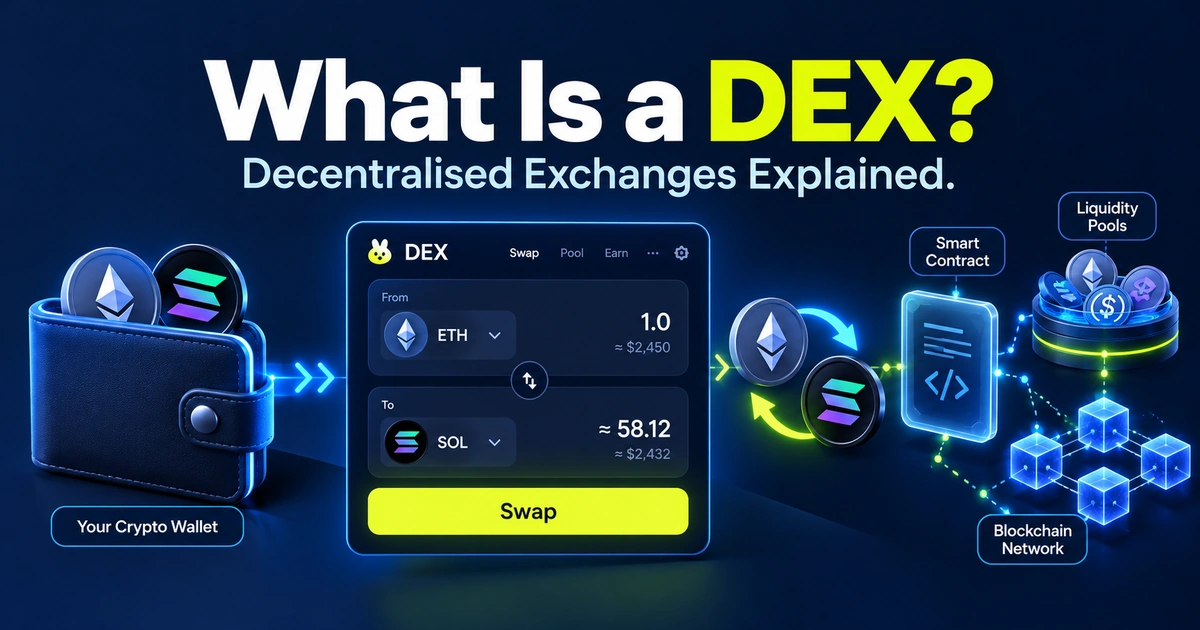
A DEX is a decentralised exchange that lets users swap crypto through blockchain-based infrastructure, often by connecting a crypto wallet and interacting with smart contracts instead of depositing funds into a conventional exchange account.
This guide explains how DEXs work, how they compare with centralised exchanges, and what beginners should know about wallets, fees, liquidity, slippage, price impact and risk.
Quick Answer: What Is a DEX?
A DEX is a decentralised exchange that allows users to swap crypto through blockchain-based systems, commonly using wallets, smart contracts and liquidity sources rather than a conventional exchange account.
What Is a Decentralised Exchange?
A decentralised exchange is a crypto exchange that lets users swap digital assets through blockchain-based infrastructure instead of relying only on a company-operated trading account.
DEX is short for decentralised exchange. The US spelling is decentralized exchange, so both spellings may appear across crypto platforms, documentation and search results.
A DEX usually sits inside the wider world of DeFi. Before using one, it helps to understand what DeFi is because decentralised exchanges are one of the most common examples of DeFi tools.
Instead of depositing assets into a standard exchange account, many DEX users connect a crypto wallet, choose the assets they want to swap, review the quote and approve the transaction through the wallet. The swap may then be processed by smart contracts, liquidity pools, order books or routing systems, depending on the DEX design.
A decentralised exchange can feel very different from a centralised exchange because the user may remain responsible for wallet access, transaction approvals, network selection and token checks. This can give users more direct control, but it also adds responsibility.
Exchanges that are decentralised are not automatically safer, cheaper or fully decentralised. DEX architecture varies. Decentralised exchanges can use automated market makers, some use order books, some use hybrid models and some aggregators route trades across multiple liquidity sources.
How Does a DEX Work?
A DEX usually works by connecting a user’s wallet to a decentralised exchange interface, then using blockchain-based systems to complete a crypto swap.
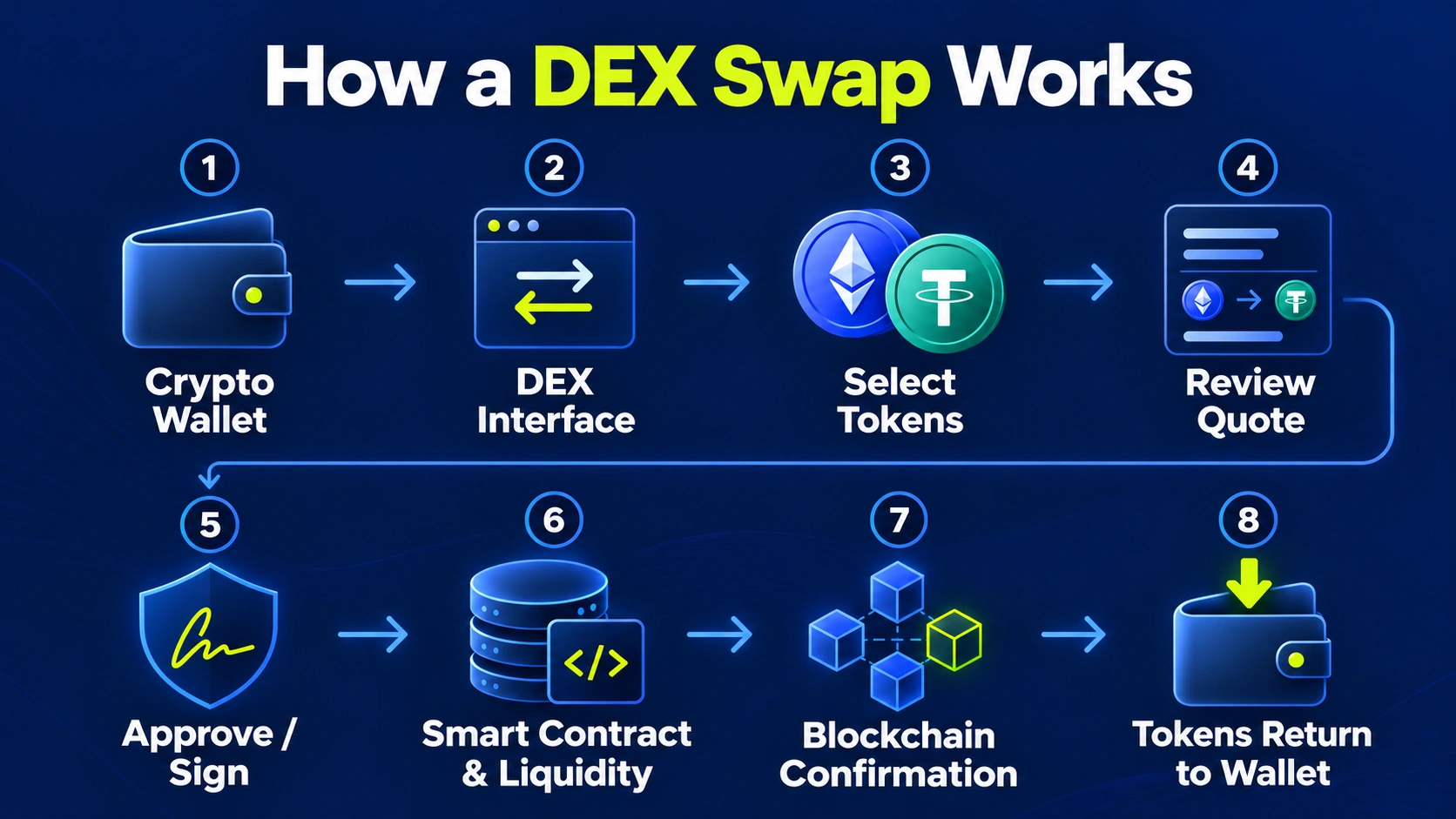
The exact steps can vary by protocol, blockchain, wallet and interface, but a typical beginner workflow may look like this:
- Open a DEX interface.
- Connect a compatible crypto wallet.
- Choose the asset you want to swap from.
- Choose the asset you want to receive.
- Enter the trade amount.
- Review the quote and expected output.
- Approve token access if required.
- Check fees, slippage and price impact.
- Sign the transaction using the wallet.
- Wait for the blockchain to process the transaction.
- If successful, the swapped tokens return to the wallet.
Behind the scenes, smart contracts may be used to apply programmed rules, interact with liquidity and process the swap. A smart contract does not remove risk. It follows code, and that code may still contain bugs, vulnerabilities or unsafe permissions.
Some DEX transactions also require gas fees, which are blockchain network fees paid to process activity on the network. These fees are separate from slippage and price impact.
What Are the Main Types of DEXs?
Not every decentralised exchange uses the same model. Automated market makers are one common structure, while order book DEXs use a different approach. Hybrid systems may combine parts of more than one model. Aggregators can also search across different liquidity sources rather than operating as one single exchange protocol.
Automated Market Makers
An automated market maker, or AMM, is a system that can help price and execute token swaps using liquidity pools.
A liquidity pool is a pool of crypto assets supplied to a protocol. The people who supply those assets are called liquidity providers. When users swap through an AMM, they are usually interacting with a pool rather than being matched with one specific person on the other side of the trade.
AMMs often use mathematical pricing mechanisms to adjust prices based on the balance of assets in the pool. Beginners do not need to understand the formulas immediately, but they should understand that liquidity affects the quoted price, slippage and price impact.
The Bank for International Settlements has also discussed automated market makers as a key DeFi trading mechanism in its research on decentralised finance and AMMs.
Order Book DEXs
An order book DEX uses buy and sell orders. This structure is closer to the way many traditional trading venues and centralised exchanges display markets.
In an order book model, buyers and sellers place orders at different prices. The system then matches compatible orders. Some order book DEXs place more activity on-chain, while others use hybrid structures where some parts of the process happen off-chain and settlement happens on-chain.
Order book DEXs can feel more familiar to users who already understand exchange trading, but they may still involve wallets, blockchain transactions, network fees and smart-contract risk.
DEX Aggregators
A DEX aggregator is a tool that searches multiple liquidity sources to help route a swap.
Instead of relying on one pool or one protocol, an aggregator may compare available routes across several decentralised exchanges or liquidity sources. The goal is often to find better execution, lower slippage or a more efficient path for the trade.
A DEX aggregator is not always the same thing as an individual DEX protocol. It may act more like a routing layer that helps users access liquidity from different places.
DEX vs CEX: What Is the Difference?
DEXs usually let users swap crypto through wallet-based, blockchain-connected systems, while a CEX is a centralised exchange operated by a company or platform.
A crypto exchange can be centralised or decentralised. The main difference is usually how users access the platform, how custody works and what risks are involved.
| Feature | DEX | CEX |
|---|---|---|
| Main access | Often wallet connection | Usually registered account |
| Custody | Often wallet/self-custody based | Often platform custody |
| Trading infrastructure | Blockchain protocols and smart contracts | Company-operated systems |
| Fiat support | Often limited | Often stronger |
| Account recovery | Usually limited | May provide account recovery |
| Costs | Swap/protocol fees, gas and execution effects may apply | Trading, spread, withdrawal or deposit costs may apply |
| Main risks | Wallet, approval, smart-contract and execution risks | Custody, platform, account and counterparty risks |
The custody difference is important. With many DEX interactions, the user connects a wallet and signs transactions directly. With many centralised exchanges, users log into an account and the platform may hold assets on their behalf.
This is why custodial vs non-custodial wallets matter when comparing DEXs and CEXs. Self-custody can give users more direct control, but it also means there may be little or no account recovery if the user loses access or approves something unsafe.
Neither model is universally better. A DEX can reduce reliance on exchange custody, but it can increase wallet responsibility. A CEX can feel easier for beginners, but it may create platform and account risks.
What Are Liquidity Pools and AMMs?
Liquidity pools are collections of crypto assets supplied to a protocol so users can swap tokens or access other DeFi functions.
In a common AMM-style DEX, liquidity providers deposit pairs or groups of assets into a pool. When someone makes a token swap, the trade interacts with that pool. The pool’s available liquidity can affect the price, slippage and execution quality of the swap.
The simple relationship is:
DEX → AMM → Liquidity Pool → Liquidity Provider → Token Swap
This section is only a beginner overview. Liquidity pools, liquidity providers and related risks deserve their own full guide, especially because topics like impermanent loss, pool incentives and yield farming can become technical quickly.
For now, the key point is that liquidity affects how well some DEX swaps work. A pool with deeper liquidity may handle larger swaps more easily. A pool with low liquidity may produce worse pricing, higher slippage or stronger price impact.
What Does It Cost to Use a DEX?
Using a DEX can involve several different costs or execution effects.
A beginner should separate:
- Swap or protocol fees
- Network or gas fees
- Slippage
- Price impact
Swap or Protocol Fee
A swap or protocol fee is a fee that may be charged by the DEX protocol, liquidity mechanism or trading route.
For example, a liquidity pool may charge a small fee on swaps. This fee may go to liquidity providers, the protocol or another mechanism depending on the DEX design.
Not every DEX charges fees in the same way, and not every fee is shown in the same format.
Network or Gas Fee
A network or gas fee is paid to process the transaction on the blockchain network.
Gas fees are not the same as DEX platform fees. They are linked to blockchain activity, network demand and the cost of processing transactions. This is why understanding gas fees matters before using a DEX.
A transaction may still require gas even if the swap itself fails, depending on the blockchain and what happened during processing.
Slippage
Slippage is the difference between the expected price and the executed price.
For example, a DEX interface may show an estimated output before the swap is confirmed. If market conditions, routing or liquidity change before the transaction is processed, the final received amount may be different.
Slippage is not simply an extra DEX platform fee. It is an execution difference between the quote and the final result.
Price Impact
Price impact is the effect a trade itself can have on the available market price.
If a trade is large compared with the available liquidity, the transaction may move the price while it is being executed. This can lead to a worse rate than expected.
Price impact is not the same as slippage. Slippage usually refers to the difference between expected and executed price. Price impact refers to how much the trade itself can move the price because of available liquidity.
Benefits and Limitations of DEXs
DEXs can be useful tools within DeFi, but their benefits are not guaranteed and their limitations matter.
| Potential benefits | Potential limitations |
|---|---|
| Wallet-based access | Greater wallet responsibility |
| Reduced reliance on exchange custody | Smart-contract risk |
| Access to on-chain markets | Gas fees |
| Integration with DeFi tools | Slippage |
| Transparent blockchain settlement | Price impact |
| Access to a broad range of tokens on some networks | Low liquidity |
| Direct interaction with wallet-based apps | Limited account recovery |
| Can support token swaps without a conventional exchange account | Fake interfaces or malicious tokens |
| May connect to broader DeFi activity | Complexity for beginners |
| Some systems are open and composable | Network congestion |
A DEX can give users more direct access to on-chain markets, but that access comes with more responsibility. Beginners should avoid assuming that a DEX is safer or better just because it uses blockchain technology.
Before Using a DEX Checklist
Before approving a DEX transaction, check:
- The website is the correct official DEX interface.
- The right wallet is connected.
- The selected blockchain network matches the token and DEX.
- Any token contract has been verified where needed.
- The wallet permission request makes sense for the action.
- The expected output amount looks correct before signing.
- Slippage is set at a level you understand.
- Price impact is not higher than you are comfortable with.
- The estimated network or gas fee is clear.
- You understand what the wallet is asking you to sign.
Completing this checklist does not eliminate risk. It only helps reduce avoidable mistakes.
Are DEXs Safe?
DEXs are not automatically safe or unsafe. Their risks differ depending on the protocol, blockchain, wallet, smart contracts, liquidity, permissions and the user’s security practices.
Some DEX risks come from the protocol or smart contracts. Others come from fake websites, malicious tokens, unsafe wallet approvals or user mistakes.
Common DEX risks include:
- Fake DEX websites
- Phishing links
- Malicious token contracts
- Unsafe wallet approvals
- Smart-contract vulnerabilities
- Low liquidity
- Slippage
- Price impact
- Wrong network or wrong token
- Mistakes that are difficult or impossible to reverse
- Wallet or private-key compromise
- Malicious interfaces
- Front-running, sandwich-style execution or other MEV-related risks
MEV, or maximal extractable value, can include situations where transaction ordering affects users. For beginners, the simple version is that some on-chain trades can be affected by how transactions are seen, ordered or routed before confirmation. Ethereum documentation discusses DEX arbitrage, liquidations and sandwich trading as known MEV-related activity.
Many DEX problems start with unsafe wallet behaviour, so crypto wallet safety is important before connecting to unfamiliar DeFi tools.
Fake sites, fake support accounts and urgent wallet prompts are also common attack paths, which is why common crypto scams should be understood before using decentralised exchanges.
If someone gets access to a wallet’s private key or seed phrase, they may gain control over the wallet itself, not just one DEX transaction.
Beginner Safety Note
Connecting a wallet to a DEX can involve transaction approvals and token permissions. Never enter a seed phrase into a DEX website, check what you are approving before signing, and verify that you are using the correct site, network and token.
Do You Need a Crypto Wallet to Use a DEX?
Most conventional DeFi DEX interactions require a compatible crypto wallet.
Wallets may be used to connect to the DEX, sign a message, approve token access, confirm a transaction and receive the swapped assets. This is different from logging into a centralised exchange account with an email address and password.
A DEX may look like a normal website, but the actual interaction often depends on what a crypto wallet is and how wallet connections, approvals and self-custody work.
A wallet connection does not always mean funds are being spent. However, some approvals can give smart contracts permission to interact with certain tokens. Beginners should review wallet prompts carefully before signing.
Many DEX protocols are designed around wallet-based access rather than conventional exchange accounts, but requirements can vary by interface, jurisdiction and service. It is not accurate to say every DEX always works the same way or never involves additional checks.
Beginner DEX Terms to Know
| Term | Beginner meaning |
|---|---|
| DEX | A decentralised exchange used to swap crypto through blockchain-based infrastructure |
| CEX | A centralised exchange operated by a company or platform |
| AMM | An automated system commonly used to price and execute swaps using liquidity pools |
| Liquidity pool | Crypto assets supplied to a protocol to support swaps or other DeFi activity |
| Liquidity provider | Someone who supplies assets to a liquidity pool |
| Swap | Exchanging one crypto asset for another |
| Gas fee | A blockchain network fee |
| Slippage | The difference between expected and executed price |
| Price impact | The effect a trade can have on available market pricing |
| Token approval | Permission allowing a smart contract to interact with certain tokens |
Key Takeaways
- DEX means decentralised exchange, a type of crypto exchange that usually supports wallet-based token swaps.
- Many DEXs use smart contracts and liquidity sources instead of conventional exchange accounts.
- A DEX is different from a CEX because users often interact through self-custody wallets rather than platform-held balances.
- Costs can include swap fees, gas fees, slippage and price impact.
- DEXs can be useful DeFi tools, but beginners should understand wallet approvals, fake sites, low liquidity and smart-contract risk before using one.
Where to Go Next
A DEX makes more sense once you understand the wider DeFi and wallet ecosystem around it. The next step is to build context around how DeFi tools work, why wallets matter, and what happens behind the scenes when a wallet-connected app asks you to approve a transaction.
DeFi Tools Hub
DEXs sit inside the broader DeFi Tools hub, where beginners can follow the wider learning path across decentralised exchanges, liquidity, wallet-connected apps and other blockchain-based financial tools.
DeFi Basics
Because a decentralised exchange is one type of DeFi tool, What Is DeFi? gives beginners the foundation for understanding how DEXs connect to lending, borrowing, staking, liquidity and other on-chain financial activity.
Wallet-Connected Apps
Many DEX interfaces work like wallet-connected apps, so a dApps guide helps explain how decentralised apps can connect users, wallets, smart contracts and blockchain networks.
Smart Contract Basics
Because DEX swaps often depend on programmed blockchain rules, What Are Smart Contracts? explains what may happen after a user approves a wallet request.
Wallet Basics
Because most DEX activity starts with wallet access, What Is a Crypto Wallet? is an important foundation before using decentralised exchanges or approving on-chain transactions.
Wallet Safety
Because DEXs can involve wallet connections, token approvals and irreversible mistakes, a Crypto Wallet Safety Guide is one of the most useful next guides before experimenting with unfamiliar DeFi tools.
Safety Checklist
✓ Verify the DEX website
✓ Check the blockchain network
✓ Confirm the token contract where needed
✓ Review wallet permissions
✓ Check the expected output
✓ Review slippage and price impact
✓ Check the gas fee
✓ Never share or enter your seed phrase

Disclaimer: This guide is for general information and education only. It is not financial, investment, legal, or tax advice. Crypto and digital assets can be risky, and prices may change quickly. Always do your own research and consider speaking with a qualified professional before making financial decisions.
The Meta Directory may earn commissions from some links, but this does not influence our editorial content.

Author
Frequently Asked Questions
DEX means decentralised exchange. In crypto, a DEX is usually a blockchain-based exchange system that lets users swap digital assets through wallets, smart contracts, liquidity sources or other decentralised exchange infrastructure.
A DEX usually uses wallet-based access and blockchain infrastructure, while a centralised exchange usually uses registered accounts and company-operated systems. A DEX may give users more direct wallet control, while a CEX may offer account recovery, fiat payment options and platform-managed custody.
Most conventional DeFi DEX interactions require a compatible crypto wallet. The wallet is commonly used to connect to the DEX, sign transactions, approve token permissions and receive swapped assets.
DEX requirements can vary by protocol, interface, service and jurisdiction. Many DEX protocols are designed around wallet-based access rather than conventional exchange accounts, but it is not accurate to say every DEX never involves identity checks or additional requirements.
Decentralised exchanges are not automatically safe. Risks can include fake websites, phishing, malicious tokens, unsafe wallet approvals, smart-contract vulnerabilities, low liquidity, slippage, price impact and user mistakes.
DEX transactions can cost more than expected because the final result may involve swap or protocol fees, network or gas fees, slippage and price impact. Slippage and price impact are not simply extra platform fees. They relate to execution and available liquidity.
Beginners can use a DEX more safely if they first understand crypto wallets, blockchain networks, gas fees, token approvals, slippage, price impact and common scams. A DEX can be technical, so beginners should learn carefully and avoid rushing into transactions.
HOW WE REVIEW & RANK
We research and compare platforms using a consistent framework: security signals, track record, product usability, feature quality, transparency of terms, and real-world usefulness.
When something changes – fees, policies, availability, or features – we update our listings and reviews.
Learn more about how we review platforms ->
STAY UPDATED
Get new crypto guides, updated rankings, and practical tips straight to your inbox — no spam, unsubscribe anytime.
NO SPAM. UNSUBSCRIBE ANYTIME.