What Are Smart Contracts? A Beginner’s Guide to Blockchain-Based Agreements
Updated: September 2026
Written By
Table of Contents
- Understand The Fundamentals Of Smart Contracts
- Traditional Contracts vs Smart Contracts
- What Are Smart Contracts Used For?
- How Do Smart Contracts Connect to Web3?
- Do You Need a Crypto Wallet to Use Smart Contracts?
- What Do You Need Before Using Smart Contracts?
- Before You Start Checklist
- Are Smart Contracts Safe?
- Pros and Cons of Smart Contracts
- Beginner Smart Contract Terms to Know
- How Beginners Should Start Learning Smart Contracts
- Key Takeaways
- Where to Go Next
- Frequently Asked Questions
QUICK FACTS
Best for:
Beginners
Difficulty: Beginner-friendly
Main topic:
Smart contracts
Covers:
Blockchain rules, Web3 apps, DeFi, dApps, wallet approvals, risks
You’ll learn:
What smart contracts are, how they work, where they are used, and what to check before approving one

What are smart contracts? Smart contracts are programs or sets of rules that can run on a blockchain. They help automate actions when certain conditions are met.
Despite the name, a smart contract is not always a legal contract in the traditional sense. It’s usually code that follows programmed instructions.
The easiest way to think about it is this:
A smart contract is a blockchain-based rule system that can carry out an action when the right conditions are met.
For example, smart contracts are used in Web3 apps, DeFi tools, NFT platforms, decentralised exchanges, DAO tools and token systems. However, while they can be useful, they can also create risks if the code is flawed, the permissions are unsafe or the user approves something they do not understand.
This beginner guide explains what smart contracts are, how they work, how they connect to blockchain, Web3, DeFi, and dApps, and what risks beginners should understand before using smart contract tools.
Smart contracts form part of the wider Web3 and crypto ecosystem, providing programmable infrastructure for applications, financial protocols, tokens and other blockchain-based services.
Understand The Fundamentals Of Smart Contracts
Before using DeFi platforms, wallet-connected apps, NFT marketplaces or other blockchain tools, it helps to understand the basic role smart contracts can play.
Although the name can sound misleading, a smart contract is not “smart” in the human sense. It doesn’t think, negotiate or judge context. Instead, it follows programmed code and carries out the relevant action when the required conditions are met.
With that foundation in place, this section explains smart contracts in beginner-friendly terms without turning the guide into a coding lesson.
What Does Smart Contract Mean?
Quick Answer
A smart contract is a program or set of rules that runs on a blockchain. When triggered, the smart contract follows its programmed logic to transfer tokens, record ownership or carry out part of a DeFi transaction.
Smart contracts are used across different blockchain networks, although their design and execution can vary. Ethereum is one prominent example and has extensive documentation explaining how smart contracts operate on its network.
Ethereum’s smart contract documentation describes an Ethereum smart contract as a program containing code and data at a blockchain address, which users can interact with by submitting transactions that execute its functions.
For example, a smart contract might help swap one token for another, record an NFT transfer, manage a DeFi lending action, or handle a vote inside a DAO tool. The smart contract’s code and platform determine which actions it can perform.
Smart contracts operate through blockchain networks, which provide the underlying infrastructure used to process and record many contract interactions.
A smart contract is not always the same as a normal legal agreement. In crypto and Web3, the term usually refers to programmed blockchain logic rather than a signed document between two people.
How Do Smart Contracts Work?
A smart contract works by following programmed rules.
A simple version looks like this:
User Action → Smart Contract Rules → Blockchain Network → Result Recorded
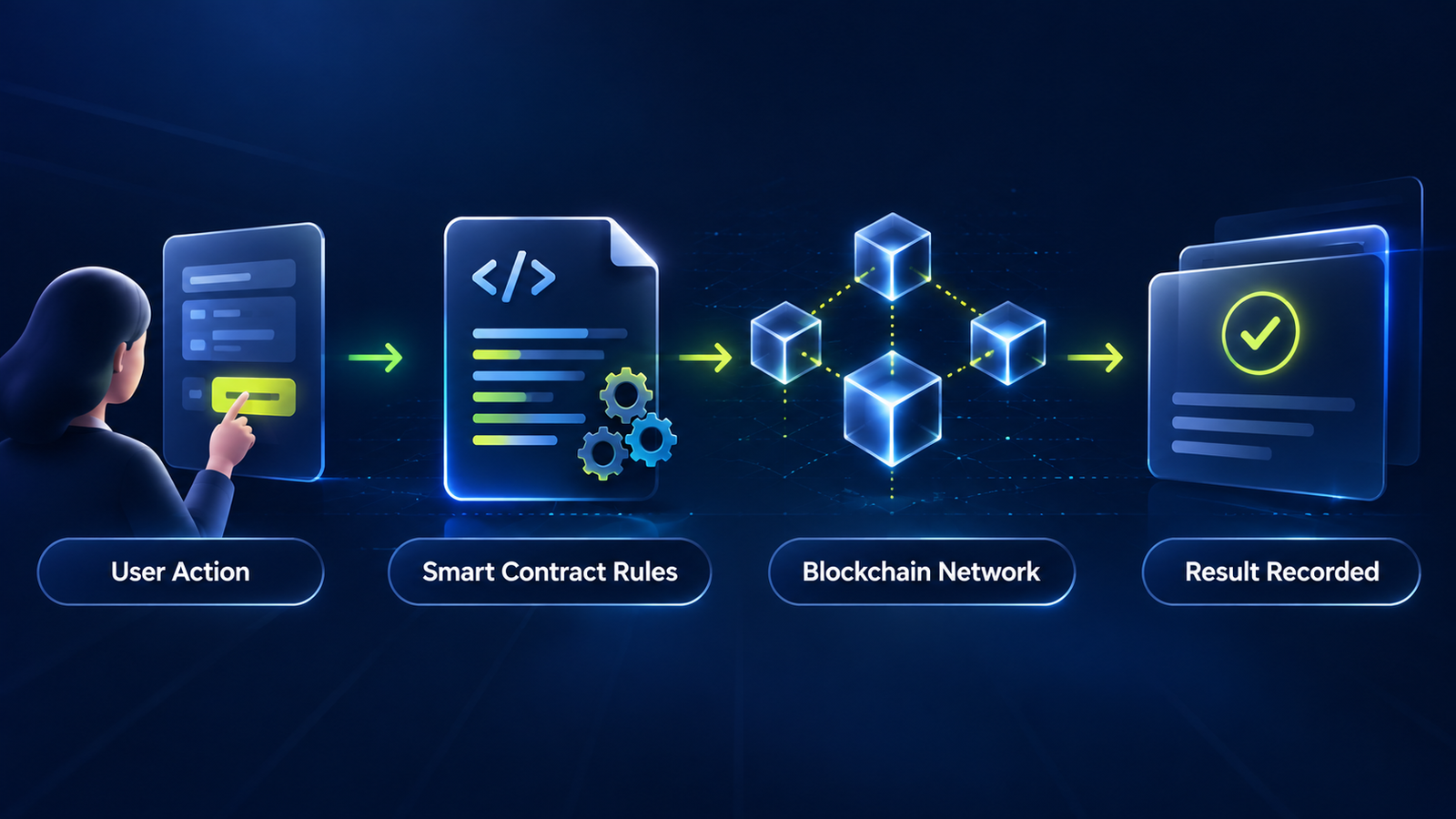
A user, app or wallet action may trigger the contract. The smart contract then checks its programmed rules and, if the conditions match, carries out the required action. Once completed, the blockchain may record the result.
Because some smart contract interactions create blockchain transactions, gas fees or other network fees may apply depending on the blockchain being used.
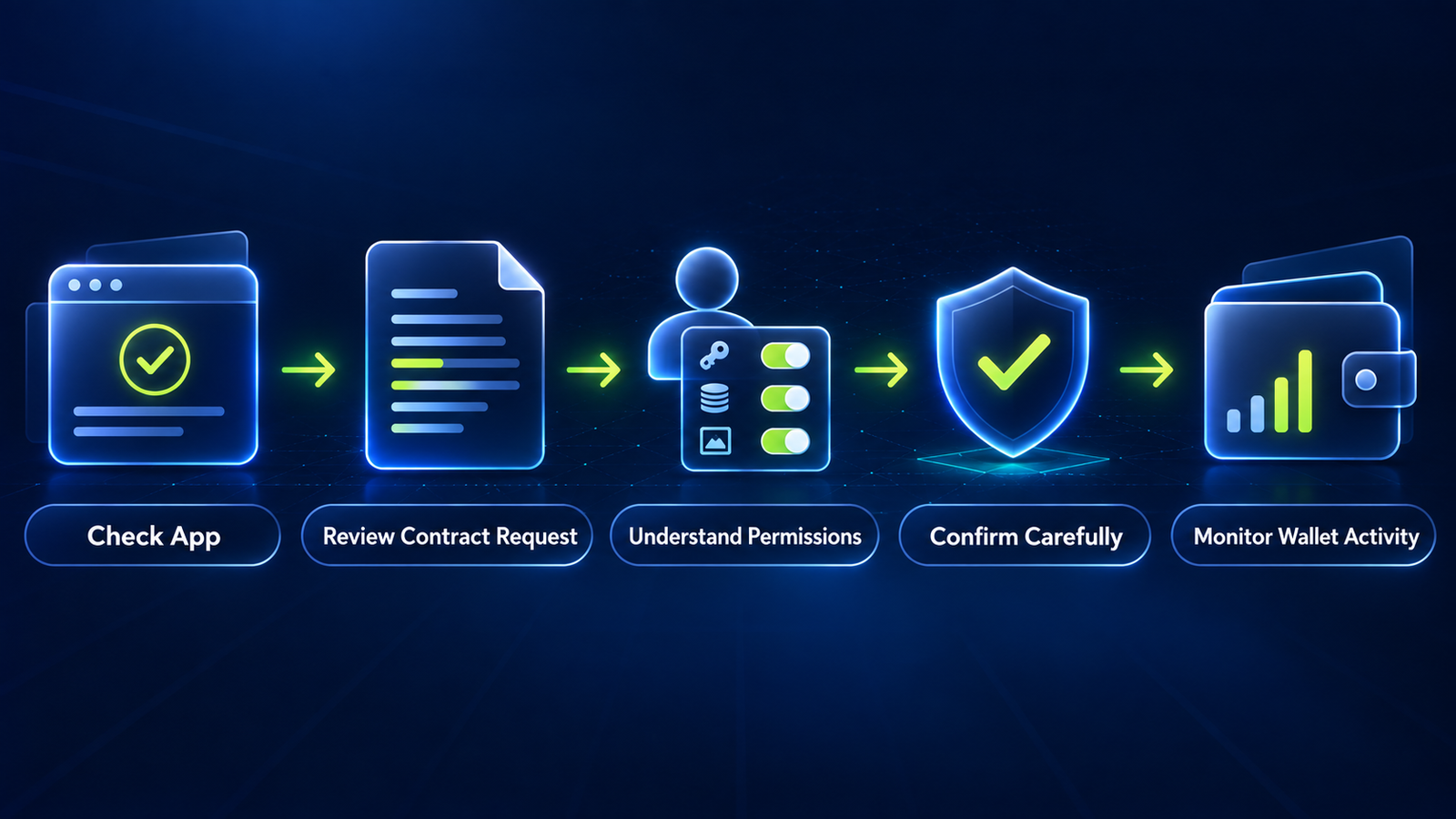
In addition, smart contracts can involve wallet approvals, token permissions, transactions and blockchain records. For this reason, beginners should slow down and review each request carefully before confirming anything inside a wallet.
Traditional Contracts vs Smart Contracts
Traditional contracts and smart contracts work very differently.
A traditional contract is usually a written agreement between people, companies or organisations. It may include terms, obligations, signatures, legal rights and enforcement through courts or other formal systems.
By contrast, a smart contract is usually code. Instead of relying on human enforcement in the same way, it follows programmed instructions and can run through a blockchain or smart contract platform.
| Feature | Traditional contract | Smart contract |
| Format | Written agreement | Code or programmed rules |
| Runs through | People, companies, lawyers, courts, or systems | Blockchain networks or smart contract platforms |
| Action | Usually needs human enforcement or system processing | Can run automatically when conditions are met |
| Flexibility | Can include judgement, context, and negotiation | Follows programmed rules |
| Main risk | Misunderstanding, breach, or legal disputes | Bugs, exploits, malicious code, or user mistakes |
| Beginner note | May need legal advice | May need technical and wallet safety awareness |
The word “contract” can be misleading for beginners. A smart contract may help automate an action, but it does not guarantee fairness, safety, legal protection, or good design.
What Are Smart Contracts Used For?
Smart contracts can support many blockchain-based tools but beginners don’t need to understand every use immediately. It helps to recognise the main categories where smart contracts commonly appear.
DeFi Tools
DeFi platforms often use smart contracts to support activities such as swaps, lending, borrowing, staking, liquidity provision and yield products.
For example, a decentralised exchange may use smart contracts to help you swap one token for another. Similarly, a lending platform may rely on smart contracts to manage deposits, loans, collateral and repayments.
Decentralised finance (DeFi) is one of the largest areas in which users encounter smart contracts, with protocols using programmed logic for activities such as swaps, lending, borrowing and liquidity management.
DeFi tools can include decentralised exchanges, lending protocols, liquidity platforms and other financial applications that use smart contracts in different ways.
Smart contract automation does not remove risk. DeFi can involve volatile assets, bugs, exploits, liquidity problems, unsafe permissions, and platform failure.
dApps
Many dApps use smart contracts behind the scenes. A user may connect a wallet, approve an action, and interact with an app that relies on blockchain-based rules.
For example, a dApp may use a smart contract to process a token swap, mint an NFT, manage a game asset, or record a governance vote.
Many decentralised applications (dApps) rely on smart contracts to process at least part of their blockchain-based logic, even when the interface looks similar to a conventional website or app.
However, not all dApps are fully decentralised. For example, some use standard websites and company-run interfaces, while smart contracts handle only part of the underlying system.
NFTs and Digital Ownership
Platforms involving NFTs and digital assets may use smart contracts for minting, transfers, ownership records, marketplace rules or other programmable actions.
For example, when someone creates or transfers an NFT, a smart contract may help record the action on a blockchain. However, beginners should still be careful. Fake collections, copied projects, unsafe mint pages, and risky approvals are common in NFT-related spaces.
DAOs and Governance
DAO tools may use smart contracts for voting, proposals, treasury rules, permissions, or community decisions.
For example, a DAO may use token-based voting or blockchain records to help coordinate group activity. Beginners do not need to use DAO tools straight away, but they are part of the wider smart contract and Web3 ecosystem.
How Do Smart Contracts Connect to Web3?
Smart contracts are one of the building blocks behind many Web3 experiences.
Web3 apps often involve wallets, tokens, digital ownership, blockchain records, and smart contract interactions. A user might connect a wallet to a dApp, approve a smart contract action, and see the result recorded through a blockchain network.
Smart contracts form one part of the wider Web3 ecosystem, alongside blockchain networks, wallets, dApps, tokens and other forms of digital ownership.
However, this doesn’t mean every Web3 tool is fully decentralised. Many Web3 projects still use normal websites, teams, apps, interfaces, and business structures. The smart contract may only handle certain actions in the background.
Do You Need a Crypto Wallet to Use Smart Contracts?
Many smart contract interactions happen through a crypto wallet.
For example, a wallet may show a transaction, message, approval or permission request. In some cases, it may simply ask you to sign a message. In others, it may ask you to approve token access, send funds, interact with a contract or confirm a blockchain transaction.
As a result, a crypto wallet can act as the interface through which users sign messages, approve permissions and submit transactions that interact with smart contracts.
However, connecting a wallet does not always mean funds are being spent. Even so, beginners should never treat wallet prompts casually. Some approvals can give a smart contract permission to interact with tokens or other assets, so you should understand exactly what you are authorising before confirming a request.
What Do You Need Before Using Smart Contracts?
Before using smart contract tools, beginners should understand the basics of blockchain, wallets, fees, approvals, and risk.
It helps to know:
- What action you are approving
- Which app or platform is asking for permission
- Which blockchain network is being used
- Whether gas fees apply
- Which wallet or token is involved
- Whether you are approving one action or broader access
- Whether the project has a real track record
- Whether the website URL is correct
- Whether the app is being promoted through pressure or hype
- How much you could afford to lose if something goes wrong
Author’s Tip
Smart contracts are easier to understand when you stop thinking of them as digital paperwork and start thinking of them as programmed rules that can act. For beginners, the important question is not only what the app says it will do, but what the wallet request actually authorises.
Before You Start Checklist
Before using or approving a smart contract interaction, make sure you can answer these questions:
- Do I understand what action I am approving?
- Do I know which app or platform is asking for permission?
- Have I checked the website URL carefully?
- Do I understand whether gas fees apply?
- Do I know which wallet or token the request involves?
- Am I approving a single action or broader access?
- Have I checked whether the project is legitimate?
- Am I avoiding links from DMs, ads, or social media comments?
- Am I starting small enough that a mistake would not cause serious financial harm?
If the answer is no to any of these, spend more time learning before approving the transaction or connecting a wallet.
Are Smart Contracts Safe?
Smart contracts can be useful, but beginners should not assume code is safe simply because it runs on a blockchain.
For example, risks can come from bugs, exploits, fake apps, malicious approvals, scam tokens, unclear permissions, unaudited code, admin control or user mistakes.
In addition, the OWASP Smart Contract Top 10 for 2026 highlights security risks including access-control vulnerabilities, business-logic flaws, price-oracle manipulation, reentrancy attacks and weaknesses involving contract upgrades.
Common Smart Contract Risks
Common risks include:
- Smart contract bugs
- Exploits
- Malicious permissions
- Fake dApps
- Wallet-draining scams
- Phishing links
- Risky tokens
- Unaudited code
- High or unexpected gas fees
- Project failure
- Admin control or upgrade risks
- User mistakes
Common crypto scams targeting smart-contract users can include copied applications, phishing websites, fake tokens, impersonated support and malicious wallet requests designed to obtain unsafe approvals.
Beginner Safety Note
Smart contracts can automate blockchain-based actions, but they can also contain bugs, unsafe permissions, risky token rules, or malicious code. Beginners should understand what a contract is asking them to approve before interacting with Web3 apps, DeFi platforms, or wallet-connected tools.
Crypto wallet safety is important when interacting with smart contracts because you may be asked to sign messages, approve token access or authorise blockchain transactions.
Private keys and seed phrases shouldn’t be entered into a smart contract interface, unfamiliar application or support message because you could lose control over your wallet.
Pros and Cons of Smart Contracts
Smart contracts can help automate blockchain-based actions, but they also introduce risks that beginners should take seriously.
| Pros | Cons |
| Can automate blockchain-based actions | Bugs or exploits can cause serious losses |
| Can support Web3 apps, DeFi tools, NFTs, and DAOs | Beginners may not understand what they are approving |
| Can reduce reliance on manual processing in some use cases | Code does not guarantee safety or fairness |
| Can make certain rules visible on a blockchain | Smart contracts can still be connected to risky platforms |
| Can run when conditions are met | Mistakes may be difficult or impossible to reverse |
A smart contract isn’t automatically good, safe, or decentralised. It depends on the code, the platform, the permissions, the team, the risks, and the way users interact with it.
Beginner Smart Contract Terms to Know
Smart contract topics can become technical quickly. These beginner meanings can help you understand the basics first.
| Term | Beginner meaning |
| Smart contract | Blockchain-based code or rules that can run when conditions are met |
| Blockchain | A shared digital record where transactions or actions can be stored |
| dApp | A decentralised app that may use smart contracts behind the scenes |
| DeFi | Blockchain-based financial tools that often use smart contracts |
| Wallet approval | A request shown in a crypto wallet before an action is confirmed |
| Gas fee | A blockchain transaction fee |
| Token approval | Permission that may allow a smart contract to interact with certain tokens |
| Exploit | When a weakness is used to attack or misuse a system |
| Audit | A review of smart contract code, often used to check for risks |
| Permission | Access a smart contract may request before performing an action |
The goal is not to become a developer immediately. The goal is to understand what a smart contract may do before using a wallet-connected tool.
How Beginners Should Start Learning Smart Contracts
The best way to learn smart contracts is to build the concept slowly.
Start with the basics:
- Learn what blockchain is.
- Understand what Web3 is.
- Learn what crypto wallets do.
- Understand dApps.
- Learn what DeFi is.
- Understand wallet approvals and gas fees.
- Learn common scam signs.
- Start small if choosing to interact with smart contract tools.
For most beginners, the first goal isn’t to code smart contracts. It’s to understand what they do, where they appear, and why wallet approvals matter.
Key Takeaways
- Smart contracts are blockchain-based rules or code that runs when certain conditions are met.
- A smart contract is not always a legal contract in the traditional sense.
- Smart contracts are often used in Web3, DeFi, dApps, NFTs, DAOs, and token systems.
- Many smart contract interactions happen through crypto wallets.
- Beginners should understand wallet approvals, permissions, gas fees, and scams before using smart contract tools.
- Smart contracts can be useful, but they can also contain bugs, risky permissions, or malicious code.
Where to Go Next
Smart contracts connect blockchain infrastructure with the applications, wallets and financial protocols people use across Web3. These guides explain the technologies surrounding smart-contract interactions and the risks worth understanding before approving one.
- What Is Blockchain?: Understand the underlying networks that process smart-contract transactions and record resulting changes.
- What Is Web3?: See how smart contracts fit alongside wallets, digital assets and blockchain-based applications within the broader Web3 ecosystem.
- What Are dApps?: Understand how user-facing applications can rely on smart contracts to process blockchain-based actions behind the interface.
- What Is DeFi?: Explore how financial protocols use smart contracts for activities such as swaps, lending, borrowing and liquidity management.
- DeFi Tools: Discover the types of financial applications where users commonly encounter smart-contract interactions in practice.
- What Is a Crypto Wallet?: Understand how wallets let users sign requests and authorise transactions that interact with smart contracts.
- What Are Gas Fees?: Learn why executing certain smart-contract actions can create blockchain transaction costs.
- Private Keys and Seed Phrases: Understand the sensitive credentials that protect wallet access when interacting with blockchain applications.
- Crypto Wallet Safety Guide: Review safer habits for checking wallet requests, permissions and transaction approvals before confirming an action.
- Common Crypto Scams to Avoid: Recognise fake applications, phishing sites, malicious approvals and impersonation tactics that can target smart-contract users.
- NFT & Digital Asset Hub: Explore another major area where smart contracts can support minting, transfers, ownership records and marketplace activity.
- Web3 & Crypto Guide: Place smart contracts within the wider relationship between blockchain technology, crypto, wallets, applications and digital assets.
Safety Checklist
✓ Check the app or platform carefully
✓ Review every wallet approval
✓ Understand what the contract may access
✓ Watch for fake apps and phishing links
✓ Check whether gas fees apply
✓ Start small when learning



Disclaimer: This guide is for general information and education only. It is not financial, investment, legal, or tax advice. Crypto and digital assets can be risky, and prices may change quickly. Always do your own research and consider speaking with a qualified professional before making financial decisions.
The Meta Directory may earn commissions from some links, but this does not influence our editorial content.

Author
Frequently Asked Questions
Smart contracts are blockchain-based programs or rules that can run when certain conditions are met.
Smart contracts aren’t always legal contracts in the traditional sense. For Example, In crypto and Web3, the term usually refers to code that runs on a blockchain.
Smart contracts work by following programmed rules. When the required conditions are met, the contract can carry out the action it was designed to perform.
Yes, many DeFi tools use smart contracts to support swaps, lending, borrowing, staking, liquidity pools, and other blockchain-based financial actions.
Yes, many dApps use smart contracts behind the scenes to manage transactions, permissions, tokens, NFTs, voting, or app logic.
Many smart contract interactions require a crypto wallet because the wallet is used to connect, approve actions, sign messages, or confirm blockchain transactions.
Smart contracts can be risky if they contain bugs, unsafe permissions, malicious code, poor security, or unclear rules. Beginners should understand what they are approving before interacting with one.
Beginners can use smart contract tools more safely if they first understand wallets, approvals, gas fees, scams, and the specific app or platform they are using.
HOW WE REVIEW & RANK
We research and compare platforms using a consistent framework: security signals, track record, product usability, feature quality, transparency of terms, and real-world usefulness.
When something changes – fees, policies, availability, or features – we update our listings and reviews.
Learn more about how we review platforms ->
STAY UPDATED
Get new crypto guides, updated rankings, and practical tips straight to your inbox — no spam, unsubscribe anytime.
NO SPAM. UNSUBSCRIBE ANYTIME.