How to Choose a Crypto Exchange Safely
Updated: September 2026
Written By
Table of Contents
- How Do You Choose a Crypto Exchange?
- 10 Things to Check Before Choosing a Crypto Exchange
- What Are the Red Flags of an Unsafe Crypto Exchange?
- Is a Regulated Crypto Exchange Safe?
- Is It Safe to Leave Crypto on an Exchange?
- Should Beginners Use a Centralised Crypto Exchange?
- Crypto Exchange Safety Checklist
- How We Evaluate Crypto Exchanges
- Key Takeaways
- Where to Go Next
- Frequently Asked Questions
QUICK FACTS
Best for:
Beginners choosing a crypto exchange
Difficulty: Beginner-friendly
Main topic:
Crypto exchange safety
Covers:
Security, custody, fees, regulation & withdrawals
You’ll learn:
How to assess an exchange before depositing funds
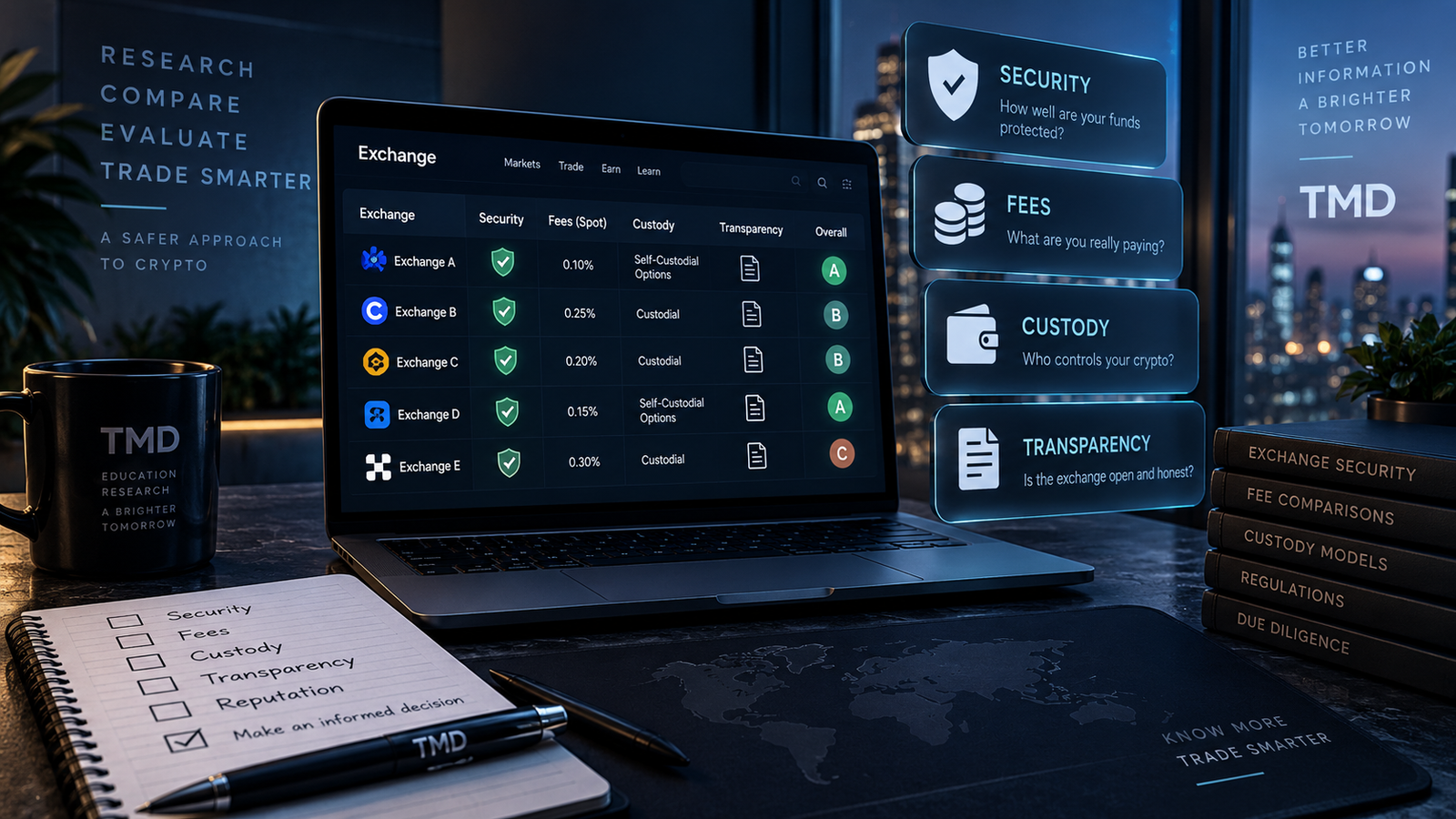
Knowing how to choose a crypto exchange isn’t simply about finding the platform with the lowest fees or the largest selection of cryptocurrencies. Security, custody, fees and platform reliability are some of the main considerations across wallets and exchanges because they affect how your assets are accessed, managed and protected.
Before depositing money or cryptocurrency, understanding how crypto exchanges work can help you identify who you’ll be trusting with your assets and what could happen if you lose account access or the platform experiences problems.
A good exchange should make important information about its services reasonably easy to find. Your job is to look beyond advertising claims and evaluate the factors that actually affect your money, access and security.
How Do You Choose a Crypto Exchange?
So how do you choose a crypto exchange? it starts by comparing its security measures, custody arrangements, regulatory status, fees, supported assets and networks, deposit and withdrawal options, liquidity and reputation. You should also confirm that the exchange serves your location and understand how account recovery works before depositing funds.
Knowing how to choose a crypto exchange, especially the right exchange, depends partly on what you need it for.
Quick Answer
Choose a crypto exchange by comparing its security, custody, regulatory status, fees, supported assets, withdrawal options and reputation. Confirm that it serves your location and understand who controls your crypto before depositing funds.
Someone who simply wants to buy Bitcoin occasionally may prioritise ease of use and straightforward deposits. An active trader might care more about liquidity, order types and trading fees, while someone planning to withdraw assets into self-custody may place greater importance on supported blockchain networks and withdrawal costs.
Instead of asking which exchange is universally “best”, ask:
Does this exchange meet my needs, and do I understand the risks of using it?
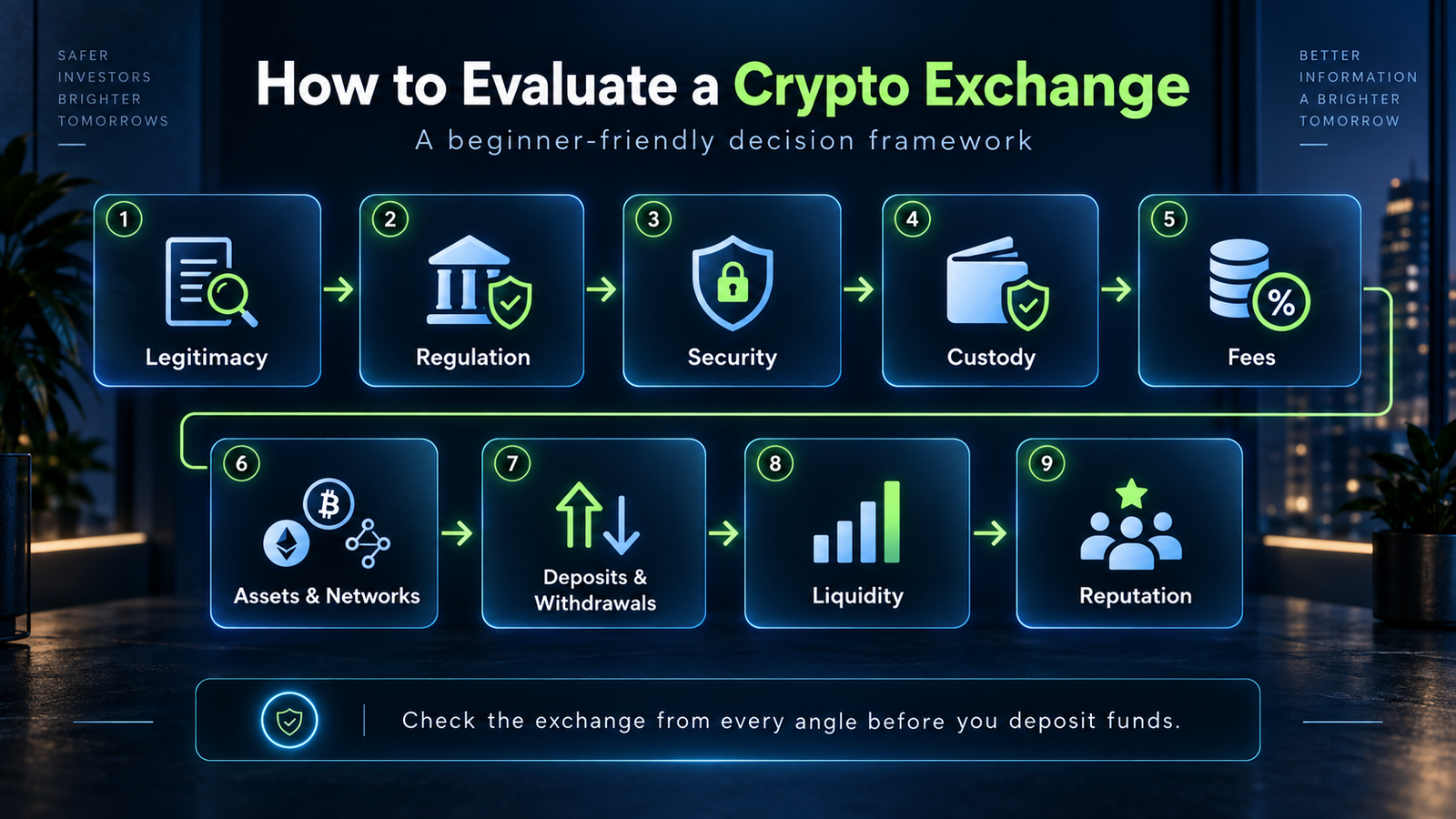
10 Things to Check Before Choosing a Crypto Exchange
A professional-looking website or popular brand name doesn’t tell you everything you need to know when choosing a cryptocurrency exchange.
Use the following criteria to evaluate a platform before depositing money.
1. Check Whether the Exchange Is Legitimate
Start by verifying the company behind the platform.
Look for clear information about the legal entity behind the exchange, where it is based and which jurisdictions it serves. Check that you’re using the exchange’s genuine website or application rather than a lookalike designed to steal login information or cryptocurrency.
Useful questions include:
- Who operates the exchange?
- Where is the company registered?
- How long has the platform operated?
- Is company and contact information available?
- Does the website clearly explain its services and terms?
- Can claims about licences or registrations be independently verified?
Be particularly careful when arriving at an exchange through social media, an advertisement, direct message or unfamiliar link.
Popularity alone isn’t proof that an exchange is safe.
A large platform can still experience security incidents, financial difficulties or operational problems.
2. Check Regulation and Where the Exchange Operates
Cryptocurrency regulations differ considerably between countries. An exchange may be registered or licensed for certain activities in one jurisdiction while operating differently elsewhere.
Check whether the exchange is authorised or registered for the services it provides in your location.
Also, to choose a safe crypto exchange, it’s best to find out which legal entity would actually provide your account. Large international exchanges sometimes operate through different companies depending on the customer’s country.
A regulated exchange can still experience:
- Cybersecurity incidents
- Financial difficulties
- Service outages
- Account-access problems
- Changes to supported services
- Custody failures
Think of regulatory information as one part of your assessment, not a guarantee that your assets can’t be lost.
International regulatory frameworks also look beyond registration alone. The Financial Stability Board’s global crypto-asset recommendations cover areas including governance, risk management, disclosures and the risks created when crypto service providers perform multiple functions.
3. Examine the Exchange’s Security Features
A safe crypto exchange should provide security measures that protect both account access and sensitive transactions.
Look for features such as:
- Multi-factor authentication
- Login and security notifications
- Device or session management
- Withdrawal confirmations
- Withdrawal address allowlisting where available
- Anti-phishing features where offered
- Clear account-recovery procedures
Strong security features are only useful if you actually enable and use them correctly.
For example, setting a unique password and enabling stronger authentication can reduce the risk of someone accessing your account using stolen login credentials.
The strength of authentication methods can also vary. NIST’s authentication guidance distinguishes phishing-resistant cryptographic authentication from methods that require users to manually enter one-time codes, which can still be vulnerable to phishing.
You also remain responsible for recognising suspicious websites, protecting your devices and avoiding fraudulent requests. Strong crypto wallet security also includes protecting your devices, recognising suspicious websites and avoiding fraudulent requests that could expose an exchange account or personal wallet.
4. Understand Who Controls the Crypto
When you leave cryptocurrency in a typical centralised exchange account, you generally don’t directly control the private keys associated with those assets. The exchange or its custody arrangements manage them on your behalf.
This can make using cryptocurrency easier because you don’t personally need to manage private keys or recovery phrases.
It also means you rely on the provider.
If the platform freezes withdrawals, restricts your account, experiences a security incident or becomes insolvent, accessing assets could be affected.
Self-custody works differently.
The difference between custodial and non-custodial wallets determines whether a provider controls the keys on your behalf or you manage them yourself.
Neither approach removes responsibility entirely. It changes which risks you are responsible for managing.
5. Research How Customer Assets Are Held
Knowing that an exchange “uses cold storage” isn’t enough to understand its entire custody model.
Look for information about how the platform says it protects customer assets, including whether it:
- holds assets directly
- Uses third-party custodians
- Separates certain customer assets from company assets
- Keeps some private keys in offline environments
- Maintains insurance or other protections
- Publishes information about its reserves
Be careful with broad marketing claims.
For example, an exchange might advertise insurance without making it immediately obvious what is insured, under which circumstances and whether individual customer losses would actually be covered.
What About Proof of Reserves?
Some crypto exchanges publish proof-of-reserves information intended to demonstrate that certain customer assets are backed by assets held by the platform.
This can provide useful transparency, but proof of reserves shouldn’t be treated as complete proof of an exchange’s financial health or safety.
Depending on the methodology, a reserve report may not provide a complete picture of liabilities, corporate obligations, operational risks or how assets are controlled.
Treat proof of reserves as another piece of information to investigate rather than a substitute for broader due diligence.
6. Compare the Real Fees
Don’t choose an exchange based solely on its advertised trading fee.
The real cost of using a crypto exchange can include several different charges.
| Cost | What to Check |
|---|---|
| Trading fee | What you’re charged when buying or selling |
| Spread | Difference between quoted buying and selling prices |
| Deposit fee | Cost of adding fiat or cryptocurrency |
| Withdrawal fee | Cost of withdrawing money or crypto |
| Network fee | Blockchain-related cost associated with transfers |
| Currency conversion | Cost of converting between fiat currencies |
Blockchain transaction costs can vary by network. On networks such as Ethereum, these transaction charges are commonly known as gas fees and can affect the cost of moving crypto away from an exchange.
The storage used depends on the wallet, your circumstances and the level of risk involved. Some platforms use simple buy-and-sell interfaces where the total cost may not be represented by one obvious trading fee.
Others use maker/taker pricing, subscription tiers or volume-based discounts.
Before depositing, check the fee schedule for the actions you actually expect to perform.
A platform with low trading fees could still be expensive for you if withdrawing your preferred cryptocurrency carries a high charge.
7. Check Supported Cryptocurrencies and Networks
A large number of listed cryptocurrencies doesn’t automatically make an exchange more suitable.
What matters is whether it supports the assets and blockchain networks you actually intend to use.
For example, check:
- Whether your chosen cryptocurrency can be bought and sold
- Whether crypto deposits are supported
- Whether withdrawals are available
- Which blockchain networks can be used
- Whether particular services are restricted in your location
This becomes particularly important for assets that exist across multiple blockchain networks.
Seeing an asset listed for trading doesn’t necessarily mean every possible network is supported for deposits and withdrawals.
Before transferring crypto, confirm that the asset, network and receiving address are compatible.
8. Check Deposit and Withdrawal Options
The exchange shouldn’t only be evaluated by how easily you can put money in, but also by getting money or cryptocurrency out.
Check available deposit methods, which might include:
- Bank transfers
- Payment cards
- Supported payment services
- Cryptocurrency deposits
Then investigate withdrawals separately.
Look at:
- Fiat withdrawal methods
- Crypto withdrawal support
- Minimum and maximum amounts
- Withdrawal fees
- Supported networks
- Identity-verification requirements
- Security holds
- Expected processing times
Restrictions can vary according to payment method, location and account status.
This is information worth understanding before you deposit rather than discovering when you’re trying to withdraw.
Author’s Tip
I always check an exchange’s withdrawal process as carefully as its deposit process and test a smaller amount first so I understand the fees, network options and verification steps.
9. Consider Liquidity and Your Trading Needs
Liquidity refers to how easily an asset can be bought or sold without the transaction causing a substantial change in market price.
For a beginner making occasional small purchases of a highly traded cryptocurrency, detailed liquidity analysis may not be the most important factor.
For larger transactions or active trading, it becomes more significant.
An exchange with deeper trading activity in a particular market may be better able to execute larger orders close to the expected market price, although market conditions can change quickly.
Also consider whether you actually need advanced trading features.
A platform packed with derivatives, leverage, complicated order types and professional charting tools isn’t automatically better for someone who simply wants to buy and hold cryptocurrency.
More features don’t necessarily mean a better fit.
10. Research Reputation and Customer Support
An exchange’s reputation can reveal useful patterns, but online reviews need to be read and understood carefully.
Almost every large financial platform will have negative reviews.
Instead of focusing only on an average star rating, look for repeated complaints or documented issues involving:
- Withdrawals
- Account freezes
- Security incidents
- Unexpected fees
- Identity verification
- Customer support
- Access to funds
Then check whether the complaints are have credible evidence and how the company responded.
Customer support is also worth considering before you need it.
Check what support channels exist, whether help documentation is available and how the platform handles account-recovery or security incidents.
Avoid trusting “support agents” who contact you unexpectedly through social media or private messages.
What Are the Red Flags of an Unsafe Crypto Exchange?
Potential crypto exchange warning signs include unclear company information, unverifiable regulatory claims, guaranteed returns, pressure to deposit quickly, suspicious withdrawal requirements and requests for private keys and seed phrases. That is a particularly serious warning sign because these credentials can provide control over self-custody wallet access and shouldn’t be handed to an exchange or unsolicited support contact.
One warning sign doesn’t automatically prove that a platform is fraudulent, but multiple unexplained issues should make you cautious.
Look out for:
- No clear company identity
- Regulatory claims that cannot be independently verified
- Unrealistic or guaranteed investment returns
- Pressure to deposit immediately
- Unexpected direct messages from “support”
- Requests for private keys or seed phrases
- Requests to deposit additional crypto before withdrawals can be released
- Unclear or hidden fee information
- Suspicious or misspelled website addresses
- Fake celebrity endorsements
- Unexplained restrictions on withdrawals
- Little information about custody or security
Beginner Safety Note
Never give an exchange, support agent or unsolicited contact your private key or seed phrase. Be especially cautious if you are asked to send additional crypto or pay a fee to unlock a withdrawal.
Be particularly suspicious if someone introduces you to an exchange through social media, a messaging app or an unsolicited investment opportunity and then pressures you to transfer cryptocurrency.
Common crypto scams involving exchanges can include phishing, impersonated support, fake investment platforms, guaranteed-return claims and fraudulent demands for additional payments before withdrawals are released.
Is a Regulated Crypto Exchange Safe?
Regulation can provide more information and may impose requirements on an exchange, but regulatory status does not guarantee that a platform cannot fail, suffer a security breach or experience financial problems.
The meaning of “regulated” also depends on the jurisdiction and the particular service being offered.
An exchange might hold one type of registration without being authorised for every financial activity a customer assumes it performs.
Before relying on a regulatory claim:
- Identify the company operating your account
- Determine which regulator or authority supposedly oversees it
- Verify the registration using the regulator’s official records where possible
- Understand which services that registration actually covers.
Don’t rely solely on a regulatory logo displayed on the exchange’s own website.
Is It Safe to Leave Crypto on an Exchange?
Keeping cryptocurrency on a reputable exchange can be convenient, but it introduces custodial risk because you rely on the provider to safeguard assets and maintain access to them.
Exchange custody can be useful for people who:
- Trade regularly
- Want straightforward access to buying and selling
- Don’t want to manage private keys themselves
- Need fiat deposit or withdrawal services
Self-custody gives the user greater direct control through a crypto wallet, but it introduces different responsibilities.
If you lose the recovery credentials for a traditional self-custody wallet, there may be no company capable of resetting access for you.
The decision therefore isn’t simply:
Exchange = unsafe
Self-custody = safe
A better comparison is:
Which risks does each approach introduce, and which am I prepared to manage?
Some users combine both approaches, keeping assets needed for trading on an exchange while using self-custody for other purposes.
Should Beginners Use a Centralised Crypto Exchange?
When decided how to choose a crypto exchange it’s important to know that a centralised crypto exchange can provide a relatively simple way for beginners to buy and sell cryptocurrency, particularly when it supports familiar payment methods and account recovery. However, beginners should still understand custody, fees and security before depositing funds.
Potential advantages include:
- Familiar username-and-password accounts
- Fiat payment methods
- Simplified buying and selling
- Customer support
- Account-recovery processes.
Potential disadvantages include:
- Reliance on the exchange to protect assets
- Account or withdrawal restrictions
- Platform-specific fees
- Limited control over private keys
- Exposure if the provider experiences financial or security problems
A beginner-friendly interface should not be confused with low risk.
You still need to understand what you’re buying, what you’re paying and who controls the assets after the purchase.
Crypto Exchange Safety Checklist
Before depositing money or cryptocurrency:
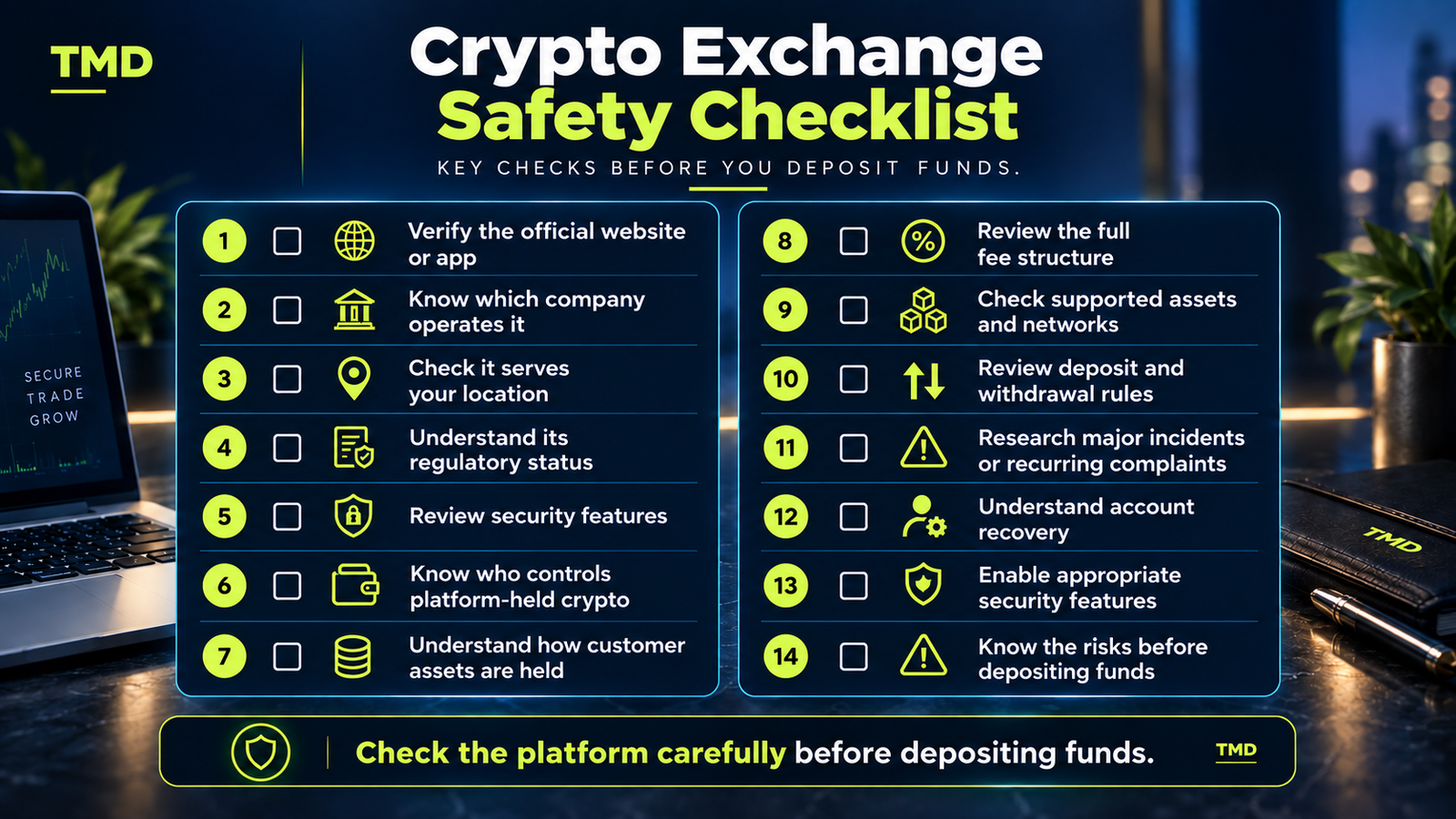
You don’t need an exchange to be perfect. You need enough reliable information to understand what you’re trusting it to do and what could go wrong.
How We Evaluate Crypto Exchanges
When The Meta Directory tests and researches a cryptocurrency exchange, we look beyond headline fees, promotional offers and the number of cryptocurrencies advertised to give you the most beneficial information and show you how to choose a crypto exchange yourself.
Our assessment considers factors such as:
- Security: Account protections and available security features.
- Custody: How customer assets are managed and who controls the keys.
- Transparency: Availability and clarity of important company information.
- Regulatory information: Where the exchange operates and what registrations or licences apply.
- Fees: Trading costs, spreads, deposits, withdrawals and other relevant charges.
- Assets and networks: Which cryptocurrencies and blockchain networks are supported.
- Deposits and withdrawals: Available methods, restrictions, limits and costs.
- Usability: How practical the platform is for its intended users.
- Customer support: Available support and account-recovery options.
- Track record: Relevant security incidents, operational issues and significant recurring concerns.
The importance of each factor can vary depending on the exchange and the type of user it serves.
TMD’s How We Review methodology sets out the framework used to research and assess platforms, including security signals, usability, transparency, features and real-world usefulness.
Once you understand the criteria that matters, comparing reputable crypto exchanges using the same framework can help you narrow down platforms and understand how to choose a crypto exchange that suits your needs.
Key Takeaways
- Don’t choose a cryptocurrency exchange based solely on popularity, low fees or the number of listed coins.
- Verify the company operating the exchange and investigate its regulatory status where relevant.
- Review account security features before depositing funds.
- Understand who controls cryptocurrency held through the platform.
- Look beyond advertised trading fees and calculate the costs relevant to how you’ll actually use the exchange.
- Confirm that your required cryptocurrencies, blockchain networks and withdrawal methods are supported.
- Research significant security incidents and recurring customer complaints rather than relying solely on star ratings.
- Treat proof of reserves and regulatory registration as useful information, not guarantees of safety.
- Understand how you would withdraw your assets and recover your account before you need to.
- Be suspicious of unsolicited support, guaranteed returns and demands for additional payments to unlock withdrawals.
Exchange evaluation forms part of the wider research covered across TMD’s crypto guides, including wallets, custody, security and blockchain transactions. The broader Web3 and crypto ecosystem also includes the networks, applications and digital assets that exchanges can provide access to.
Where to Go Next
Choosing an exchange involves more than comparing platforms. Understanding custody, wallet access, network compatibility and common security risks can make the differences between exchanges much easier to assess.
- Wallets & Exchanges: Browse TMD’s wider coverage of the services used to buy, hold, transfer and manage cryptocurrency.
- Crypto Guides: Strengthen the core crypto knowledge that can help you assess exchange features, terminology and potential risks more confidently.
- What Is a Crypto Exchange?: See what happens behind an exchange account, from buying and selling crypto to custody, fees and withdrawals.
- Crypto Wallet Safety Guide: Understand the security habits that matter when protecting exchange logins, devices, transfers and personal wallets.
- Custodial vs Non-Custodial Wallets: See how leaving assets with a provider differs from withdrawing them into a wallet whose keys you control.
- Private Keys and Seed Phrases: Understand what changes when you move from exchange-managed custody to managing wallet access and recovery yourself.
- What Is a Crypto Wallet?: Learn what a personal wallet actually does before deciding whether assets should remain on an exchange or be withdrawn.
- Common Crypto Scams to Avoid: Identify fake exchanges, impersonated support, withdrawal scams and other tactics that can make an unsafe platform appear legitimate.
- What Is Blockchain?: Understand the underlying networks you need to check when comparing an exchange’s supported deposits and withdrawals.
- Web3 & Crypto Guide: See where exchanges fit within the wider ecosystem of cryptocurrencies, blockchain networks, wallets and digital-asset services.
Safety Checklist
✓ Verify the exchange is legitimate
✓ Check security features
✓ Understand who holds your crypto
✓ Compare fees and withdrawals
✓ Check supported networks
✓ Watch for scam warning signs
Related Guides
- What Are Smart Contracts? A Beginner’s Guide to Blockchain-Based Agreements
- What Are dApps? A Beginner’s Guide to Decentralised Apps
- What Is DeFi? A Beginner’s Guide to Decentralised Finance
- What Are Gas Fees? A Beginner’s Guide to Crypto Transaction Costs
- Common Crypto Scams to Avoid: How to Spot the Warning Signs
Disclaimer: This guide is for general information and education only. It is not financial, investment, legal, or tax advice. Crypto and digital assets can be risky, and prices may change quickly. Always do your own research and consider speaking with a qualified professional before making financial decisions.
The Meta Directory may earn commissions from some links, but this does not influence our editorial content.

Author
Frequently Asked Questions
Knowing how to choose a crypto exchange requires a good look at security, custody, regulatory status, fees, supported cryptocurrencies and networks, deposit and withdrawal options, liquidity, reputation and customer support.
The importance of each factor depends on how you intend to use the platform. A beginner buying cryptocurrency occasionally may have different requirements from an active trader or someone who regularly withdraws assets to self-custody.
Start by identifying the company operating the exchange, verifying its official website and checking regulatory claims independently where applicable.
You can also research its operating history, security record, terms, custody information and recurring customer complaints.
Be cautious of platforms introduced through unsolicited messages, guaranteed-return schemes or pressure to deposit quickly.
There is no type of crypto exchange that can be considered universally safest. Security depends on the individual platform, its custody and security arrangements, how it is operated and how the customer protects their own account.
Centralised exchanges introduce custodial risk, while decentralised alternatives can introduce different smart-contract, wallet and user-responsibility risks.
To find out which crypto exchange to use, research the actual platform.
Keeping crypto on an exchange can be convenient for trading and account recovery, but it means relying on a custodian to protect assets and maintain access.
Some users choose to keep assets needed for trading on an exchange while moving other holdings into self-custody.
Whether a crypto exchange requires registration, licensing or other regulatory authorisation depends on the country, the company and the services being offered.
An exchange operating legally in one jurisdiction may not necessarily be authorised to provide the same services somewhere else.
Check the rules and official regulatory records relevant to your location.
HOW WE REVIEW & RANK
We research and compare platforms using a consistent framework: security signals, track record, product usability, feature quality, transparency of terms, and real-world usefulness.
When something changes – fees, policies, availability, or features – we update our listings and reviews.
Learn more about how we review platforms ->
STAY UPDATED
Get new crypto guides, updated rankings, and practical tips straight to your inbox — no spam, unsubscribe anytime.
NO SPAM. UNSUBSCRIBE ANYTIME.