Crypto Wallet Safety Guide: How to Protect Your Crypto
Updated: September 2026
Written By
Table of Contents
- How Do You Keep a Crypto Wallet Safe?
- Understand What You’re Actually Protecting
- Protect Your Seed Phrase and Private Keys
- Secure the Devices and Accounts Connected to Your Wallet
- Check Every Crypto Transaction Before You Approve It
- Protect Yourself From Phishing and Fake Wallets
- Does a Hardware Wallet Make Crypto Safer?
- Is a Hot Crypto Wallet Safe?
- How Should You Protect Crypto Held on an Exchange?
- What Should You Do Before Connecting a Wallet to a dApp?
- Should You Keep All Your Crypto in One Wallet?
- Crypto Wallet Safety Checklist
- What Should You Do if Your Crypto Wallet Is Compromised?
- Key Takeaways
- Where To Go Next
- Frequently Asked Questions
QUICK FACTS
Best for:
Beginners & crypto users
Difficulty: Beginner-friendly
Main topic:
Crypto wallet safety
Covers:
Private keys, seed phrases, transactions, phishing, wallet security
You’ll learn:
How to protect your wallet, secure recovery details and avoid common threats

Crypto wallet safety isn’t only about choosing a secure wallet. Protecting your cryptocurrency also depends on how you manage private keys and recovery credentials, secure your devices and accounts, verify transactions and recognise scams before interacting with them.
Security is one of the most important considerations across wallets and exchanges because the risks can change depending on who controls access and how assets are managed.
Whether you use a custodial account or manage your own keys, understanding how crypto wallets work can help you recognise what needs protecting and where the biggest risks may occur.
The exact security measures you need will depend on the wallet, network and services you use, but the basic principle remains the same: protect access, verify before acting and never approve something you don’t understand.
How Do You Keep a Crypto Wallet Safe?
Keeping a crypto wallet safe involves protecting private keys and recovery credentials, securing the devices and accounts used to access it, verifying addresses and transactions before approval, and avoiding suspicious links, applications and requests.
The precautions you need also depend on whether you use custodial or non-custodial wallets, because the responsibility for protecting key access changes between the two models.
A strong wallet-security routine should include:
- Protecting private keys and recovery credentials
- Using legitimate wallet software from verified sources
- Securing devices and accounts with strong authentication
- Checking wallet addresses and blockchain networks before sending crypto
- Understanding transactions and permissions before approving them
- Recognising phishing attempts, fake applications and impersonation scams
- Maintaining a secure recovery plan
- Knowing what to do if you suspect a wallet has been compromised.
No single security measure makes a crypto wallet completely safe.
Instead, wallet security works in layers. If one layer fails, for example, you accidentally click a phishing link, other precautions may help prevent that mistake from becoming a loss of funds.
Understand What You’re Actually Protecting
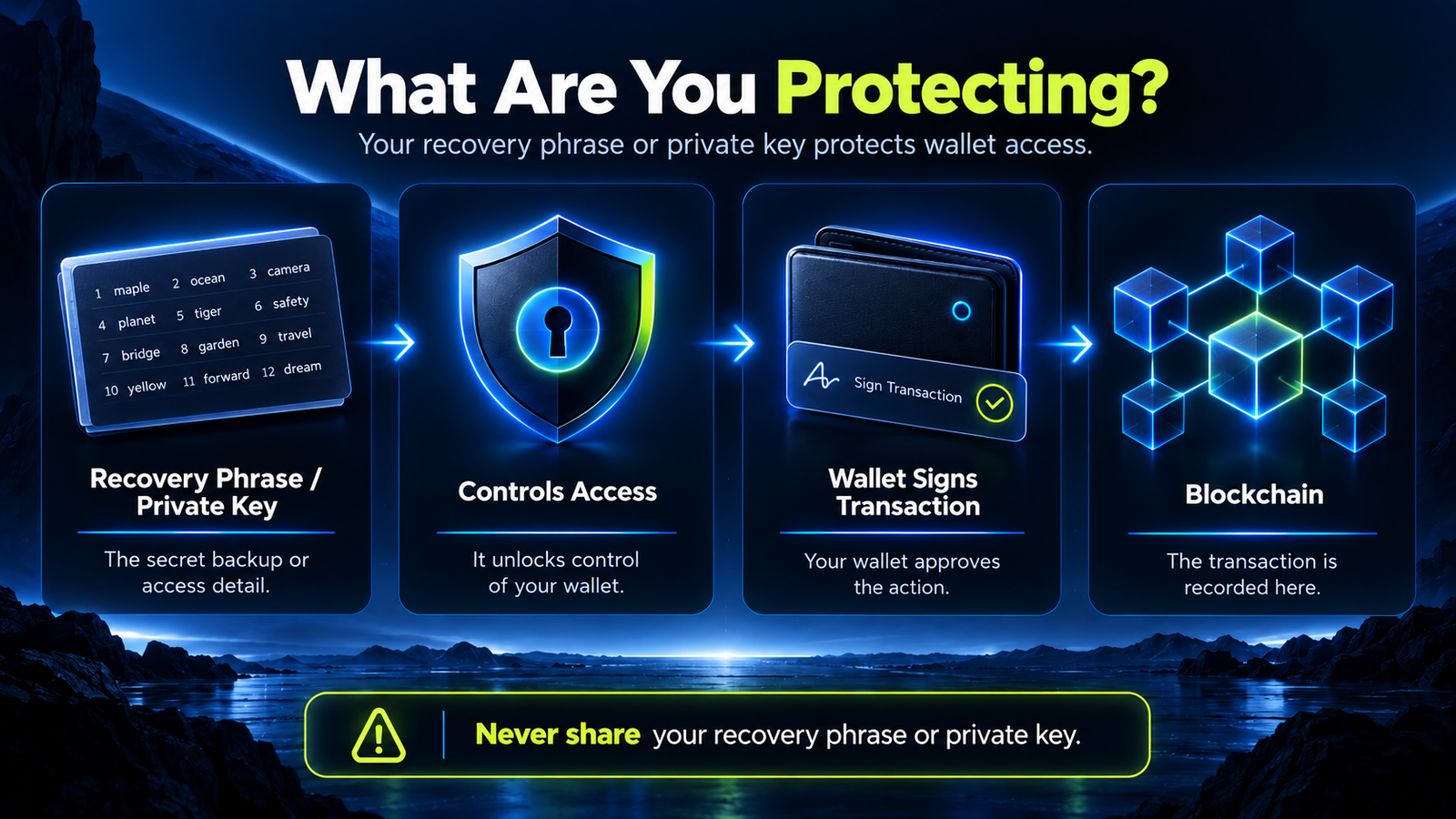
Before thinking about passwords, hardware wallets or two-factor authentication, before delving into crypto wallet safety, it helps to understand what a crypto wallet actually protects.
Your Crypto Isn’t Literally Stored Inside the Wallet.
Despite the name, a crypto wallet doesn’t hold cryptocurrency in quite the same way a physical wallet holds cash.
Cryptocurrency exists as records on a blockchain. Your wallet provides an interface for interacting with those records and managing the credentials needed to authorise activity associated with your blockchain accounts.
That distinction matters for security.
Losing a phone containing a wallet application, for example, doesn’t necessarily mean the cryptocurrency itself has disappeared. Whether access can be restored depends on the wallet’s design and the recovery method available.
Private Keys Control Access
A private key is cryptographic information used to authorise transactions associated with a blockchain account.
If someone has the private key controlling an account, they may be able to authorise transactions from it. This is why private keys must remain private.
With a custodial service, the provider generally manages the underlying keys. With a traditional self-custody wallet, that responsibility belongs to the user.
Recovery Phrases Can Restore Control
Many self-custody wallets provide a recovery phrase, also known as a seed phrase or secret recovery phrase. It can be used to recover the accounts associated with the wallet, making it one of the most sensitive pieces of information a self-custody user may possess. Ethereum’s security guidance warns that anyone who obtains a recovery phrase can access its associated accounts and assets.
Private keys and seed phrases play different but closely connected roles in wallet access and recovery, which makes understanding both particularly important before moving meaningful amounts of cryptocurrency into self-custody.
Protect Your Seed Phrase and Private Keys
For traditional self-custody crypto wallet safety, it’s about protecting private keys and recovery credentials is one of the most important parts of wallet security.
If those credentials are exposed, changing your wallet application’s password may not solve the problem. Someone who has the information necessary to control the underlying accounts may still be able to access them.
Never Share Your Recovery Credentials
Never give your private key or recovery phrase to someone just because they claim to be support staff, a wallet provider, an exchange representative or a blockchain expert.
Legitimate wallet providers and support teams should never require your private key or recovery phrase to verify, activate or troubleshoot a wallet.
Be particularly suspicious of anyone who contacts you unexpectedly and claims:
- There is a problem with your wallet
- Your account needs to be verified
- Your wallet needs to be “synchronised” or “validated”
- You need to provide a seed phrase to receive an airdrop
- They can recover stolen cryptocurrency
- You need to enter recovery credentials into a website they provide.
Possession of your recovery credentials can be far more consequential than someone simply learning your wallet address.
Store Recovery Information Securely
A recovery backup is a fundamental need when it comes to crypto wallet safety, and should be protected against both unauthorised access and accidental loss.
Writing a recovery phrase down and keeping it securely offline can reduce exposure to online attacks, but physical storage introduces its own risks, including theft, fire, water damage or simply forgetting where the backup was stored.
The right backup strategy therefore depends on your circumstances and the wallet you use.
Whatever method you choose, consider whether:
- Another person could easily find or photograph it
- The backup could be destroyed with your device
- You would still be able to recover it years later
- Somebody you trust would know what to do if you became unable to access it
- Your storage method introduces additional digital exposure.
There is no universal storage method that eliminates every risk.
Be Careful With Digital Copies
Screenshots, unencrypted notes, emails and cloud documents can create additional ways for sensitive wallet information to be exposed.
A screenshot stored on a phone, for example, may automatically synchronise to cloud storage, creating another location where recovery information could be compromised.
Treat recovery credentials differently from ordinary passwords.
Have a Recovery Plan Before You Need One
Don’t wait until a device breaks to discover how your wallet recovery process works.
Before storing substantial value in a self-custody wallet, understand:
- What information is required for recovery
- Where that information is stored
- Whether your backup actually corresponds to the wallet you are using
- What would happen if your phone, computer or hardware device disappeared.
Depending on the wallet architecture, losing both access and the only valid recovery credentials can make recovery impossible.
Author’s Tip
For crypto wallet safety, I recommend treating wallet recovery as something to prepare for, not something to figure out during an emergency. Know how your particular wallet works before it contains an amount you would be seriously concerned about losing.
Secure the Devices and Accounts Connected to Your Wallet
Strong key management can still be undermined by an insecure phone, computer, browser or exchange account.
Your wider digital-security habits are therefore part of crypto wallet safety.
Use Strong, Unique Authentication
For accounts that use passwords, create a strong, unique password rather than reusing one from another service.
Where supported, enable multi-factor authentication (MFA or 2FA). This adds another authentication requirement so that possession of a password alone may not be enough to access an account.
Multi-factor authentication can provide an additional layer of account protection, although the strength of different authentication methods varies. NIST’s authentication guidance notes that some MFA methods provide stronger phishing resistance than manually entered one-time codes.
Authenticator applications and physical security keys can provide stronger protection than relying solely on a password. SMS-based authentication can carry additional risks, including SIM-swapping attacks.
Remember, however, that account authentication and wallet recovery are different things.
Two-factor authentication on an exchange account can help protect that account. It cannot protect a self-custody wallet if someone has obtained the private key or recovery credentials controlling it.
Keep Devices and Software Updated
To ensure you keep your crypto wallet safe, Install security updates for your operating system, browser and wallet software from legitimate sources.
Updates can contain fixes for security vulnerabilities as well as functional improvements.
Be equally cautious about unnecessary software and browser extensions. Software with extensive device or browser permissions can increase your attack surface.
Download Wallet Software From Verified Sources
Fake wallet applications and browser extensions can imitate legitimate products.
Rather than following an unsolicited social-media link or advertisement, verify the wallet provider’s official source before downloading software.
Check details carefully. A convincing logo and professional-looking website are not proof that an application is legitimate.
Check Every Crypto Transaction Before You Approve It
Blockchain transactions can carry consequences that are difficult or impossible to reverse.
A good crypto wallet safety security routine therefore includes checking what you’re doing before pressing approve or confirm.
Verify the Wallet Address
Before sending cryptocurrency, carefully check the recipient’s wallet address.
Don’t assume that an address is correct simply because you copied and pasted it. Malware and other attacks can attempt to manipulate copied addresses, while human error can result in funds being sent to the wrong destination.
For important transfers, compare multiple parts of the address rather than relying only on the first or last few characters.
Where appropriate, sending a small test transaction before transferring a much larger amount can provide an additional opportunity to catch an error.
Check the Blockchain Network
Different blockchain networks can support the same or similar cryptocurrencies and tokens, but exchanges and wallets do not necessarily support every network in the same way.
Before transferring assets, confirm that:
the sending platform supports the network → the receiving wallet supports it → the address is appropriate → you understand the fees
Choosing an incorrect or unsupported network can create serious recovery problems.
Understand What You’re Signing
Wallets aren’t used only for sending cryptocurrency.
In Web3, you may also be asked to sign messages, connect to applications or approve smart-contract interactions.
Do not treat every wallet pop-up as a routine confirmation.
Read the information your wallet provides and understand what the request is intended to do before approving it.
Review Smart-Contract and Token Approvals
Some decentralised applications require permission to interact with tokens in your wallet.
These permissions can be legitimate, but approving unnecessary or malicious access can create security risks. Understanding how smart contracts interact with wallets also makes it easier to see why token approvals and permissions should be reviewed carefully.
Periodically reviewing permissions and revoking approvals you no longer need can reduce unnecessary exposure.
Ethereum’s token-approval guidance explains that disconnecting a wallet from an application does not necessarily remove permissions that were previously granted to a smart contract, which is why unwanted token approvals may need to be revoked separately.
This becomes particularly important when using DeFi protocols and other decentralised applications.
Protect Yourself From Phishing and Fake Wallets
Phishing remains one of the most important threats in crypto wallet safety for crypto users because attackers don’t necessarily need to break the blockchain or crack cryptography. They can instead try to convince you to give them access.
Fake websites can imitate wallet providers, exchanges and decentralised applications. A malicious site might ask for a recovery phrase, encourage you to connect a wallet or persuade you to approve a dangerous transaction.
Be cautious of:
- Unsolicited support messages
- Urgent security warnings
- Fake wallet websites
- Lookalike domain names
- Fake browser extensions and applications
- Unexpected airdrops or giveaways
- Social-media impersonators
- Links sent through direct messages
- Requests for recovery phrases or private keys
- Promises to recover stolen cryptocurrency for an upfront payment.
Common crypto scams targeting wallet users include phishing sites, fake applications, impersonated support accounts, malicious links and fraudulent recovery services.
A useful wallet-safety habit is to bookmark legitimate sites you use frequently rather than repeatedly finding them through advertisements, social-media posts or unfamiliar search results.
Does a Hardware Wallet Make Crypto Safer?
A hardware wallet can reduce certain security risks by keeping private keys isolated from ordinary internet-connected devices, but it does not make cryptocurrency completely safe.
A hardware device can make it harder for malware on a computer or phone to directly obtain a private key. Hardware wallets are therefore commonly used for self-custody and longer-term storage.
However, a hardware wallet cannot automatically protect you from every mistake.
You can still be exposed if you:
- Reveal your recovery phrase
- Approve a malicious transaction
- Interact with a phishing site
- Fail to verify information displayed during a transaction
- Use a compromised or tampered-with device
- Lose both your device and the information required for recovery.
Hardware wallets also introduce their own operational and supply-chain risks, which is another reason not to describe any wallet type as completely secure.
The key lesson is simple:
A hardware wallet is a security tool, not a substitute for safe behaviour.
Is a Hot Crypto Wallet Safe?
A hot wallet can be used safely, but because it operates on an internet-connected device or environment, it has a different risk profile from cold storage.
Hot wallets can be convenient for regular transactions and Web3 activity. That convenience also means they may have greater exposure to phishing, malicious software and unsafe applications.
Cold storage aims to keep private keys away from internet-connected environments, which can reduce some forms of online exposure.
However, “hot,” “cold,” “custodial” and “non-custodial” don’t describe exactly the same thing.
Hot and cold generally describe how keys are stored or connected, while custodial and non-custodial describe who controls those keys.
The appropriate setup depends on what you’re storing, how frequently you need access and which risks you are equipped to manage.
How Should You Protect Crypto Held on an Exchange?
Protecting crypto held through an exchange requires securing your account while also assessing the security and reliability of the company holding assets on your behalf.
This is different from self-custody.
With a centralised crypto exchange, the platform generally controls the underlying private keys while you access your account using the provider’s authentication system. That makes strong account security particularly important.
Consider:
- Using a strong, unique password
- Enabling strong multi-factor authentication
- Checking available withdrawal-security features
- Monitoring account activity
- Treating unexpected support messages with suspicion
- Verifying that you’re using the legitimate exchange website or application
- Understanding the provider’s custody and account-recovery arrangements.
You should also consider the organisation itself. Choosing a crypto exchange safely involves assessing security alongside custody arrangements, regulatory status, fees, supported assets and withdrawal policies before depositing funds.
Using an exchange removes some of the key-management burden of self-custody, but it introduces reliance on the custodian. The two models therefore involve different risks rather than one being automatically safe and the other unsafe.
What Should You Do Before Connecting a Wallet to a dApp?
Connecting a wallet to decentralised applications (dApps) can allow you to interact directly with blockchain-based services, but you should verify the application and understand what you are approving before proceeding.
Before connecting:
- Verify the website. Check that you’re using the legitimate domain rather than a lookalike.
- Understand the application. Don’t connect simply because a social-media post or message tells you to.
- Read the wallet request. Determine what permission or signature is actually being requested.
- Question unexpected approvals. An action that seems unrelated to what you’re trying to do deserves additional scrutiny.
- Review existing permissions. Remove approvals you no longer need where appropriate.
- Consider separating activities. Some users choose different wallets or accounts for different purposes to limit exposure.
Wallet approvals become particularly important when using decentralised finance (DeFi), where applications may request permission to interact with tokens or execute blockchain transactions.
Connecting a wallet is not automatically dangerous. The risk comes from what you connect to and what you authorise once connected.
Should You Keep All Your Crypto in One Wallet?
There is no single wallet arrangement that is best for every crypto user. Separating assets or activities across different wallets can limit some forms of exposure, but it also creates more accounts, backups and recovery information to manage correctly.
For example, someone might use one wallet for frequent Web3 interactions and another for assets they rarely move.
This can reduce the amount exposed if the frequently used wallet interacts with something malicious.
However, creating five wallets that you cannot securely back up isn’t necessarily safer than maintaining one wallet properly.
The goal isn’t to accumulate wallets.
It’s to create a security setup you understand, can maintain and can recover.
Crypto Wallet Safety Checklist
Before storing or using meaningful amounts of cryptocurrency, check whether you can confidently say:
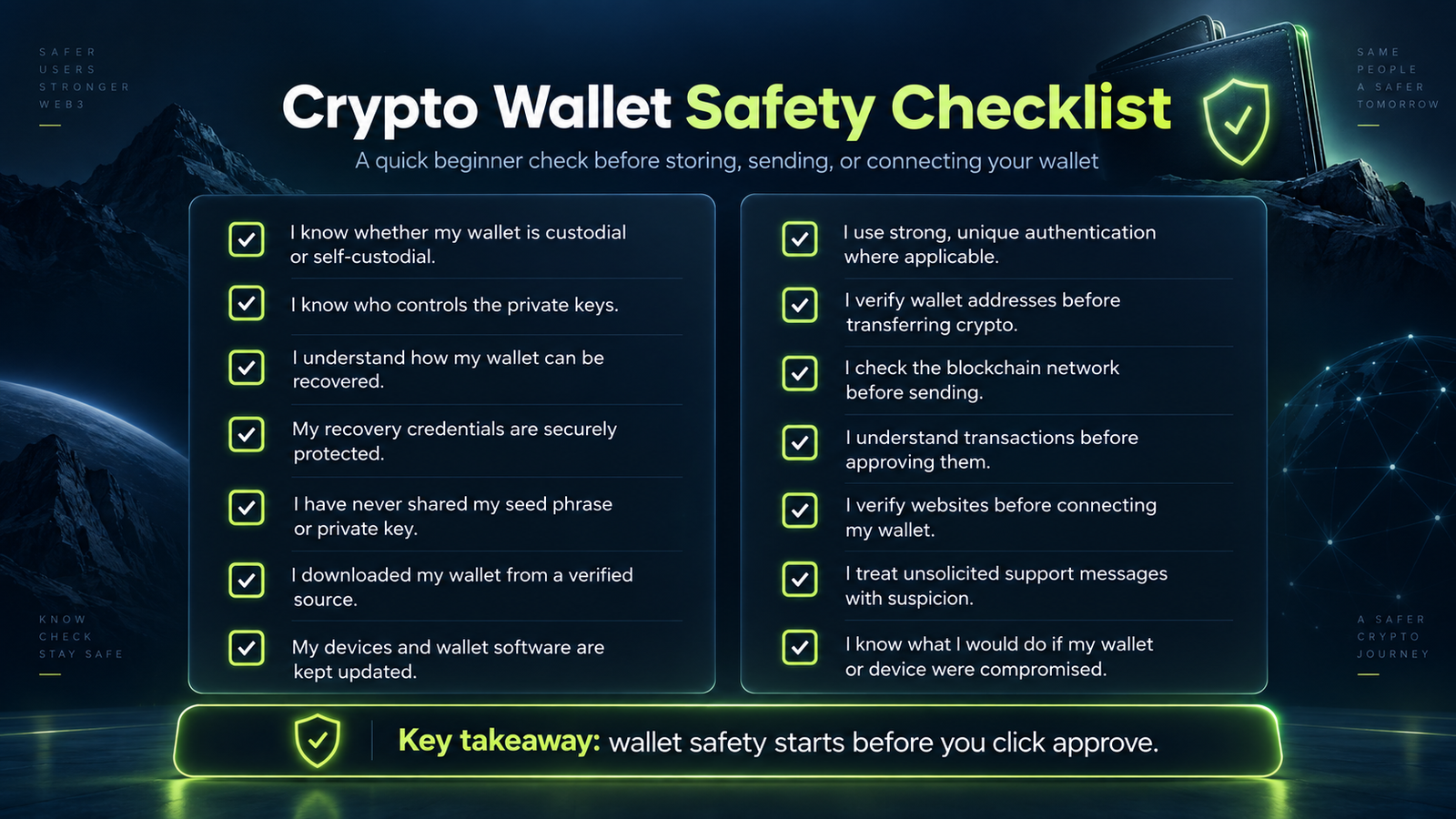
If several of these aren’t true yet, address those gaps before increasing the amount of cryptocurrency you store or interact with.
What Should You Do if You Think Your Crypto Wallet Is Compromised?
If you suspect a crypto wallet has been compromised, the appropriate response depends on what was exposed. Act cautiously and prioritise protecting assets that may still be secure.
If Your Password May Have Been Exposed
For a custodial account, use the provider’s legitimate website or application to secure the account.
Depending on the service, this may include changing the password, reviewing active sessions, enabling or resetting multi-factor authentication and contacting official support.
Don’t follow a “support” link supplied by the person or message that alerted you to the supposed problem.
If Your Seed Phrase or Private Key May Have Been Exposed
Treat this much more seriously.
Changing the password used to open a wallet application does not necessarily invalidate an exposed private key or recovery phrase.
If an attacker has obtained credentials capable of controlling the underlying accounts, the affected wallet should no longer be treated as secure.
If the private key or recovery phrase controlling a self-custody wallet may have been exposed, the affected wallet should no longer be treated as secure. Remaining assets may need to be moved to a newly secured wallet using fresh recovery credentials.
Do not reuse the compromised recovery credentials for the new wallet.
If You Approved a Suspicious Token Permission
Review and revoke unwanted token approvals using trusted tools appropriate to the network involved.
However, revoking an approval does not repair a wallet whose private keys or recovery phrase have already been exposed.
If You Suspect Your Device Is Compromised
Avoid using the affected device for sensitive wallet operations until it has been assessed and secured.
A clean wallet environment won’t help much if the device you’re using remains compromised.
And be extremely cautious about people offering recovery assistance after an incident. Victims can be targeted a second time by scammers claiming they can reverse blockchain transactions or recover stolen funds for a fee.
Key Takeaways
- Crypto wallet safety depends on how the wallet is used and protected, not simply which wallet brand you choose.
- Never share private keys or recovery phrases with someone claiming to provide support.
- Protect recovery credentials against both digital exposure and physical loss.
- Secure the devices and accounts connected to your crypto activity.
- Verify addresses, networks, websites and transaction requests before approving them.
- Hardware wallets can reduce certain risks but cannot protect against every scam or user mistake.
- Custodial and self-custodial wallets require different security approaches.
- If a private key or recovery phrase is exposed, changing an application password alone may not secure the underlying wallet.
- Treat wallet security as an ongoing process rather than something you configure once and forget.
Wallet security sits within a wider set of concepts covered across TMD’s crypto guides, including wallet custody, exchanges, blockchain transactions and digital-asset risks. The broader Web3 and crypto ecosystem also introduces wallet-connected applications and services that can create additional permissions and security considerations.
Where to Go Next
Wallet security connects closely with custody, recovery, transactions, applications and exchange safety. These guides cover the most relevant concepts to understand next:
- Wallets & Exchanges: Explore TMD’s guides covering crypto wallets, exchanges, custody, security and platform access.
- Crypto Guides: Build a broader understanding of cryptocurrency, blockchain transactions, wallets, exchanges and digital-asset security.
- What Is a Crypto Wallet?: Understand how crypto wallets manage access, interact with blockchain networks and authorise transactions.
- Private Keys and Seed Phrases: Learn how private keys, recovery phrases and wallet credentials control access and support wallet recovery.
- Custodial vs Non-Custodial Wallets: Compare who controls the keys, how recovery works and where security responsibility sits.
- What Is a Crypto Exchange?: Understand how exchange accounts work, including custody, withdrawals and platform-managed access.
- How to Choose a Crypto Exchange Safely: Compare the security, custody, withdrawal and platform factors worth checking before depositing funds.
- Common Crypto Scams to Avoid: Recognise phishing, fake wallet websites, impersonation, malicious links and other common crypto threats.
- What Are Smart Contracts?: Understand how smart contracts execute blockchain actions and why wallet approvals can carry security risks.
- What Are dApps?: Learn how decentralised applications connect to crypto wallets and request signatures, permissions and transactions.
- What Is DeFi?: Understand how decentralised finance applications use wallets, smart contracts and token permissions.
- Web3 & Crypto Guide: Explore the wider ecosystem connecting crypto, blockchain, wallets, exchanges, DeFi and Web3 applications.
Safety Checklist
✓ Keep private keys and seed phrases private
✓ Store recovery details securely
✓ Verify wallet websites and apps
✓ Check addresses before sending crypto
✓ Review transactions before approving
✓ Use strong account security
Related Guides
- What Are Smart Contracts? A Beginner’s Guide to Blockchain-Based Agreements
- What Are dApps? A Beginner’s Guide to Decentralised Apps
- What Is DeFi? A Beginner’s Guide to Decentralised Finance
- What Are Gas Fees? A Beginner’s Guide to Crypto Transaction Costs
- Common Crypto Scams to Avoid: How to Spot the Warning Signs
Disclaimer: This guide is for general information and education only. It is not financial, investment, legal, or tax advice. Crypto and digital assets can be risky, and prices may change quickly. Always do your own research and consider speaking with a qualified professional before making financial decisions.
The Meta Directory may earn commissions from some links, but this does not influence our editorial content.

Author
Frequently Asked Questions
Yes, crypto wallets and the systems surrounding them can be compromised, although the method varies. Attackers may target wallet software, devices, account credentials, recovery phrases or the user through phishing and malicious transaction requests rather than attacking the underlying blockchain itself.
Good wallet security therefore needs to protect both the technology and the person using it.
A reputable crypto wallet can provide a secure way to manage cryptocurrency when it is configured and used correctly, but no wallet eliminates every risk.
Security depends on factors including the type of wallet, custody model, device security, key management, recovery process and user behaviour.
For self-custody, you are responsible for protecting access. With custodial services, some of that responsibility shifts to the provider.
Storing a traditional seed phrase as a screenshot, ordinary note or other easily accessible file on an internet-connected phone can create unnecessary exposure. Some data may also be backed up automatically to cloud services.
Use the recovery and backup method recommended for your wallet while considering both online compromise and physical loss.
Knowing your public wallet address alone does not give someone the private key required to authorise transactions from a conventional crypto account. Public addresses are designed to be shared when receiving cryptocurrency.
However, public blockchains can expose transaction histories and balances associated with addresses, which can create privacy and targeting considerations.
Never confuse a public wallet address, which can be shared for receiving assets, with a private key or recovery phrase, which should remain secret.
HOW WE REVIEW & RANK
We research and compare platforms using a consistent framework: security signals, track record, product usability, feature quality, transparency of terms, and real-world usefulness.
When something changes – fees, policies, availability, or features – we update our listings and reviews.
Learn more about how we review platforms ->
STAY UPDATED
Get new crypto guides, updated rankings, and practical tips straight to your inbox — no spam, unsubscribe anytime.
NO SPAM. UNSUBSCRIBE ANYTIME.