What Are Private Keys and Seed Phrases?
Updated: September 2026
Written By
Table of Contents
- Private Keys vs Seed Phrases: The Quick Answer
- What Is a Private Key?
- What Is a Seed Phrase?
- What’s the Difference Between a Private Key and a Seed Phrase?
- Who Controls Your Private Keys?
- What Happens if Someone Gets Your Private Key or Seed Phrase?
- What Happens if You Lose Your Seed Phrase?
- How Should You Protect a Seed Phrase or Private Key?
- What Should You Never Do With a Seed Phrase?
- Private Key vs Password vs Wallet Address
- Do All Crypto Wallets Use Seed Phrases?
- Key Takeaways
- Recommended Next Guides
- Frequently Asked Questions
QUICK FACTS
Best for:
Crypto beginners and new wallet users
Difficulty: Beginner-friendly
Main topic:
Wallet security
Covers:
Private keys, seed phrases, recovery, self-custody and wallet access
You’ll learn:
How private keys and seed phrases work, how they differ and why protecting them matters

Private keys and seed phrases are two of the most important concepts to understand before taking control of your own crypto.
A private key is secret cryptographic information used to control an account and authorise transactions. A seed phrase, also called a recovery phrase, is a sequence of words commonly used by wallets to generate or recover the keys associated with a wallet.
They are related, but they aren’t the same thing.
Private keys and seed phrases are core security concepts across wallets and exchanges, especially when comparing self-custody with platform-managed access.
Understanding how a crypto wallet works also makes the relationship between keys, recovery phrases and blockchain accounts much easier to follow.
Private Keys vs Seed Phrases: The Quick Answer
A private key allows you to authorise transactions from a particular blockchain account, while a seed phrase is commonly used to generate and recover a collection of private keys associated with a wallet.
For a beginner, the easiest way to think about the relationship is:
Seed phrase → Private keys → Accounts/addresses → Access to crypto
A wallet handles the cryptography behind the scenes, so you generally don’t need to manually use your private keys when sending crypto.
What you do need to understand is the consequence of exposing them.
Someone who has the private key for controlling an account may be able to authorise transactions from it. And if someone has the recovery phrase for a traditional self-custody wallet, they may be able to recreate the wallet’s keys and gain access to multiple associated accounts.
Here’s the basic difference:
| Private Key | Seed Phrase | |
| What is it? | Secret cryptographic key | Human-readable recovery information |
| Typical appearance | Long string of characters | Usually a sequence of words |
| Main purpose | Signs/authorises activity for an account | Generates/recovers wallet keys |
| Should you share it? | Never | Never |
| If someone gets it | They may control the associated account | They may gain access to the wallet/accounts derived from it |
| If you lose it | Access may be lost without another recovery method | Recovery may be impossible for traditional wallets if no other backup exists |
There are different wallet designs, so these descriptions shouldn’t be treated as the universal rules for every wallet ever created. Newer smart-account systems, for example, can offer different recovery mechanisms.
For traditional self-custody wallets, however, understanding these two secrets is fundamental.
What Is a Private Key?
A private key is a secret cryptographic value that allows its holder to authorise activity associated with a blockchain account. It should never be shared with another person or entered into an untrusted website, app or service.
Public blockchain networks use cryptography to establish whether a transaction was authorised by the person controlling an account. A private key is part of that process.
When you send cryptocurrency from a self-custody wallet, the wallet can use your private key to create a digital signature. The network can verify that signature without the private key itself being revealed.
Ethereum’s account documentation explains that externally owned Ethereum accounts use public/private key pairs and that private keys are used to sign transactions.
What Does a Private Key Look Like?
A private key usually isn’t a memorable password that you choose yourself. It’s generated cryptographically and may appear as a long string of letters and numbers.
For most everyday wallet users, however, there is usually no reason to memorise or manually type a raw private key. Wallet software manages much of the technical work in the background. That distinction is useful because beginners sometimes assume their:
wallet password = private key
It doesn’t.
A password may unlock a wallet application on a particular device, while the underlying private key is what cryptographically controls the associated blockchain account. Losing one therefore isn’t necessarily the same as losing the other.
What Is a Seed Phrase?
A seed phrase is a sequence of words that can be used to generate or recover the cryptographic keys associated with many traditional self-custody wallets. You may also see it called a recovery phrase, secret recovery phrase or mnemonic phrase.
A wallet may present a recovery phrase when it is first created.
It often consists of 12 or 24 words, although wallet designs can vary. Ethereum’s current account-creation guidance, for example, describes recovery phrases of 12–24 randomly generated words and stresses that the order of the words matters.
The phrase isn’t merely a backup password. In traditional deterministic wallet designs, it can provide the information needed to derive the keys used by the wallet. That is why protecting it is so important.
One widely used approach is defined by the BIP-39 specification, which describes how a human-readable mnemonic phrase can be converted into a seed and then used with deterministic wallet systems.
Is a Seed Phrase the Same as a Recovery Phrase?
In everyday crypto use, “seed phrase” and “recovery phrase” are often used to describe the same or closely related wallet-recovery concept.
You may see terms including:
- Seed phrase
- Recovery phrase
- Secret recovery phrase
- Mnemonic phrase
- Wallet backup phrase
The terminology used by individual wallet providers can differ.
For beginners, the important point isn’t memorising every term. It’s recognising that a phrase capable of recovering your self-custody wallet is highly sensitive information.
If a wallet tells you that a set of words can restore access, treat those words as a critical secret.
What’s the Difference Between a Private Key and a Seed Phrase?
The main difference is that a private key controls a particular blockchain account, while a seed phrase can be used by many traditional wallets to derive and recover multiple private keys and accounts.
This distinction makes more sense when you picture the relationship:
Seed phrase
↓
Private keys
↓
Blockchain accounts/addresses
↓
Transactions and assets
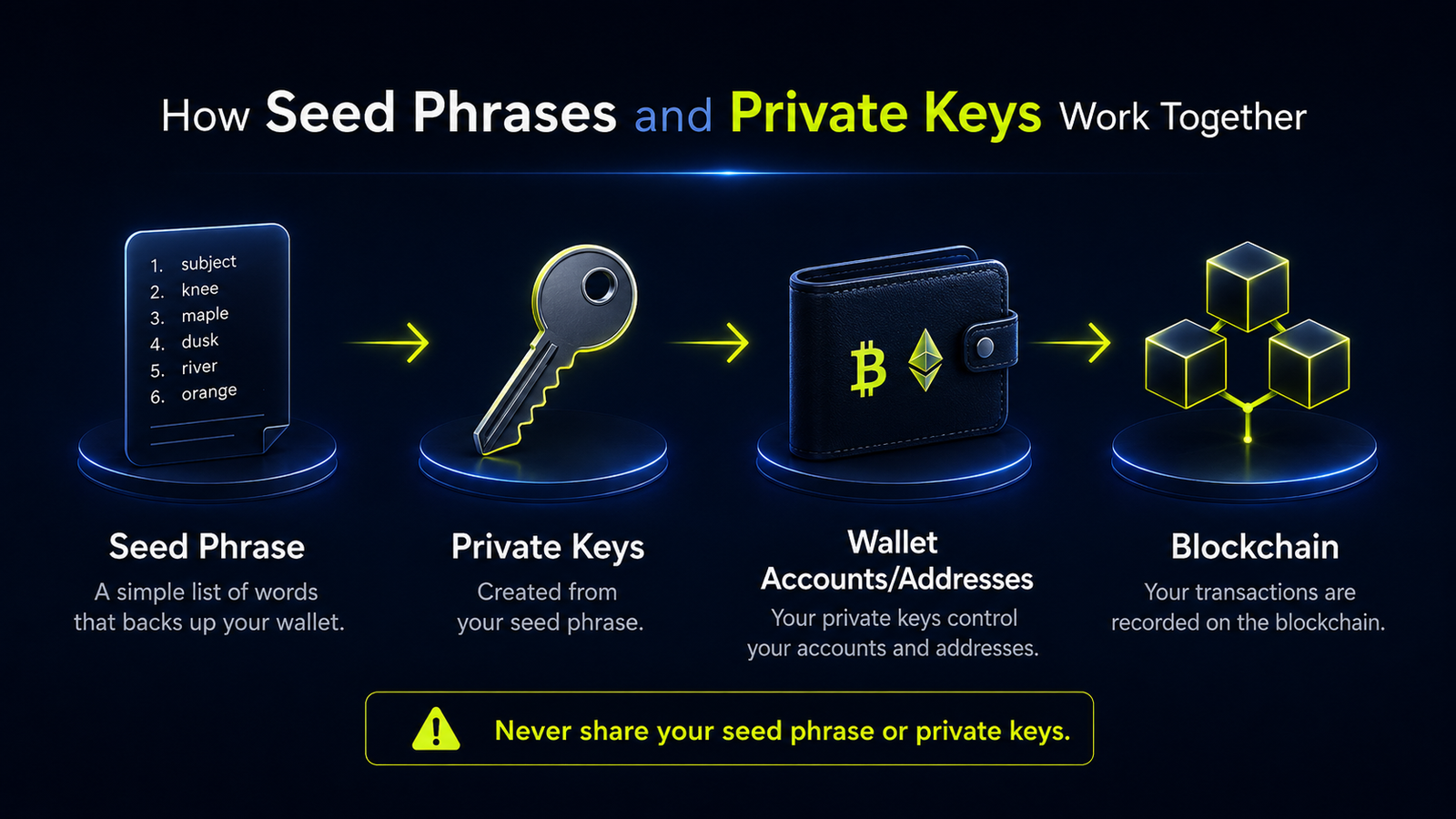
A single wallet may manage several accounts. Instead of requiring the user to separately back up a long private key for every account, deterministic wallet systems can derive multiple keys from common seed information.
That is one reason recovery phrases became so useful.
It’s also why compromising one can be so serious.
Someone having one private key may compromise the account controlled by that key. Someone having a wallet’s seed phrase may potentially be able to derive multiple private keys associated with that seed.
Who Controls Your Private Keys?
Who controls the keys depends largely on the type of wallet or service you are using. With self-custody, you generally retain control of the private keys. With a custodial service, the provider manages them on your behalf.
The difference between custodial and non-custodial wallets therefore comes down largely to who controls key access and who carries responsibility for recovery.
A custodial service may provide conventional account recovery if you forget your password. With traditional self-custody, there may be no company capable of restoring access if you lose all valid recovery methods.
This distinction is especially important with a crypto exchange account because the assets shown in your account may be managed through custody arrangements controlled by the platform rather than private keys held directly by you.
It’s therefore important to know which arrangement you are using. Owning crypto through an exchange account and controlling crypto through your own wallet can look similar on-screen while having very different custody arrangements underneath.
What Happens if Someone Gets Your Private Key or Seed Phrase?
If someone obtains a private key, they may be able to control the associated blockchain account. If they obtain the seed phrase for a traditional self-custody wallet, they may be able to reconstruct its keys and access multiple associated accounts.
This is one of the most important security lessons in crypto:
Your recovery phrase should not be treated like an ordinary password. Changing the password used to open a wallet app doesn’t necessarily neutralise a compromised seed phrase.
If an attacker already possesses the information required to recreate the wallet, they may not need your device or app password.
This is why legitimate wallet security advice repeatedly warns users not to disclose private keys or recovery phrases.
Common ways sensitive wallet information can be exposed include:
- Phishing websites
- Fake wallet applications
- Impersonated customer support
- Malicious browser extensions
- Compromised devices
- Screenshots or digital copies stored insecurely
- Cloud storage breaches
- Entering a recovery phrase into an untrusted website
- Sharing it with another person.
Many common crypto scams target this exact information through phishing websites, fake wallet apps, impersonated support accounts and fraudulent recovery requests.
A particularly important rule is: Nobody needs your seed phrase to send crypto to you.
To receive crypto, another person normally needs your public wallet address, not your private key or recovery phrase.
If somebody claims they need your recovery phrase to verify, activate, repair or credit your wallet, treat that as a major warning sign.
Ethereum’s security guidance also warns that anyone with a recovery phrase can access the associated accounts and that private keys provide the same type of control over individual accounts.
What Happens if You Lose Your Seed Phrase?
Losing a seed phrase does not necessarily mean your crypto disappears immediately. If you still have access to the wallet, you may still be able to use the associated accounts. The danger is that you may no longer be able to recover them if that access is later lost.
Imagine your wallet still works on your phone, but you’ve lost its only recovery phrase.
Everything may appear normal.
Then the phone is:
lost → stolen → damaged → reset
If there is no other valid recovery mechanism, you could lose access permanently.
That is why recovery information should be secured before something goes wrong.
For traditional self-custody wallets, there may be no central “forgot my seed phrase” button.
However, wallet technology is evolving. Smart-contract wallets and account-abstraction systems can support alternative recovery arrangements, so it would be inaccurate to say that every non-custodial wallet always depends on one seed phrase forever.
The recovery method should therefore be checked for the specific wallet you’re using.
How Should You Protect a Seed Phrase or Private Key?
Private keys and seed phrases should be kept secret, protected from unauthorised access and backed up according to the recovery method recommended by the wallet provider. They should never be shared with someone claiming to offer wallet support or recovery assistance.
The exact storage method depends on the wallet, your circumstances and the level of risk involved.
At minimum:
- Never send a seed phrase or private key through email, chat or social media.
- Don’t give it to someone claiming to be customer support.
- Be extremely cautious about storing recovery information digitally.
- Verify wallet software and websites before entering sensitive information.
- Keep backups somewhere protected from theft, loss and physical damage.
- Make sure you understand your recovery process before depositing meaningful amounts of crypto.
Strong crypto wallet safety includes protecting recovery information, verifying wallet software and websites, reviewing transaction requests carefully, and understanding the wallet’s recovery process before depositing meaningful amounts of crypto.
Author’s Tip
Don’t wait until you’ve lost your phone or wallet device to learn how recovery works. Before storing meaningful funds, understand exactly what information would be required to restore your wallet and make sure your backup is both secure and usable.
There’s a balance here.
A backup that’s impossible for anyone, including you, to access isn’t particularly useful. But a backup that is convenient enough for another person to discover isn’t secure either.
What Should You Never Do With a Seed Phrase?
Some wallet-security rules should be treated as non-negotiable.
Never:
- Share your seed phrase with another person
- Send it to “customer support”
- Enter it into a website because of an unsolicited message
- Post or photograph it publicly
- Use a seed phrase supplied to you by a stranger
- Assume someone needs it to send crypto to your wallet.
Be particularly suspicious of urgency.
Messages such as:
“Your wallet will be suspended unless you verify it now.”
or:
“We detected a problem with your wallet. Enter your recovery phrase to restore access.”
are exactly the type of scenarios in which stopping to verify the situation matters.
Private Key vs Password vs Wallet Address
These terms are easy to confuse when you’re starting out.
| Term | What it does | Keep secret? |
| Wallet address | Identifies where crypto can be received | No |
| Wallet/app password | May protect access to an app or device | Yes |
| Private key | Authorises control/activity for an associated account | Yes — critical |
| Seed/recovery phrase | Can recover keys/accounts in many wallet designs | Yes — critical |
Do All Crypto Wallets Use Seed Phrases?
No. Not every crypto wallet uses a traditional seed phrase, and recovery methods are continuing to evolve. Many familiar self-custody wallets use mnemonic recovery phrases, but other wallet architectures can use different systems.
Smart-contract wallets, for example, can potentially incorporate features such as multiple authorised keys, recovery mechanisms or additional rules controlling transactions. Custodial accounts work differently again because the service provider manages custody and may provide account recovery through its own systems.
That’s why you shouldn’t assume:
crypto wallet = 12 words
Instead, when setting up any wallet, establish:
Who controls the keys? How is access recovered? What information must remain secret? What happens if that information is lost?
Those questions matter more than the terminology used by the provider.
Key Takeaways
- A private key is secret cryptographic information used to authorise activity associated with a blockchain account.
- A seed phrase is commonly used to generate or recover the keys associated with traditional self-custody wallets.
- Private keys and seed phrases are related, but they are not the same thing.
- A public wallet address can be shared; a private key or recovery phrase should not be.
- Anyone obtaining sensitive recovery information may potentially gain control of associated crypto assets.
- Losing the only recovery method for a traditional self-custody wallet can result in permanent loss of access.
- Not every modern wallet uses the same recovery architecture.
- Understanding your wallet’s recovery process is part of using self-custody safely.
Private keys and seed phrases form part of the wider security foundation covered across TMD’s crypto guides, alongside wallets, exchanges, transactions, custody and common risks.
Recommended Next Guides
Private keys and seed phrases connect closely with wallet access, custody, recovery and security, making these the most relevant next topics:
TIP: START WITH Crypto Wallet Safety Guide OR Common Crypto Scams to Avoid.
Safety Checklist
✓ Never share your private key or seed phrase
✓ Keep recovery details securely backed up
✓ Never send recovery details to “support”
✓ Verify websites and wallet apps
✓ Never store an unprotected screenshot of your seed phrase
✓ Understand your wallet’s recovery process before adding funds
Related Guides
- What Are Smart Contracts? A Beginner’s Guide to Blockchain-Based Agreements
- What Are dApps? A Beginner’s Guide to Decentralised Apps
- What Is DeFi? A Beginner’s Guide to Decentralised Finance
- What Are Gas Fees? A Beginner’s Guide to Crypto Transaction Costs
- Common Crypto Scams to Avoid: How to Spot the Warning Signs
Disclaimer: This guide is for general information and education only. It is not financial, investment, legal, or tax advice. Crypto and digital assets can be risky, and prices may change quickly. Always do your own research and consider speaking with a qualified professional before making financial decisions.
The Meta Directory may earn commissions from some links, but this does not influence our editorial content.

Author
Frequently Asked Questions
No. A private key is used to control and authorise activity for an associated blockchain account, while a seed phrase can be used by many traditional wallets to derive or recover multiple private keys. They are closely related but perform different roles.
Potentially, yes. If someone obtains the recovery phrase for a traditional self-custody wallet, they may be able to recreate its keys and transfer assets without needing your physical device. A seed phrase should therefore never be shared with another person.
Not usually in the same way you change a password. How recovery credentials work depends on the wallet. If a recovery phrase is exposed, simply changing the wallet application’s password may not protect the underlying accounts. Follow the specific wallet provider’s security guidance and, where appropriate, move assets to newly secured accounts.
A public wallet address is intended to be shareable and is different from a private key or seed phrase. However, public blockchains can make activity associated with an address visible, so sharing an address can have privacy implications.
Storing an unencrypted screenshot or ordinary digital copy of a seed phrase can expose it to device compromise, cloud backups or unauthorised access. Follow the wallet provider’s recommended backup process and choose a method appropriate to the risks you’re protecting against.
HOW WE REVIEW & RANK
We research and compare platforms using a consistent framework: security signals, track record, product usability, feature quality, transparency of terms, and real-world usefulness.
When something changes – fees, policies, availability, or features – we update our listings and reviews.
Learn more about how we review platforms ->
STAY UPDATED
Get new crypto guides, updated rankings, and practical tips straight to your inbox — no spam, unsubscribe anytime.
NO SPAM. UNSUBSCRIBE ANYTIME.