DeFi Safety Guide for Beginners: Risks & How to Stay Safer
Updated: October 2026
Written By
Table of Contents
- What Does DeFi Safety Mean?
- Why Is DeFi Safety Different From General Crypto Safety?
- What Can Go Wrong With a DeFi Protocol?
- What Can Go Wrong When You Connect a Wallet to DeFi?
- Can You Lose Money in DeFi Without Being Hacked?
- Does a Smart-Contract Audit Mean a DeFi Protocol Is Safe?
- Does Decentralised Mean Nobody Controls the Protocol?
- The TMD DeFi Safety Check
- What Should You Check Before Connecting a Wallet?
- What Are Common DeFi Red Flags?
- DeFi Safety vs Wallet Safety vs Scam Prevention
- Beginner Safety Note
- Beginner DeFi Safety Terms to Know
- Key Takeaways
- Where to Go Next
- Frequently Asked Questions
QUICK FACTS
Best for:
DeFi beginners
Difficulty: Beginner-friendly
Main topic:
DeFi safety and risk
Covers:
Smart contracts, wallet approvals, governance, oracles, liquidity, liquidation, protocol dependencies and scams
You’ll learn:
How to identify different types of DeFi risk and what to check before interacting with a protocol
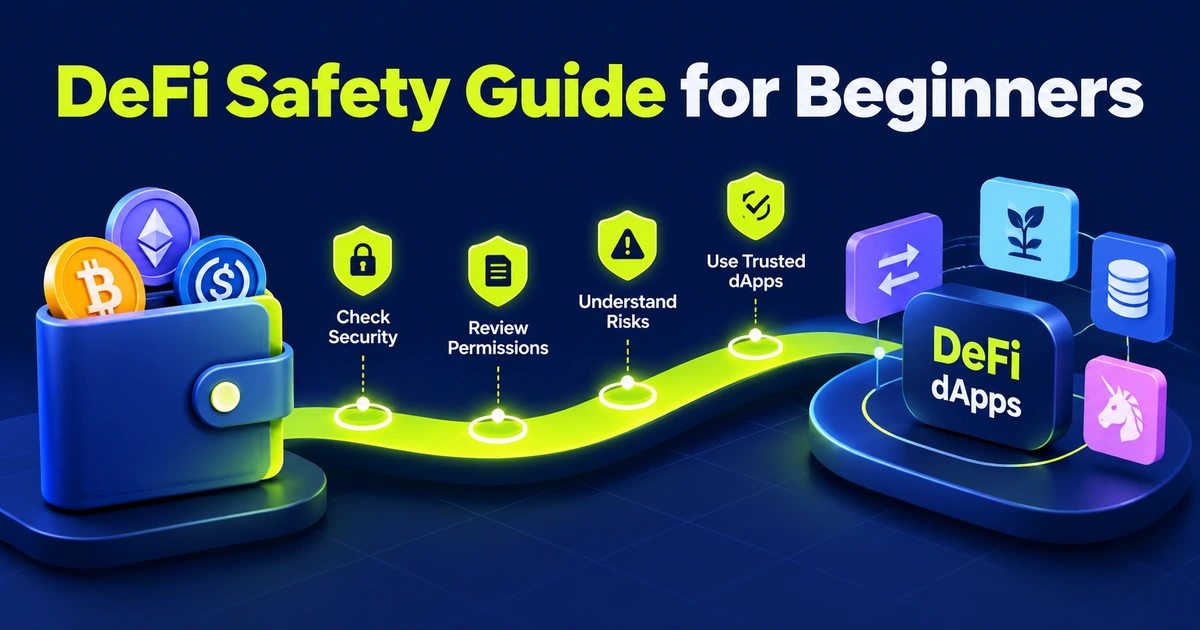
DeFi safety involves understanding much more than the possibility of cryptocurrency scams or hacked wallets. When someone uses decentralised finance (DeFi), they may interact with smart contracts, financial protocols, digital assets and systems that depend on other blockchain services.
Risks can arise in three distinct ways: protocol or system risk, user or interaction risk, and financial or market risk. Each can lead to losses for different reasons.
A DeFi protocol might contain vulnerable code, a user might approve an unsafe transaction, or a legitimate financial position might lose value even when everything operates as intended.
Understanding DeFi is useful before exploring these risks because decentralised financial applications work differently from traditional financial services.
This beginner guide explains the most important DeFi risks, what smart-contract audits can and cannot establish, how wallet permissions work, and what to investigate before connecting a wallet or committing assets.
Quick Answer: Is DeFi Safe?
DeFi is not automatically safe or unsafe. Its risks depend on the protocol, smart contracts, digital assets, governance controls, external dependencies, wallet permissions and financial activity involved. Users can lose money through software vulnerabilities, scams, incorrect approvals, market movements or liquidation. Audits and security precautions may reduce certain risks, but no checklist or security tool can guarantee that a DeFi protocol is safe or financially profitable.
What Does DeFi Safety Mean?
DeFi safety means understanding the risks associated with using decentralised financial protocols and taking practical steps to identify avoidable problems.
It involves more than assessing whether a platform has been hacked before. Users need to understand what a financial application does, how its underlying systems operate, what permissions it requests and which events could cause losses.
Before interacting with a DeFi protocol, several questions matter:
- What does the protocol do with the assets involved?
- Which smart contracts control its functions?
- Who can change the protocol’s rules?
- Does the system depend on other protocols or external data?
- What permissions must a wallet grant?
- How could the assets lose value?
- Can the user withdraw or exit under difficult market conditions?
These questions apply differently to decentralised exchanges, lending platforms, liquidity pools and other financial applications.
The broader DeFi tools ecosystem includes services with different purposes, technical designs and risk profiles. A token swap doesn’t create the same exposure as borrowing against collateral or supplying liquidity.
The Three Main Types of DeFi Risk
| Risk category | What it means | Examples |
|---|---|---|
| Protocol or system risk | Something goes wrong with the technology, governance or systems supporting the activity | Vulnerable code, oracle failures, unsafe upgrades, bridge dependencies |
| User or interaction risk | A user makes a mistake or is deceived during an interaction | Phishing, incorrect addresses, malicious approvals, unclear signatures |
| Financial or market risk | The financial position loses value, even without a hack | Liquidation, falling token prices, impermanent loss, low liquidity |
These categories can overlap. For example, incorrect oracle data might trigger a liquidation, combining system risk with financial loss.
Protection against hacking doesn’t mean protection against financial loss.
Why Is DeFi Safety Different From General Crypto Safety?
DeFi safety includes the familiar risks of holding cryptocurrency, but adds exposure to financial protocols and programmed blockchain transactions.
General crypto safety often focuses on protecting private keys, recovery phrases, exchange accounts and wallet access.
Those remain important. However, DeFi users may also interact directly with smart contracts, liquidity pools, lending markets and token permissions that continue to affect their assets after the initial transaction.
For example, a wallet can remain uncompromised while the owner loses money because a lending position is liquidated. Similarly, someone might approve access to tokens through a legitimate-looking interface without understanding the permission being granted.
Good crypto wallet safety helps protect credentials and improve transaction habits. DeFi safety adds questions about how the financial activity and underlying protocol operate.
Another difference is that several independent components may contribute to one transaction. A DeFi application might depend on an oracle for prices, a separate protocol for liquidity and a blockchain network for settlement.
Problems in any of those systems can affect the result, even when the user’s own wallet remains secure.
What Can Go Wrong With a DeFi Protocol?
A DeFi protocol can fail or cause losses through smart-contract vulnerabilities, flawed system design, governance controls, unreliable dependencies, liquidity problems or underlying blockchain disruptions.
These risks are not always visible from the website or application interface.
Smart-Contract Vulnerabilities
Smart-contract risk arises when blockchain-based code contains vulnerabilities, logic errors or unexpected behaviour that can affect transactions or assets.
Many DeFi applications rely on smart contracts to manage financial rules. These programs may process swaps, control deposits, calculate collateral requirements or distribute assets.
However, smart contracts are software, and software can contain mistakes.
A vulnerability might allow unauthorised asset movement, incorrect accounting or other unintended behaviour. Problems can also occur when multiple smart contracts interact in unexpected ways.
Publicly available code may allow more people to review the system, but visibility alone does not establish that the code is secure.
The important questions are which contracts control the assets, whether the code has been reviewed and whether the protocol can change those contracts later.
Governance and Admin-Control Risk
Governance risk concerns who has the authority to make decisions or change important aspects of a DeFi protocol.
A project may describe itself as decentralised while still allowing a development team, administrator, multisignature wallet or governing organisation to exercise significant control.
Depending on the design, privileged parties might be able to:
- upgrade smart contracts
- change protocol parameters
- pause certain functions
- alter collateral requirements
- manage treasury assets
- activate emergency controls
Administrative functions are not automatically harmful. Some allow teams to respond to emergencies or repair problems.
The risk is not merely that control exists. It is whether users understand who holds that control, what actions are possible and what safeguards apply.
Governance arrangements can also change over time, making it important to distinguish a protocol’s marketing claims from its actual control structure.
Oracle and Price-Feed Risk
An oracle provides a blockchain application with information that the blockchain cannot independently determine, such as the external market price of an asset.
Some DeFi lending protocols rely on price feeds to calculate the value of collateral and decide whether a position meets required borrowing conditions.
If this information becomes inaccurate, delayed, unavailable or manipulated, the protocol may make decisions using incorrect data.
For example, an incorrect collateral price could affect whether a lending position is eligible for liquidation.
Oracle risk doesn’t mean every DeFi application uses the same type of external data. Protocol designs vary, and some functions may not need external price feeds.
Before using a protocol, it helps to understand whether it relies on oracles and what happens when the supplied data is unreliable.
Bridge and Protocol-Dependency Risk
Protocol-dependency risk arises when a DeFi application relies on other systems that can affect its operation or the assets it manages.
One DeFi protocol may use another protocol’s liquidity, tokenised assets, oracle information or financial infrastructure.
This ability to connect systems is often called composability.
While composability can make blockchain applications more flexible, it also creates interconnected risks. A problem in one component can affect another application that relies on it.
A protocol may depend on:
- another smart contract
- an external oracle
- a stablecoin
- a blockchain bridge
- a lending or liquidity protocol
- external infrastructure
Bridges can also introduce risks when assets or messages move between blockchain networks. Their security arrangements vary, including how assets are held and how transfers are verified.
A user should therefore investigate more than the platform immediately visible on their screen.
Blockchain and Network Risk
DeFi protocols depend on blockchain networks to process transactions and maintain records.
Network congestion, unusual transaction costs, processing delays or infrastructure disruptions may affect how an application behaves.
During periods of heavy activity, users might encounter higher gas fees or delays that affect their ability to submit transactions.
For financial positions that depend on timely action, these interruptions can become especially important.
Different blockchain networks have different confirmation, finality and operational characteristics. An issue affecting one network should not automatically be assumed to affect every other blockchain.
Users should understand which network they are using and what happens when transactions become expensive, delayed or temporarily unavailable.
What Can Go Wrong When You Connect a Wallet to DeFi?
Connecting a wallet to a DeFi application does not, by itself, give every application unrestricted access to the wallet’s assets. However, later approvals, signatures and transactions can authorise actions or permissions with important consequences.
The distinction between these interactions is essential.
Fake Websites and Interfaces
DeFi users may encounter copied websites, misleading advertisements, impersonated support accounts or compromised application interfaces.
A fraudulent website can imitate the appearance of a genuine dApp while directing wallet interactions towards different contracts or recipients.
Even a familiar interface is not proof that every transaction request is legitimate.
Users should confirm the correct website address and investigate unexpected prompts. An interface may also become compromised after previously operating normally.
Token Approvals
A token approval is a permission that may allow a smart contract or other authorised spender to use specified tokens under the relevant token standard and approval conditions.
For example, a decentralised application may request permission before performing a swap involving a user’s tokens.
The permission might cover a limited amount or allow broader spending access, depending on the transaction.
Some approvals can remain active after the immediate interaction has finished.
This matters because a broad, long-lived permission may create additional exposure if the approved contract or associated systems are later exploited or abused.
Not every token approval is malicious. However, beginners should understand which token is involved, how much access is being granted and whether the permission is necessary.
Wallet Signatures and Transaction Prompts
Wallet interactions can involve several different actions.
| Wallet action | What it generally means |
|---|---|
| Connect wallet | Allows an application to identify or communicate with a wallet/account |
| Sign message | Authorises or proves something through a cryptographic signature; consequences depend on the message |
| Approve token spending | Grants specified token permissions to an authorised spender |
| Confirm transaction | Authorises an on-chain action, potentially involving assets, permissions or protocol changes |
These actions should not be treated as interchangeable.
Some messages are used for authentication, while others may contain authorisations with meaningful financial consequences.
Blind signing refers to authorising information that a user cannot adequately interpret from the wallet interface.
A transaction prompt might contain technical details without clearly showing the intended outcome.
The Ethereum Foundation’s clear-signing guidance discusses the importance of making transaction approvals understandable to users.
If a request cannot be understood or verified, the safer decision is not to approve it.
A hardware wallet can protect private keys against certain threats, but it cannot prevent someone from knowingly or unknowingly authorising a harmful transaction.
Disconnecting vs Revoking Permissions
Disconnecting an application from a wallet interface does not necessarily revoke permissions previously granted to a smart contract.
These are different actions.
Disconnecting typically removes an application’s connection through the wallet interface. An existing on-chain token approval may remain active until it is changed or revoked.
The distinction matters when a user stops using a DeFi application or discovers a potentially unsafe permission.
Ethereum’s official security guidance discusses how token approvals can persist and may need to be revoked separately.
Revoking a permission does not reverse transactions that have already happened. It changes applicable future authorisation, subject to the relevant token and contract rules.
Can You Lose Money in DeFi Without Being Hacked?
Yes. DeFi users can lose money even when a protocol operates exactly as designed and no security breach occurs.
Financial losses may come from market conditions, collateral rules, token characteristics, transaction costs or the structure of a DeFi position.
Token-Price Risk
Cryptocurrency prices can rise or fall significantly.
A DeFi position may contain assets that lose value during normal market movements, regardless of whether the protocol is technically secure.
Rewards or incentives do not necessarily compensate for a falling asset price.
Liquidation Risk
Liquidation can happen when a collateralised borrowing position no longer satisfies a protocol’s required conditions.
For example, a user may deposit crypto as collateral and borrow another asset against it.
If the collateral falls in value, the position’s borrowing conditions may be breached.
The protocol may then allow some or all of the collateral to be sold or transferred according to its liquidation rules.
Liquidation isn’t necessarily evidence of a malfunction. It may be the programmed outcome of a position falling outside the permitted limits.
Borrowing limits, collateral thresholds, liquidation penalties and available protections vary between protocols.
Impermanent Loss
Impermanent loss describes a form of relative underperformance that liquidity providers may experience compared with holding the underlying assets outside a pool.
It can occur when the relative prices of pooled assets change and the pool’s asset balances adjust through trading.
This is relevant to certain liquidity pools, particularly those used by automated market makers.
Trading fees or incentives may offset some losses, but they do not guarantee that a liquidity position will outperform simply holding the assets.
Impermanent loss is a financial risk associated with a pool’s mechanics, not a hack.
Liquidity and Slippage
Liquidity risk arises when there are insufficient available assets or trading opportunities to enter, exit or adjust a position under reasonable conditions.
Low liquidity may make trades more difficult or increase the cost of completing them.
Slippage is the difference between an expected trade result and the actual executed outcome.
These risks can matter when using decentralised exchanges, particularly when trading through shallow liquidity pools or during volatile market conditions.
Price impact is related but distinct. A trade can change the available price because of its size relative to the liquidity available.
Beginners should not treat quoted prices or estimated outputs as guaranteed execution results.
Stablecoin and Token Risk
Stablecoins are designed to maintain a particular value relationship, often with a currency or another asset.
However, they aren’t all structured in the same way.
Depending on the stablecoin, risks may involve collateral, redemption arrangements, reserve assets, smart contracts, market liquidity or other mechanisms.
A stablecoin may lose its expected peg or trade below its intended value.
Other tokens can also experience severe price falls, liquidity shortages or failure.
A DeFi protocol can operate correctly while the tokens used within it lose substantial value.
Changing Rewards and Incentives
Some DeFi activities distribute rewards or incentives to participants.
Those rewards may change as protocol rules, market conditions, participation or incentive programmes evolve.
An advertised reward rate does not guarantee a particular financial outcome.
Transaction costs, token-price declines or changing incentives may outweigh the rewards received.
It is also important not to confuse DeFi incentive programmes with crypto staking, which generally relates to proof-of-stake network participation and validator activity.
Does a Smart-Contract Audit Mean a DeFi Protocol Is Safe?
No. A smart-contract audit can provide useful evidence of independent code review, but it does not establish that a DeFi protocol is free from risk.
An audit may identify vulnerabilities, errors or design weaknesses within a defined review scope.
The findings can help developers address problems and give users additional information about a protocol’s security practices.
However, an audit does not guarantee that:
- every vulnerability has been discovered
- the reviewed code will never change
- future upgrades will be secure
- governance controls are safe
- external integrations are reliable
- oracles provide accurate data
- the website interface cannot be compromised
- the protocol’s assets will retain value
- a user will authorise the correct transaction
The audit’s date, scope, reviewed code version, findings and remediation status all matter.
A report covering one contract does not necessarily establish the security of every other component in a protocol.
A smart-contract audit is a risk signal to investigate, not a certificate that a DeFi protocol cannot fail.
Multiple audits, substantial total value locked (TVL), an established reputation or a long operating history may provide useful context, but none proves that a protocol is safe.
Does Decentralised Mean Nobody Controls the Protocol?
Not necessarily. A DeFi protocol can use decentralised technology while retaining concentrated control over some functions.
Governance structures vary considerably.
Some protocols use token-holder voting. Others rely on development teams, foundations, delegates, multisignature arrangements or administrative authorities.
Important questions include:
- Who can upgrade the contracts?
- Are there privileged administrative keys?
- Can certain transactions or functions be paused?
- Who controls emergency decisions?
- Can governance change financial parameters?
- Are major changes subject to delays or oversight?
- Can users leave before important changes take effect?
The existence of governance controls does not automatically make a protocol unsafe. Emergency functions can sometimes help limit damage.
However, those powers can also introduce additional trust assumptions.
The relevant question for a beginner is not whether a project calls itself decentralised. It is how much control different parties retain and what those parties are authorised to do.
The TMD DeFi Safety Check
The TMD DeFi Safety Check is a ten-point framework for reviewing important risks before using a decentralised financial protocol to help beginners ask better questions rather than treat a single security feature, audit or reputation signal as proof of safety.
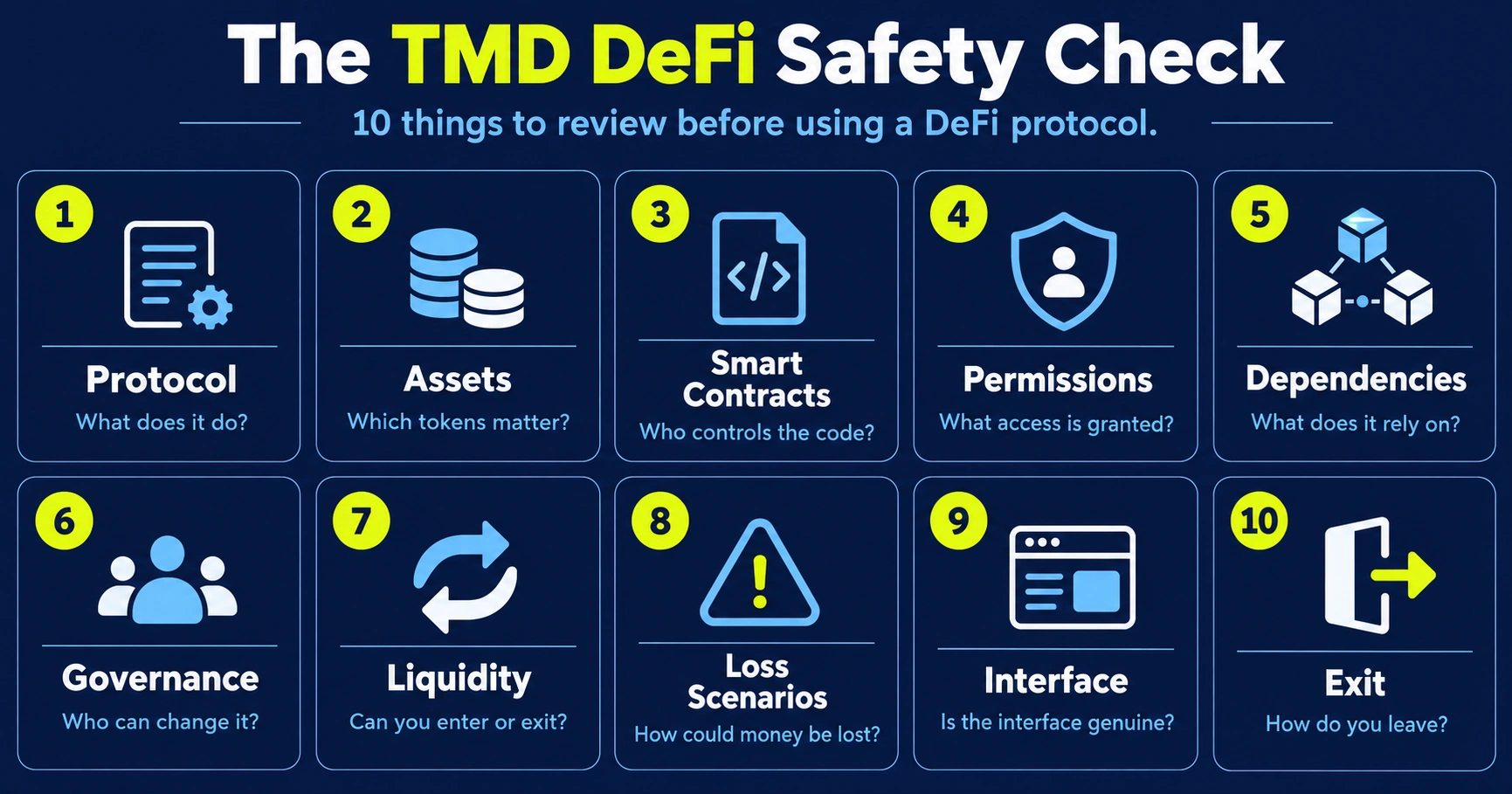
1. Protocol
What does the protocol actually do?
Identify whether the application supports swapping, lending, borrowing, liquidity provision or another financial activity.
Understand what happens to the assets when they enter the protocol. Are they exchanged, deposited, transferred, held as collateral or controlled by a particular contract?
2. Assets
Which tokens, stablecoins or collateral assets are involved?
Check the assets used by the activity and understand how changes in their value could affect the position.
A stablecoin, governance token, wrapped token and network-native cryptocurrency may have different characteristics and risks.
3. Smart Contracts
Which smart contracts control the activity?
Investigate whether the code has been independently reviewed, whether relevant issues were addressed and whether contracts can be upgraded.
An audit can help inform the assessment, but the protocol’s security depends on more than a single report.
4. Permissions
What access is the wallet being asked to grant?
Review signatures, token approvals and transaction requests before confirming them.
A permission may allow future actions beyond the immediate transaction, so check the approved spender, assets and authorised amount wherever that information is available.
5. Dependencies
Does the protocol rely on other systems?
A DeFi application may depend on price oracles, bridges, stablecoins, blockchain infrastructure or other smart contracts.
Identify the most important connections and consider how a failure elsewhere could affect the assets involved.
6. Governance
Who can change or influence the protocol?
Look for upgrade authorities, multisignature controls, administrator privileges, emergency functions and voting arrangements.
Understand what decisions those parties can make and whether important changes are subject to meaningful safeguards.
7. Liquidity
Can assets be entered or exited under realistic conditions?
Consider whether the market or pool has sufficient liquidity for the intended position.
Thin liquidity can create larger execution costs, make withdrawals harder or leave a user exposed during volatile conditions.
8. Loss Scenarios
How could the position lose money without an exploit?
Consider falling token values, collateral liquidation, impermanent loss, stablecoin depegging, transaction costs and changing incentives.
A technically functioning protocol does not guarantee a favourable financial result.
9. Interface
Is the interface genuine, and are the transaction requests understandable?
Verify the website and investigate unexpected prompts.
A convincing design, familiar logo or previously trusted link does not establish that the current interaction is safe.
10. Exit
How does the user leave the position?
Review withdrawal rules, lockups, liquidation conditions, waiting periods, applicable fees and any permissions that remain active afterwards.
Understanding the exit process before committing assets can help reveal restrictions that might otherwise be overlooked.
Passing every check doesn’t make a protocol risk-free. The purpose of the TMD DeFi Safety Check is to identify risks that should be understood before assets are committed or wallet permissions are granted.
What Should You Check Before Connecting a Wallet?
Before interacting with a DeFi application, use this shorter checklist to review the immediate transaction.
- Confirm that the protocol’s website and interface are genuine.
- Check which blockchain network is being used.
- Understand what the application does with assets.
- Confirm which wallet and account are connected.
- Review the contract and token involved where practical.
- Read transaction prompts instead of approving automatically.
- Check the amount and spender associated with token permissions.
- Avoid signing messages that cannot be understood or verified.
- Determine whether permissions may remain active afterwards.
- Understand how to exit the position or revoke relevant access.
- Consider whether the assets involved can withstand the activity’s potential losses.
No checklist can prevent every exploit, scam or market loss. These steps help identify avoidable mistakes and questions requiring further investigation.
What Are Common DeFi Red Flags?
Certain warning signs deserve additional scrutiny before interacting with a DeFi platform.
Examples include:
- promises of guaranteed returns
- pressure to act immediately
- unexplained wallet signatures or approvals
- unusual website addresses or copied branding
- vague information about how funds are used
- withdrawal rules that are missing or difficult to understand
- unclear governance and administrator privileges
- claims that a protocol has no possible risks
- unsolicited support accounts requesting transactions
- instructions to provide recovery phrases or private keys
- suspicious recovery services offering to retrieve lost assets
A red flag should prompt investigation, not necessarily an automatic conclusion that a protocol is fraudulent.
For example, an unaudited contract, anonymous development team, high reward rate or broad token approval may increase uncertainty in a particular situation. None is definitive proof of fraud by itself.
The wider patterns behind phishing, impersonation and fraudulent wallet requests are covered through common crypto scams, which helps distinguish deliberate deception from the technical and financial risks of DeFi.
DeFi Safety vs Wallet Safety vs Scam Prevention
DeFi safety, wallet safety and scam prevention overlap, but each addresses a different question.
| Area | Main question | Typical risks |
|---|---|---|
| DeFi safety | What can go wrong with the protocol or financial activity? | Smart contracts, governance, oracles, liquidity, liquidation, dependencies and permissions |
| Wallet safety | How do I protect access to my wallet and assets? | Seed phrase exposure, private keys, signing habits and device security |
| Scam prevention | Is someone attempting to deceive me? | Phishing, impersonation, fake platforms and social engineering |
These distinctions matter because a secure wallet does not make every DeFi protocol safe, and a legitimate protocol does not guarantee that every financial position will be profitable.
Similarly, a user can lose money without being deceived or hacked.
Beginner Safety Note
DeFi risks don’t come only from scams or hacks. A legitimate protocol can operate as designed while a user still loses money through token-price movements, liquidation, low liquidity, impermanent loss, changing incentives or other financial risks.
Smart-contract audits, established brands and security tools can reduce some uncertainties, but none can guarantee that a DeFi activity is safe or profitable.
Beginner DeFi Safety Terms to Know
| Term | Beginner meaning |
|---|---|
| Protocol risk | Risk arising from how a DeFi protocol is designed or operates |
| Smart-contract risk | Risk that contract code behaves incorrectly or contains exploitable vulnerabilities |
| Audit | An independent review of code or systems intended to identify potential problems |
| Oracle | A mechanism that provides external information, such as prices, to blockchain applications |
| Admin key | A key or authority that may control privileged protocol functions |
| Governance | The process used to make or approve changes to a protocol |
| Token approval | Permission allowing an authorised spender to interact with specified tokens under defined conditions |
| Liquidation | Closing or reducing a collateralised position when protocol conditions are triggered |
| Slippage | The difference between expected and actual trade execution |
| Depeg | When an asset intended to track another value moves away from that relationship |
| Composability | The ability of DeFi protocols to interact with and depend on one another |
Key Takeaways
- DeFi safety has three main dimensions: protocol or system risk, user or interaction risk, and financial or market risk.
- A DeFi protocol can operate correctly while users still lose money through price movements, liquidation or other financial mechanisms.
- Smart-contract audits provide useful evidence of code review but do not guarantee that a protocol is secure.
- Wallet connections, signatures, token approvals and blockchain transactions are different actions with different consequences.
- External dependencies, such as oracles, bridges and interconnected protocols, can introduce risks beyond the immediate application.
- The TMD DeFi Safety Check helps beginners investigate protocols, assets, permissions, governance, liquidity and exit conditions, but cannot eliminate every risk.
Where to Go Next
Understanding DeFi risks becomes easier when you know how the underlying technologies work, what your wallet authorises and where financial losses can occur. These related topics build on the safety principles covered above.
DeFi Fundamentals
The broader world of decentralised finance includes lending, borrowing, decentralised trading and other blockchain-based financial activities, each with its own risks and requirements.
Smart Contract Security
Many DeFi vulnerabilities originate in the programmed rules behind transactions, making an understanding of smart contracts useful when assessing protocols and their potential weaknesses.
Wallet-Connected Applications
Because many DeFi services operate through dApps, understanding how these applications connect to wallets and blockchain networks helps explain the risks associated with transactions and permissions.
Protecting Wallet Access
DeFi users remain responsible for understanding transaction requests and safeguarding sensitive credentials, making crypto wallet safety an important part of managing exposure.
Recognising DeFi Scams
Even legitimate protocols can be impersonated by fraudulent platforms, so recognising common crypto scams helps users identify phishing attempts, fake interfaces and suspicious wallet requests.
Safety Checklist
✓ Understand what the protocol does
✓ Check which assets are involved
✓ Review smart-contract and audit information
✓ Understand wallet approvals and signatures
✓ Check governance and upgrade controls
✓ Identify important protocol dependencies
✓ Review liquidity and exit conditions
✓ Understand loss scenarios beyond hacks

Disclaimer: This guide is for general information and education only. It is not financial, investment, legal, or tax advice. Crypto and digital assets can be risky, and prices may change quickly. Always do your own research and consider speaking with a qualified professional before making financial decisions.
The Meta Directory may earn commissions from some links, but this doesn’t influence our editorial content.

Author
Frequently Asked Questions
DeFi is not automatically safe. Risks depend on the protocol, smart contracts, governance, wallet permissions and financial activity involved. Even audited protocols can experience security failures, while legitimate transactions can result in financial losses.
The main DeFi risks include smart-contract vulnerabilities, unsafe wallet approvals, governance weaknesses, unreliable price oracles, phishing, liquidation and volatile assets. These risks fall into three categories: protocol or system risk, user or interaction risk, and financial or market risk.
Yes. Losses can occur even when a DeFi protocol operates as intended. Falling token prices, collateral liquidation, impermanent loss, stablecoin depegging and changing incentives can all reduce the value of a position without a security breach.
Wallets, Smart Contracts & Protocol Risk
Not necessarily. A smart-contract audit can identify vulnerabilities and provide useful evidence of code review, but it cannot guarantee safety. Undiscovered bugs, future upgrades, governance decisions and external dependencies may still introduce risks.
Yes, a smart contract may transfer certain tokens if you have granted the necessary permissions or authorised a relevant transaction. Simply connecting a wallet does not automatically allow unrestricted access to your assets.
Not necessarily. Disconnecting a dApp from your wallet does not automatically revoke existing on-chain token approvals. Those permissions may need to be reviewed and revoked separately. Revoking an approval does not reverse previously completed transactions.
HOW WE REVIEW & RANK
We research and compare platforms using a consistent framework: security signals, track record, product usability, feature quality, transparency of terms, and real-world usefulness.
When something changes – fees, policies, availability, or features – we update our listings and reviews.
Learn more about how we review platforms ->
STAY UPDATED
Get new crypto guides, updated rankings, and practical tips straight to your inbox — no spam, unsubscribe anytime.
NO SPAM. UNSUBSCRIBE ANYTIME.