What Is Crypto Staking? A Beginner’s Guide to How Staking Works
Updated: October 2026
Written By
Table of Contents
- What Does Staking Mean in Crypto?
- Why Do Proof-of-Stake Networks Use Staking?
- How Does Crypto Staking Work?
- What Is a Validator?
- What Does Delegating Crypto Mean?
- What Are the Different Ways to Stake Crypto?
- Ways to Stake Crypto Comparison Table
- How Do Crypto Staking Rewards Work?
- Can You Lose Money When Staking Crypto?
- What Is Slashing in Crypto Staking?
- Can You Unstake Crypto at Any Time?
- Crypto Staking vs Liquidity Pools
- Crypto Staking vs Crypto Lending
- Is Crypto Staking Safe?
- Before Staking Crypto Checklist
- Beginner Safety Note
- Beginner Crypto Staking Terms to Know
- Key Takeaways
- Where to Go Next
- Frequently Asked Questions
QUICK FACTS
Best for:
Crypto staking beginners
Difficulty: Beginner-friendly
Main topic:
Proof-of-stake staking
Covers:
Proof of stake, validators, delegation, staking pools, liquid staking, rewards, slashing and risks
You’ll learn:
What crypto staking is, how staking works, what validators do, how rewards and penalties work, and what risks beginners should understand
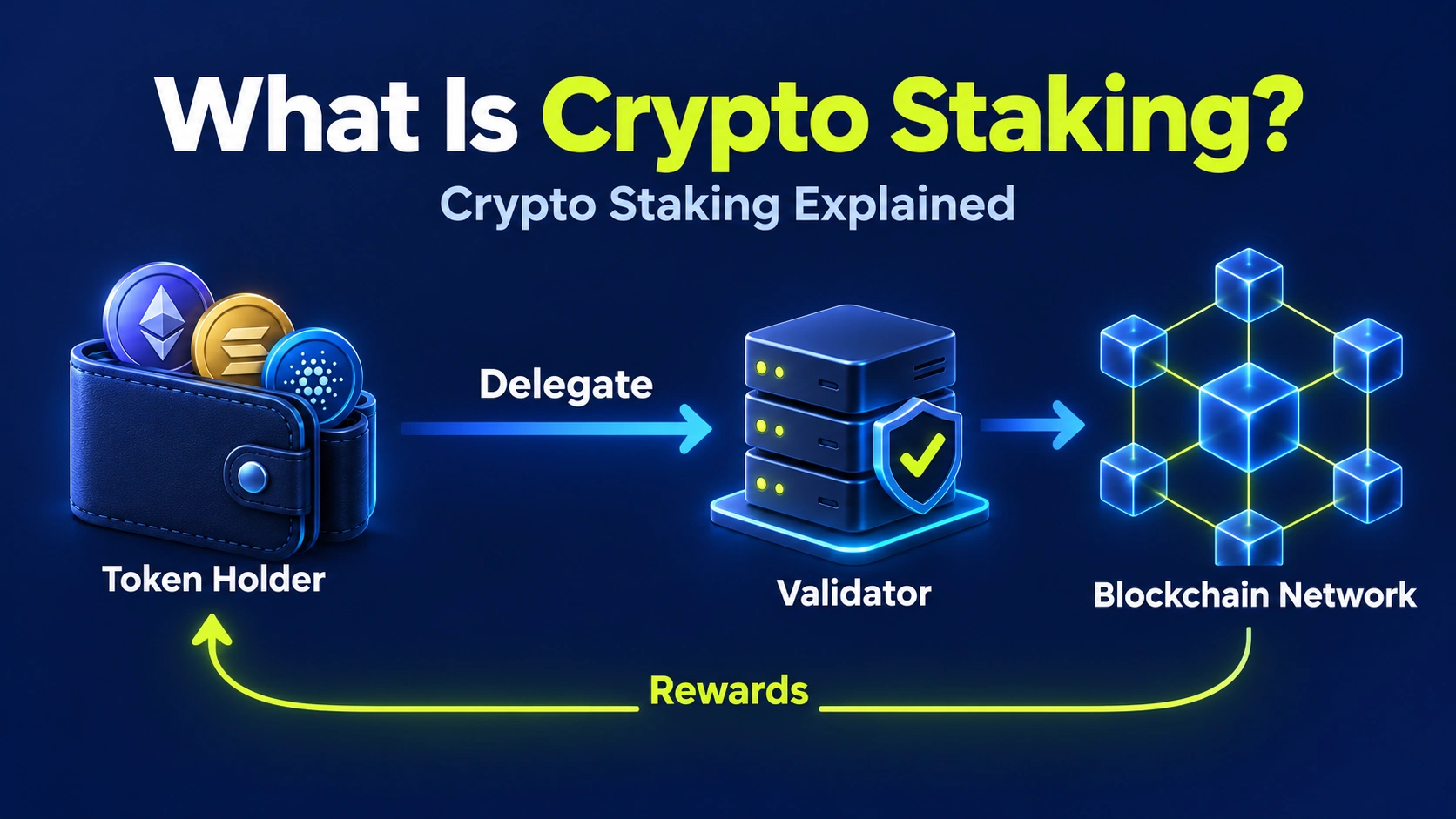
Crypto staking is connected to proof-of-stake blockchain systems, where eligible crypto assets can be committed, assigned or delegated under network-specific rules. Staking is not always as simple as “locking coins to earn rewards”, because different blockchains and staking methods work in different ways.
Depending on the blockchain and staking method, users may run validators directly, delegate stake to validators, join staking pools, use liquid staking protocols, or rely on custodial platforms that handle staking on their behalf.
This beginner guide explains what crypto staking is, how staking works, what validators do, how rewards and penalties can apply, and what risks to understand before using any staking method.
Quick Answer: What Is Crypto Staking?
Crypto staking is a way eligible assets participate in proof-of-stake blockchain systems. Depending on the network and staking method, users may run a validator, delegate stake to a validator, join a staking pool or use a staking service. Validators may receive protocol rewards for participating correctly, while risks, penalties, custody and withdrawal rules vary.
What Does Staking Mean in Crypto?
Crypto staking generally means committing or assigning eligible crypto assets within a proof-of-stake system so validators can participate in network consensus.
In a proof-of-stake network, validators help the blockchain agree on valid activity. They may propose, check or confirm blockchain activity depending on how that network works. The exact process varies between blockchains.
Staking is connected to the idea of economic stake. A validator’s participation is tied to assets that are committed, delegated or otherwise counted under that network’s rules. Correct participation may lead to rewards. Incorrect behaviour, poor performance or prohibited actions may lead to reduced rewards or penalties, depending on the protocol.
This is why staking should not be defined only as “locking crypto to earn rewards”. Certain staking models involve locked assets, while others use delegation. Liquid staking models may issue another token that represents a staking position. Platforms may also use the word staking for products that are not direct protocol staking.
Understanding blockchain helps explain why proof-of-stake networks need a way to agree on valid activity and record changes across a shared network.
Why Do Proof-of-Stake Networks Use Staking?
Proof-of-stake networks use staking as part of how they organise network participation, validator selection, incentives and penalties.
A blockchain needs a way to agree on which transactions or state changes are valid. Proof of Work uses computational work performed by miners. Proof of Stake uses economic stake as part of the system that allows validators to participate in consensus.
In simple terms, staking can help:
- support validator participation
- encourage correct behaviour
- discourage harmful behaviour
- organise network consensus
- reward validators according to protocol rules
- apply penalties where the network design allows it
Different proof-of-stake networks use different designs. A validator on one blockchain may not work the same way as a validator on another. One network may use delegation, while another may apply slashing rules, lockups or withdrawal queues. Other systems use different participation models.
The important point is that staking is connected to network rules, not just a generic reward product.
How Does Crypto Staking Work?
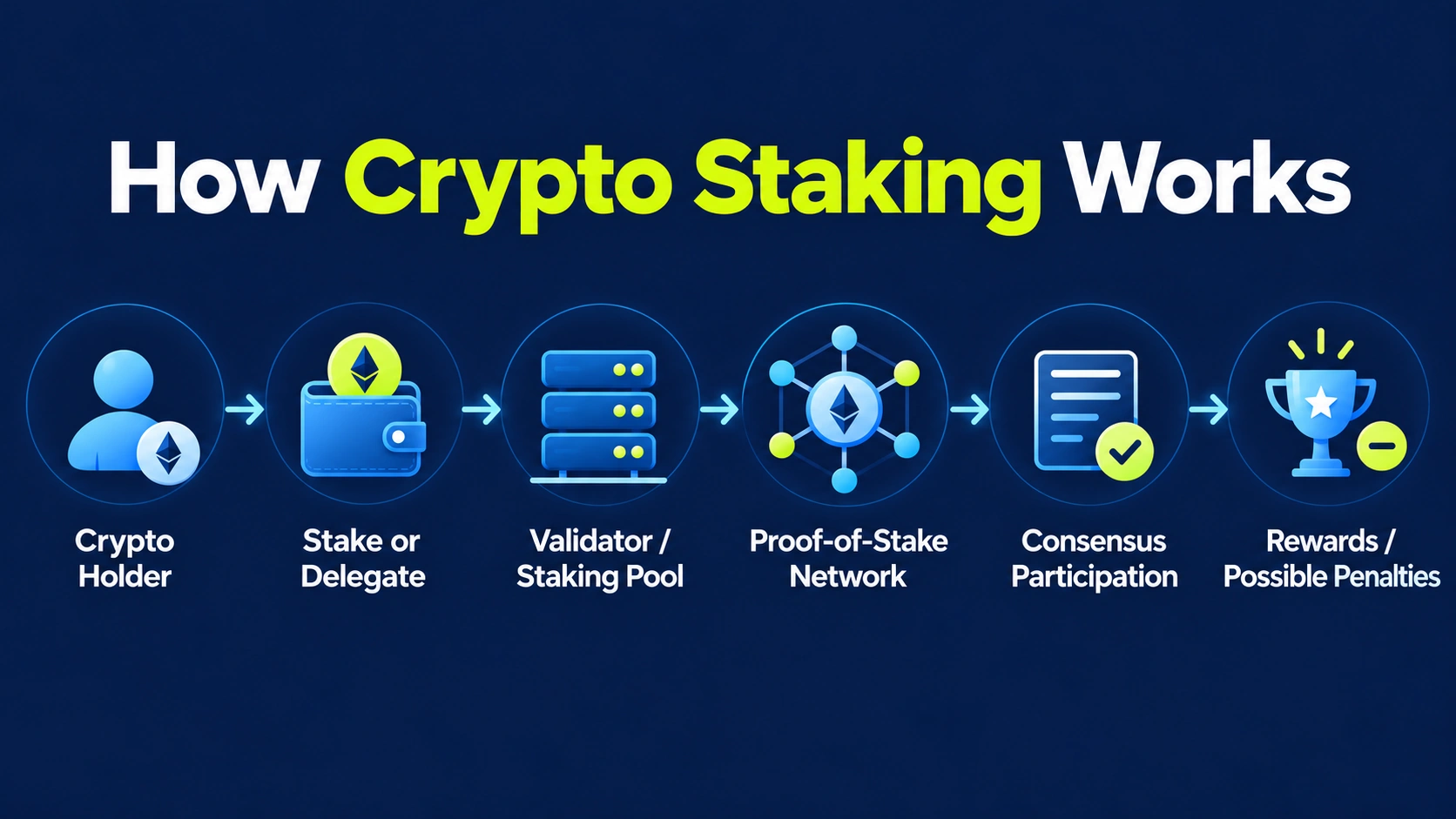
Crypto staking works differently across networks, but a simplified version can look like this:
- A blockchain uses a proof-of-stake consensus mechanism.
- Eligible crypto represents stake within the system.
- A holder chooses a supported staking method.
- Stake may be committed directly or delegated to a validator or pool.
- Validators participate in network consensus.
- The protocol calculates rewards and any penalties according to network rules.
- Rewards may be distributed directly or through a provider, validator or pool.
- Unstaking or withdrawal follows that network or provider’s rules.
- This is only a general framework. It does not apply perfectly to every proof-of-stake network or every staking product.
For example, Ethereum’s official staking material separates home staking, staking as a service, pooled staking, liquid staking and centralised exchange staking. Those options can involve different levels of custody, technical effort, provider involvement and risk.
Solana documentation describes delegation through stake accounts, where stake can be delegated to validators on the network.
Cardano documentation explains that ada holders can delegate stake while retaining spending power, which shows why staking should not be described as universal lockup.
What Is a Validator?
A validator is a participant that helps a proof-of-stake blockchain process or confirm network activity according to that blockchain’s rules.
The validator responsibilities vary by network. In some systems, validators may propose blocks, attest to valid activity, check transactions, participate in voting processes or perform other consensus duties.
Validator performance can affect staking outcomes. A validator that performs correctly may be eligible for rewards. Poor performance may reduce rewards. Some networks also use penalties for certain failures or prohibited behaviours.
Not every staking user runs a validator. Many beginners encounter staking through delegation, pooled staking, liquid staking or custodial services, where another party or protocol handles validator operation.
What Does Delegating Crypto Mean?
Delegating crypto generally means assigning staking weight or participation to a validator without operating validator infrastructure yourself.
Delegation does not always mean transferring ownership or custody of the underlying asset. The exact meaning depends on the blockchain and staking method.
For example, Solana staking uses stake accounts that can delegate tokens to validators, while Cardano allows ada holders to delegate to stake pools while retaining spending power over their ada. These are examples, not universal rules.
Delegation can make staking more accessible because the user does not necessarily need to run validator hardware or maintain technical infrastructure. However, validator choice still matters. Validator performance, commission, reliability and network-specific rules can affect the staking experience.
What Are the Different Ways to Stake Crypto?
There are several ways to stake crypto, and they do not all carry the same responsibilities or risks.
Solo Validator Staking
Solo validator staking usually means participating directly in the network’s staking system.
In some networks, this may involve running validator infrastructure, meeting minimum staking requirements, staying online, maintaining software and accepting more direct responsibility for validator performance.
Ethereum home staking is one example where running a validator requires a specific amount of ETH and validator operation. That is an Ethereum-specific example, not a universal rule for all proof-of-stake networks.
Solo staking can offer more direct control, but it is usually not the simplest option for beginners.
Delegated Staking
Delegated staking lets a token holder assign staking participation to a validator or operator.
The user may not need to run infrastructure personally. Depending on the network, custody may remain with the user, or the process may involve different technical arrangements.
Delegated staking can be easier than running a validator, but validator choice matters. Fees, commissions, performance, reliability and penalties may affect results.
Pooled Staking
Pooled staking combines participation from multiple users through a pool or service.
A staking pool may lower participation barriers by allowing users to take part without meeting solo validator requirements. The trade-off is that pool design, provider rules, smart contracts and custody arrangements can introduce additional risks.
Not all pools work the same way. A pool may issue a token, use smart contracts or rely more heavily on a provider. Another pool may use a different structure entirely.
Liquid Staking
Liquid staking is a staking method where a protocol or service may issue a token representing a staking position.
This token is often called a liquid staking token, or LST. It may be transferable or usable elsewhere, while the underlying asset remains involved in staking.
Liquid staking can add flexibility, but it can also add risk. Smart-contract risk, market liquidity, provider risk, redemption mechanics, and differences between the liquid staking token and the underlying asset all matter.
Pooled staking may use smart contracts and/or liquid staking tokens, and that these options can place software, operators or custodians between the user and the protocol.
Custodial or Exchange Staking
Custodial or exchange staking involves a platform handling some or all of the staking process for the user.
This may feel simpler, but the user depends on the platform’s terms, custody, fees, supported assets, withdrawal rules and operational decisions. The platform may control the staking process and may hold the user’s assets.
A product labelled “staking” on a platform may not always represent direct protocol staking in the same way as native staking. Beginners should check what the platform is actually doing, who controls the assets, how rewards are calculated and what happens during withdrawals.
Ways to Stake Crypto Comparison Table
| Method | Who operates validator or infrastructure? | Custody/control | Technical effort | Additional risks |
|---|---|---|---|---|
| Solo validator staking | User | Usually greatest direct control | High | Validator operation, penalties, setup mistakes |
| Delegated staking | Third-party validator/operator | Varies by network | Lower | Validator/operator risk |
| Pooled staking | Pool operators | Varies | Lower | Pool, smart-contract or provider risk |
| Liquid staking | Protocol/operators | Token-based position varies | Lower | Smart-contract, LST and liquidity risk |
| Exchange/custodial staking | Exchange/provider | Provider custody | Low | Counterparty and platform risk |
Implementations vary. A staking method that is non-custodial on one network may not work the same way on another platform or chain.
How Do Crypto Staking Rewards Work?
Crypto staking rewards are generally tied to protocol participation, validator activity and network rules.
A validator may receive rewards for participating correctly in a proof-of-stake system. Depending on the staking method, some rewards may be passed to delegators, pool participants or platform users after commissions, fees or provider terms are applied.
Reward outcomes can depend on factors such as:
- the blockchain’s reward rules
- the validator’s performance
- total network participation
- provider or validator fees
- pool rules
- staking method
- penalties where applicable
- withdrawal timing
- asset price changes
Earning more units of a crypto asset through staking does not guarantee that the position will increase in monetary value.
This is important. Staking rewards are not the same thing as bank interest. Reward rates can change, provider terms can change, validator performance can vary and the underlying crypto asset can fall in price.
Can You Lose Money When Staking Crypto?
Yes. Staking rewards do not prevent the value of the staked crypto from falling, and additional protocol, validator, custody, smart-contract or provider risks may also apply depending on the staking method.
Possible risks include:
- the underlying crypto asset falling in value
- validator underperformance
- protocol penalties
- slashing where applicable
- provider fees
- custody or counterparty failure
- smart-contract vulnerabilities
- a liquid staking token trading below or otherwise diverging from its expected redemption or underlying value
- delayed withdrawals
- lockups or unbonding periods
- fake staking websites
- platform failure
- changing network rules
Not every staking method has every risk. Solo staking, delegated staking, pooled staking, liquid staking and exchange staking all have different risk profiles.
The main point is that staking rewards do not remove crypto risk.
What Is Slashing in Crypto Staking?
Slashing is a protocol-specific penalty used by some proof-of-stake networks for certain prohibited validator behaviours.
It isn’t the same as every missed reward or every validator performance issue. Some networks distinguish ordinary penalties or reduced rewards from slashing events.
Beginners shouldn’t assume they are constantly at risk of slashing in every staking situation. They should also avoid assuming slashing is impossible. The correct answer depends on the network, validator, staking service and terms involved.
Users of pools, liquid staking services or custodial platforms may be exposed differently depending on how the provider manages validator penalties and how its terms allocate losses.
Can You Unstake Crypto at Any Time?
It depends on the blockchain and staking method.
Some staking systems have activation periods, withdrawal queues, lockups or unbonding periods. Others may allow more flexible delegation or spending, depending on how the network is designed.
Liquid staking may allow a user to sell or transfer a representative token instead of directly unstaking from the protocol. That can provide flexibility, but the token may carry market, liquidity, redemption or smart-contract risks.
Exchange and custodial staking products may also apply platform-specific rules. A platform may set its own withdrawal timing, reward schedule, fees or eligibility conditions.
Never assume all staking can be withdrawn instantly, and never assume all staking locks assets. Both claims are too broad.
Crypto Staking vs Liquidity Pools
Staking and providing liquidity are different activities.
Crypto staking generally relates to proof-of-stake network participation, validators and consensus. Providing liquidity usually means supplying assets to a pool used by DeFi protocols for swaps or other activity.
| Feature | Crypto Staking | Liquidity Pool |
|---|---|---|
| Main purpose | Support PoS consensus or validator participation | Provide assets for swaps or other DeFi activity |
| Typical participant | Validator, delegator or staker | Liquidity provider |
| Possible rewards | Protocol staking rewards | Fees or incentives depending on pool rules |
| Main risks | Price, validator, slashing, provider or custody risk | Price, impermanent loss, smart-contract and liquidity risk |
| Role in network | Consensus and network participation | DeFi liquidity |
| Assets involved | Often a network-native staking asset | May contain multiple assets |
Providing liquidity through liquidity pools is different from participating in blockchain staking. Both can involve crypto assets and potential rewards, but they serve different purposes and carry different risks.
Liquid-staking assets can sometimes be used in DeFi, so staking and DeFi can overlap. That does not make staking and liquidity provision the same activity.
Crypto Staking vs Crypto Lending
Crypto staking and crypto lending are not the same thing.
Staking generally relates to proof-of-stake network participation. Crypto lending involves assets being lent to borrowers or lending protocols in exchange for potential returns.
The risk models are different. Staking may involve validators, network rules, slashing, custody and withdrawal timing. Lending may involve borrower risk, lending-protocol risk, collateral, liquidation mechanics or platform counterparty risk.
This distinction matters because some commercial platforms use loose language. A product marketed as “staking” may not always mean direct protocol staking.
Is Crypto Staking Safe?
Crypto staking is not automatically safe. Safety depends on the blockchain, staking method, validator, custody model, smart contracts, platform, wallet security, underlying asset and withdrawal rules.
Potential risks include:
- token-price volatility
- validator penalties
- slashing where applicable
- provider insolvency or counterparty risk
- smart-contract vulnerabilities
- fake staking platforms
- phishing websites
- unsafe wallet approvals
- liquid staking token risks
- concentration risk
- changing protocol rules
- platform withdrawal restrictions
Wallet security matters because staking may involve connecting a wallet, signing a transaction, delegating assets or approving platform access. A crypto wallet safety guide can help beginners understand safer habits before interacting with staking tools.
Scams are also common around staking because fake sites can imitate real platforms, advertise unrealistic returns or pressure users into unsafe approvals. Learning about common crypto scams can help beginners recognise suspicious offers before connecting a wallet or transferring assets.
Before Staking Crypto Checklist
Before staking, check:
- Which blockchain am I using?
- Does this asset actually support protocol staking?
- What staking method am I using?
- Who controls custody of the crypto?
- Am I delegating, pooling or transferring assets?
- Who operates the validator?
- How are rewards calculated?
- Are rewards variable?
- What fees or commissions apply?
- Can validator penalties or slashing affect me?
- Is there a lockup, unbonding period or withdrawal queue?
- Can I access the asset while it is staked?
- Am I receiving a liquid staking token?
- What additional risks does that token introduce?
- Is the website or provider genuine?
- Could the underlying crypto fall sharply in value?
- Do I understand that rewards do not guarantee profit?
Completing this checklist does not make staking risk-free. It helps reduce avoidable mistakes.
Beginner Safety Note
Staking rewards don’t remove crypto risk. The value of the underlying asset can fall, validator or protocol penalties may apply, and pooled, liquid or custodial staking can introduce additional smart-contract, provider or custody risks. Understand exactly what happens to your assets before staking.
Beginner Crypto Staking Terms to Know
| Term | Beginner meaning |
|---|---|
| Staking | Participating in a proof-of-stake system by committing or assigning eligible crypto under network-specific rules |
| Proof of Stake | Blockchain consensus model that uses economic stake as part of network validation |
| Validator | Participant that performs consensus duties on a proof-of-stake network |
| Delegation | Assigning staking weight to a validator without necessarily running validator infrastructure |
| Staking pool | Service or protocol that combines staking participation from multiple users |
| Liquid staking | Staking through a system that issues a transferable token representing the staking position |
| LST | Liquid staking token |
| Staking reward | Crypto awarded according to a network or staking system’s rules |
| Slashing | Protocol-specific penalty for certain prohibited validator behaviour |
| Unstaking | The process of exiting or reducing a staking position |
Key Takeaways
- Crypto staking is connected to proof-of-stake blockchain systems and validator participation.
- Staking rules vary by blockchain, so there is no single universal staking model.
- Users may stake through solo staking, delegation, pooled staking, liquid staking or custodial services.
- Staking rewards are variable and do not guarantee profit.
- Staking does not always mean assets are locked, but some methods do involve withdrawal delays or restrictions.
- Risks can include token-price losses, validator issues, slashing, custody risk, smart-contract risk, fake platforms and withdrawal limits.
Where to Go Next
Crypto staking sits within the broader blockchain ecosystem and can overlap with DeFi through pooled and liquid staking systems. These guides can help beginners understand the related concepts before comparing staking methods or using staking platforms.
DeFi Tools
The DeFi Tools hub connects staking with other decentralised finance concepts, including wallets, smart contracts, gas fees and DeFi safety.
Liquidity Pools
Staking is often confused with providing liquidity, so What Are Liquidity Pools? is useful for understanding how liquidity provision differs from proof-of-stake participation.
DeFi Basics
Staking can overlap with DeFi, especially through pooled or liquid staking systems. What Is DeFi? explains the wider category of decentralised financial tools and protocols.
Crypto Wallet Basics
Many staking methods involve wallet connections, delegation or transaction approvals, so What Is a Crypto Wallet? is useful before staking.
Wallet Safety
Staking can involve wallet prompts, providers, websites and approvals. The Crypto Wallet Safety Guide helps beginners review requests more carefully.
Safety Checklist
✓ Check whether the asset supports protocol staking
✓ Understand the staking method
✓ Know who controls custody
✓ Check validator or provider details
✓ Review fees and reward terms
✓ Understand lockups or withdrawal rules
✓ Learn whether slashing can apply
✓ Never treat rewards as guaranteed profit



Disclaimer: This guide is for general information and education only. It is not financial, investment, legal, or tax advice. Crypto and digital assets can be risky, and prices may change quickly. Always do your own research and consider speaking with a qualified professional before making financial decisions.
The Meta Directory may earn commissions from some links, but this does not influence our editorial content.

Author
Frequently Asked Questions
Crypto staking is a way eligible crypto assets participate in proof-of-stake blockchain systems. Depending on the network and method, a user may run a validator, delegate to a validator, join a pool, use liquid staking or rely on a custodial staking service.
Crypto staking works by using eligible assets within a proof-of-stake system. Validators participate in network consensus, and rewards or penalties are handled according to the blockchain’s rules. The exact process varies by network and staking method.
Staking rewards are usually connected to validator participation and network rules. Validators may receive rewards for performing required duties correctly, and those rewards may be passed to delegators, pool participants or users depending on the staking method and provider terms.
Staking Risks, Safety & Withdrawals
No, not necessarily. Staking rewards are generally tied to proof-of-stake network participation, validator activity and protocol rules. They are not the same as conventional bank interest, and reward rates do not guarantee profit.
Not always. Some staking methods involve lockups, withdrawal queues or unbonding periods, while other delegation models may work differently. The answer depends on the blockchain, staking method and provider rules.
Delegated staking usually means assigning staking power or participation to a validator without running validator infrastructure yourself. Depending on the network, delegation may not require transferring ownership or custody of the underlying asset.
Liquid staking is a staking method where a protocol or service issues a token representing a staking position. That token may be transferable or usable elsewhere, but it can introduce additional smart-contract, liquidity, market and redemption risks.
Slashing is a protocol-specific penalty used by some proof-of-stake networks for certain prohibited validator behaviours. It is not the same as every missed reward or every validator performance issue.
Crypto staking is not automatically safe. Risks can include token-price losses, validator problems, slashing, custody issues, smart-contract vulnerabilities, fake staking platforms, phishing and withdrawal restrictions.
It depends on the network and staking method. Some staking systems allow flexible delegation, while others use lockups, unbonding periods, withdrawal queues or provider-specific withdrawal rules.
Yes, you can lose money staking crypto. The underlying asset can fall in value, validator penalties or slashing may apply, provider or custody risks can occur, and liquid staking or pooled staking can introduce additional smart-contract or liquidity risks.
HOW WE REVIEW & RANK
We research and compare platforms using a consistent framework: security signals, track record, product usability, feature quality, transparency of terms, and real-world usefulness.
When something changes – fees, policies, availability, or features – we update our listings and reviews.
Learn more about how we review platforms ->
STAY UPDATED
Get new crypto guides, updated rankings, and practical tips straight to your inbox — no spam, unsubscribe anytime.
NO SPAM. UNSUBSCRIBE ANYTIME.