
What Are Liquidity Pools? A Beginner’s Guide to DeFi Liquidity
Updated: October 2026
Written By
Table of Contents
- What Are Liquidity Pools in DeFi?
- Why Do Liquidity Pools Exist?
- How Do Liquidity Pools Work?
- What Is a Liquidity Provider?
- How Do Liquidity Providers Earn Fees?
- Automated Market Makers and Liquidity Pools
- What Happens to a Liquidity Pool During a Swap?
- What Does Liquidity Mean for a DEX?
- Slippage vs Price Impact in Liquidity Pools
- Liquidity Pools vs Order Books
- Liquidity Pools vs Staking
- What Is Impermanent Loss?
- Benefits and Limitations of Liquidity Pools
- Are Liquidity Pools Safe?
- Before Providing Liquidity Checklist
- Beginner Safety Note
- Beginner Liquidity Pool Terms to Know
- Key Takeaways
- Where to Go Next
- Frequently Asked Questions
QUICK FACTS
Best for:
Beginners learning DeFi
Difficulty: Beginner-friendly
Main topic:
DeFi liquidity pools
Covers:
Liquidity pools, liquidity providers, AMMs, DEXs, fees, slippage, price impact and risks
You’ll learn:
What liquidity pools are, how they work, what liquidity providers do, and what risks beginners should understand
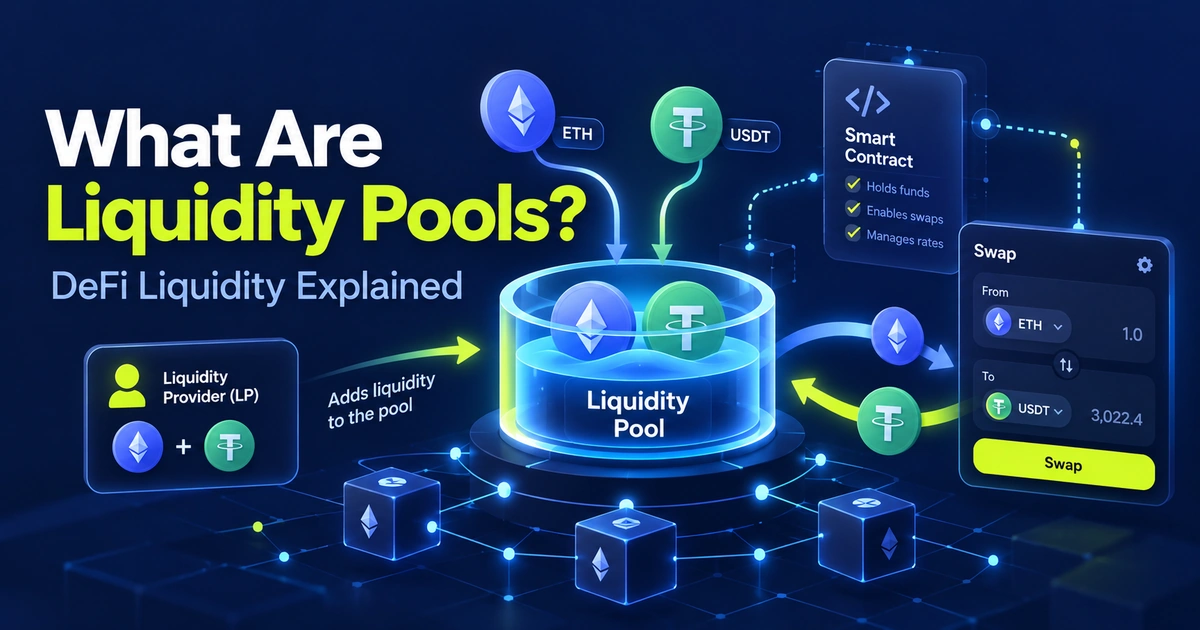
Liquidity pools are collections of crypto assets made available for use inside DeFi protocols. Beginners often come across them when learning about decentralised exchanges, token swaps, AMMs and DeFi liquidity.
In many DEXs, liquidity pools help users swap one crypto asset for another without waiting for a matching buyer or seller in a traditional order book. Instead, users can trade against assets already available in a pool. Those assets are supplied by liquidity providers, who may receive a share of certain fees according to the rules of the protocol or pool.
This guide explains what liquidity pools are, how they work, how they connect to DEXs and AMMs, and what risks beginners should understand before providing liquidity.
Quick Answer: What Is a Liquidity Pool?
A liquidity pool is a collection of crypto assets held according to a DeFi protocol’s smart-contract rules and made available for activities such as token swaps, lending or borrowing. In many decentralised exchanges, users called liquidity providers supply assets to pools so other users can trade against the available liquidity.
What Are Liquidity Pools in DeFi?
Liquidity pools in DeFi are reserves of crypto assets that users or protocols can interact with under a specific set of smart-contract rules.
The word liquidity means the ability to buy, sell or exchange an asset without causing excessive price movement. A liquidity pool is one mechanism some DeFi systems use to provide that liquidity.
Liquidity pools are commonly associated with decentralised exchanges, but they are not limited to DEX token swaps. Pooled assets can also appear in lending and borrowing protocols, yield strategies and other on-chain financial applications.
In a DeFi context, a pool may hold assets that traders, borrowers or other users interact with. The people or participants who supply assets to the pool are usually called liquidity providers or LPs.
Liquidity pools are easier to understand once DeFi makes sense, because they are one of the mechanisms some DeFi protocols use to make blockchain-based financial activity possible.
Why Do Liquidity Pools Exist?
Liquidity pools exist because markets need available assets for users to trade, borrow, lend or otherwise interact with.
Traditional exchanges often use order books, where buyers and sellers place orders at different prices. A trade happens when matching orders are available. Some decentralised exchanges use order books too, but many AMM-based DEXs use liquidity pools instead.
In a pool-based model, users can trade against assets already available in the pool. This reduces reliance on waiting for an exact matching order in that specific design.
Many AMM-based decentralised exchanges use liquidity pools so users can swap assets against available reserves rather than relying only on a conventional order book.
Liquidity pools haven’t replaced order books everywhere. They are one model used in DeFi, especially in automated market maker systems.
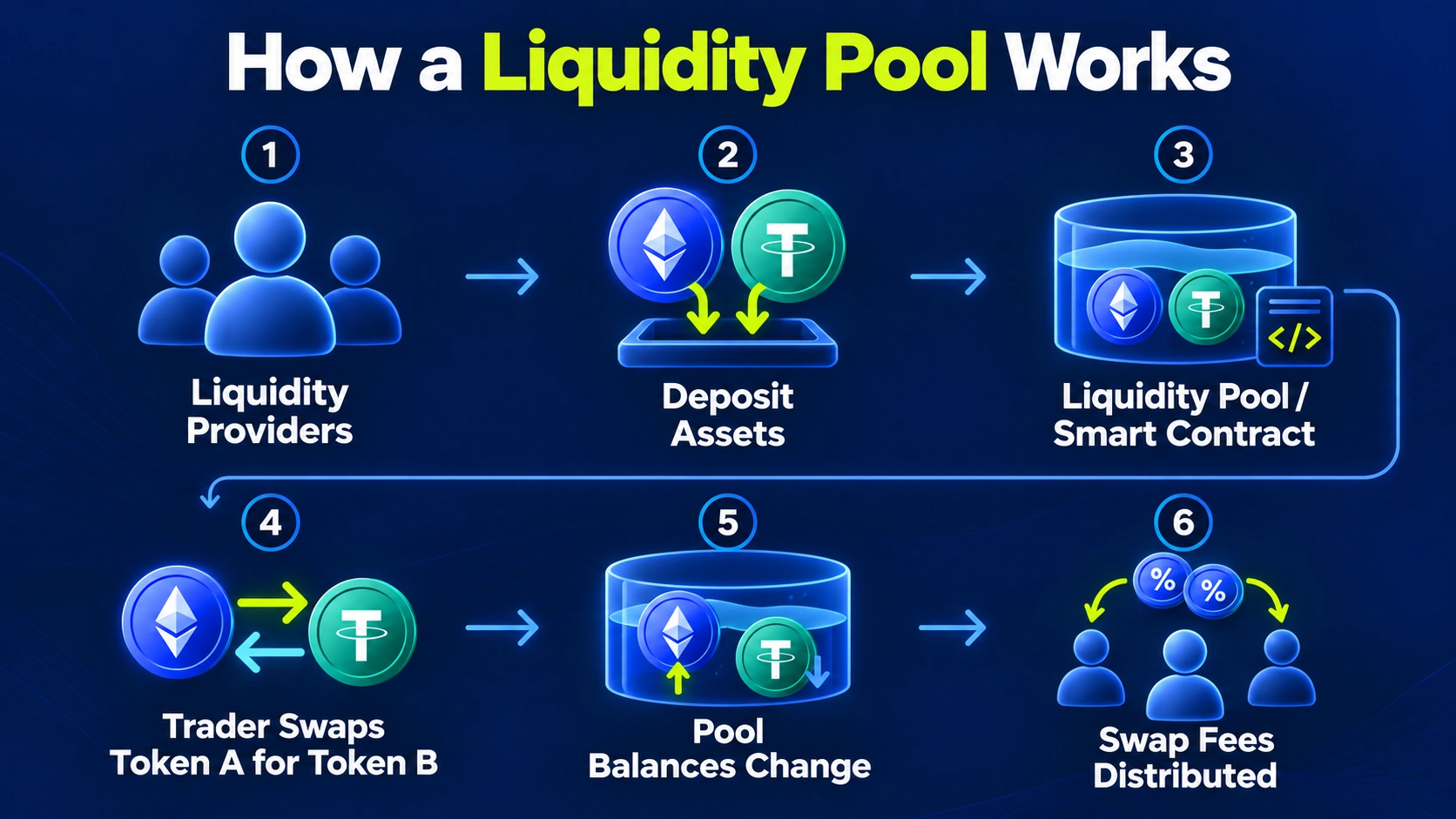
How Do Liquidity Pools Work?
Liquidity pools work by allowing eligible assets to be deposited into a DeFi protocol so other users can interact with the available pool liquidity.
A beginner-friendly version looks like this:
- A DeFi protocol creates or supports a liquidity pool.
- Liquidity providers deposit eligible assets according to the pool’s rules.
- The assets become available within the protocol.
- A trader requests a token swap.
- An AMM or other protocol mechanism determines the transaction terms.
- The trader exchanges one asset for another using the available pool liquidity.
- The pool’s asset balances change.
- Applicable fees are handled according to the protocol’s rules.
- Liquidity providers retain a claim or position representing their share of the pool.
- Providers can usually remove liquidity subject to the protocol’s rules and current pool conditions.
The exact process depends on the protocol. Some pools are designed for swaps, while others may support lending, borrowing or other DeFi activity.
The important point is that a liquidity pool is not just a pile of assets sitting untouched. The pool has rules, and those rules determine how users interact with the assets.
What Is a Liquidity Provider?
A liquidity provider, often shortened to LP, supplies eligible assets to a liquidity pool.
The provider may deposit assets into a pool and receive a pool position, LP token, NFT position or another form of share representation depending on the protocol. That position reflects the provider’s claim or participation in the pool under the protocol’s rules.
Liquidity providers may receive a share of applicable fees, incentives or rewards, but the exact structure varies. Providing liquidity is not the same as putting money into a savings account. The value of the deposited assets can change, pool balances can shift and risks can apply.
A liquidity provider should understand the assets, pool rules, fees, withdrawal process and risks before supplying assets to any pool.
How Do Liquidity Providers Earn Fees?
Liquidity providers may receive fees when users interact with a pool, but fees are not guaranteed profit.
In many DEX liquidity pools, traders pay a swap or protocol fee when exchanging one asset for another.
Some protocols may also offer additional incentives. These incentives are separate from core trading fees and can change over time.
Receiving fees doesn’t mean a liquidity provider will necessarily make a profit after changes in token prices, impermanent loss, transaction costs and other risks are considered.
Uniswap liquidity pool documentation, for example, describes liquidity pools as token reserves used by its protocol, with LP fee mechanics depending on the specific protocol version and position design.
Automated Market Makers and Liquidity Pools
An automated market maker, or AMM, is a smart-contract-based mechanism that can help determine how swaps happen inside some DeFi systems.
Many AMMs use liquidity pools. Instead of matching a buyer and seller through an order book, an AMM can allow a trader to swap against pooled assets.
AMM designs vary. Some use well-known pricing models, while others use different mechanisms, concentrated liquidity or more advanced structures. Beginners do not need to learn the formulas immediately, but they should understand that pool balances and available liquidity can affect pricing.
AMMs often rely on smart contracts to apply programmed rules, manage pool interactions and process swaps. Smart contracts can automate parts of the process, but they do not remove risk.
The BIS automated market maker research has described AMM liquidity provision as a key part of decentralised exchange activity, including fee compensation and impermanent-loss risk for liquidity providers.
What Happens to a Liquidity Pool During a Swap?
During a token swap, a trader sends one asset into the pool and receives another asset from the pool.
For example, imagine a hypothetical pool that contains:
Token A + Token B
A trader sends Token A into the pool and receives Token B.
After the swap:
- More Token A sits in the pool.
- Less Token B remains available.
- The relative balance has changed.
- An AMM or protocol mechanism adjusts the available exchange terms accordingly.
This is a simplified example. It does not mean every pool contains exactly two tokens, maintains equal values or uses the same formula.
The purpose is to understand the basic idea: a pool’s asset balances can change as users trade against the available liquidity.
What Does Liquidity Mean for a DEX?
Liquidity affects how easily a DEX can support trades without large changes in execution.
More liquidity generally means a trade can be executed with less price impact, all else being equal. Low liquidity can make swaps more expensive or less predictable because a trade may represent a larger share of the available pool.
For a DEX user, liquidity can affect:
- Expected output
- Slippage
- Price impact
- Trade execution
- The usefulness of a pool for larger swaps
This is why liquidity pools matter inside many decentralised exchanges. A DEX with shallow liquidity may show worse pricing or higher price impact for certain trades.
The relationship between liquidity and token swaps is one reason What Is a DEX? is an important supporting guide for this topic.
How Slippage And Price Impact Affect Liquidity Pools
Slippage and price impact are related to execution, but they are not the same thing.
Execution Slippage
Slippage is the difference between the expected price or output and the actual executed result.
In a liquidity-pool swap, a user may see an estimated output before confirming a transaction. If market conditions, routing, pool activity or transaction timing change before the swap completes, the final received amount may differ.
Slippage is not a platform fee. It is an execution difference.
Price Impact
Price impact is the effect the size of a trade has on the available price or liquidity in the pool.
A large trade relative to a shallow liquidity pool can create greater price impact. The trade itself changes the pool balance enough to affect the execution terms.
Price impact is also not a normal fee. It reflects how much the trade moves the available pricing because of pool depth and trade size.
Liquidity Pools vs Order Books
Liquidity pools and order books are two different ways markets can support trading.
| Feature | Liquidity Pool / AMM Model | Order Book Model |
|---|---|---|
| Main liquidity source | Assets supplied to pools | Buy and sell orders |
| Execution | Against available pool liquidity | Matching orders |
| Pricing | Protocol or AMM mechanism | Market bids and asks |
| Liquidity providers | Users or professional participants may supply pool assets | Market makers and traders place orders |
| Common use | Many DEXs | Centralised exchanges and some DEXs |
One model is not automatically better than the other. They work differently and create different trade-offs for users, liquidity providers and platforms.
Liquidity Pools vs Staking
Providing liquidity and crypto staking aren’t the same activity.
Liquidity provision generally involves supplying assets to a pool for protocol activity. Assets can be used for token swaps, lending markets or other DeFi functions.
Protocol staking generally involves committing an eligible blockchain asset to support a proof-of-stake network or related staking mechanism.
Some products marketed as “staking” may work differently, so terminology can vary across crypto platforms. Beginners should check what is actually happening to the assets rather than relying only on the label.
What Is Impermanent Loss?
Impermanent loss is a risk that can affect liquidity providers when asset prices change relative to one another.
In an AMM liquidity pool, trading activity can change the quantities represented in a liquidity provider’s position. If the relative prices of the assets move, the provider’s eventual position may be worth less than simply holding the original assets outside the pool.
Fees or incentives may offset some of this difference, but they are not guaranteed to do so.
Impermanent loss is not harmless just because it is called “impermanent”. The full mechanics deserve a dedicated guide, especially for beginners comparing liquidity pools, yield farming and other DeFi strategies.
What Are the Benefits and Limitations of Liquidity Pools?
Liquidity pools can be useful, but they also involve important limitations and risks.
| Potential benefits | Potential limitations and risks |
|---|---|
| Provides on-chain liquidity | Impermanent loss |
| Enables AMM token swaps | Token-price volatility |
| Reduces reliance on order matching in certain DEXs | Smart-contract vulnerabilities |
| Allows eligible participants to supply liquidity | Low liquidity |
| May allocate fees to providers according to protocol rules | Malicious or low-quality tokens |
| Connects with other DeFi protocols | Transaction or gas costs |
| Supports open DeFi infrastructure | Protocol risk |
| May support different pool designs | Changing fee structures |
| Helps users swap against available reserves | Complex concentrated-liquidity management |
| May support broader DeFi activity | Potential losses despite earning fees |
A pool’s design, assets, liquidity, smart contracts and incentive structure all matter.
Are Liquidity Pools Safe?
A liquidity pool isn’t automatically safe because it’s through smart contracts.
Risks can come from the protocol, the assets, the smart contracts, the interface, the crypto wallet approvals or the user’s own actions.
Common liquidity-pool risks include:
- Smart-contract vulnerabilities
- Protocol risk
- Token-price volatility
- Impermanent loss
- Low liquidity
- Malicious or low-quality tokens
- Fake websites or interfaces
- Unsafe wallet approvals
- Network or gas costs
- Changing incentives
- Governance or protocol changes
- Complexity for beginners
Many risks begin before assets are even deposited, so crypto wallet safety matters when interacting with DeFi platforms and pool interfaces.
Fake websites, fake tokens and social-media pressure can also lead users into unsafe pools, which makes common crypto scams important background before providing liquidity.
This doesn’t mean every pool is a scam or every liquidity provider will lose money. Risks should just be understood.
Before Providing Liquidity Checklist?
Before supplying assets to a liquidity pool, check:
- Use the protocol you intended to use.
- Confirm the website or interface is official.
- Understand the assets being deposited.
- Check both tokens or assets carefully.
- Review the pool rules before committing funds.
- Any possible fee allocation is clear.
- Transaction or gas costs have been reviewed.
- Impermanent loss has been considered.
- Either asset could fall sharply in value.
- Pool liquidity is not too low for the activity involved.
- Wallet approvals have been reviewed carefully.
- Liquidity removal rules are understood.
- Any lockups or restrictions have been checked.
- Advertised incentives are not being treated as guaranteed income.
- Smart-contract or protocol failure remains possible.
Completing this checklist doesn’t make providing liquidity safe. It helps reduce avoidable mistakes.
Beginner Safety Note
Providing liquidity involves more than depositing crypto and collecting fees. The value of the assets can change, pool balances can shift, smart-contract and token risks can apply, and fees earned may not offset losses. Understand the specific pool before committing assets.
Beginner Liquidity Pool Terms to Know
| Term | Beginner meaning |
|---|---|
| Liquidity | How easily an asset can be traded without causing excessive price movement |
| Liquidity pool | Crypto assets made available under a DeFi protocol’s rules for swaps or other activity |
| Liquidity provider | A user or participant supplying assets to a pool |
| LP | Short for liquidity provider |
| AMM | An automated market maker used by many DEXs to manage swaps and pricing |
| Token pair | Assets associated with a particular trading pool or market |
| Swap fee | Fee associated with exchanging assets through a protocol |
| Slippage | Difference between expected and actual execution |
| Price impact | Effect a trade has on the available pool price |
| Impermanent loss | Potential underperformance of an LP position compared with simply holding the original assets |
Key Takeaways
- Liquidity pools are reserves of crypto assets used by some DeFi protocols for swaps, lending, borrowing or other on-chain activity.
- Many AMM-based DEXs use liquidity pools so traders can swap against available pooled assets.
- Liquidity providers supply assets to pools and may receive fees or incentives according to protocol rules.
- Earning fees does not guarantee profit because token prices, impermanent loss, transaction costs and other risks can affect the final outcome.
- More liquidity can reduce price impact, all else being equal, but high liquidity doesn’t remove every execution risk.
- Liquidity pools can be useful DeFi infrastructure, but they carry smart-contract, token, protocol and wallet-related risks.
Where to Go Next
Liquidity pools connect closely with DEXs, DeFi tools, smart contracts and gas fees. The next step is to understand how pooled assets fit into the wider DeFi learning path.
DeFi Tools Hub
The DeFi Tools hub connects liquidity pools with decentralised exchanges, wallets, smart contracts and other DeFi concepts.
DEX Basics
Because liquidity pools are often used inside AMM-based decentralised exchanges, What Is a DEX? is the most important next guide for understanding how traders interact with pool liquidity.
DeFi Basics
Liquidity pools sit inside the broader DeFi ecosystem, so What Is DeFi? helps explain how pools connect to swaps, lending, borrowing and other blockchain-based financial tools.
Smart Contract Basics
Many liquidity pools operate through programmed rules, which makes What Are Smart Contracts? useful for understanding what happens behind a pool interface.
Gas Fee Basics
Pool interactions can involve blockchain transaction costs, so What Are Gas Fees? helps explain why deposits, swaps or withdrawals may cost more than expected.
Safety Checklist
✓ Check the official protocol website
✓ Understand both assets in the pool
✓ Review the pool rules before depositing
✓ Check possible fees and gas costs
✓ Understand impermanent loss
✓ Review wallet approvals carefully
✓ Check liquidity removal rules
✓ Never treat incentives as guaranteed income


Disclaimer: This guide is for general information and education only. It is not financial, investment, legal, or tax advice. Crypto and digital assets can be risky, and prices may change quickly. Always do your own research and consider speaking with a qualified professional before making financial decisions.
The Meta Directory may earn commissions from some links, but this does not influence our editorial content.

Author
Frequently Asked Questions
A liquidity pool is a collection of crypto assets under a DeFi protocol’s rules. In many DEXs, liquidity pools allow traders to swap against available assets rather than waiting for a matching buyer or seller.
In a Liquidity pool, providers deposit eligible assets into a protocol. Traders can then interact with the available pool liquidity, while the protocol handles pricing, fees and pool balance changes according to its rules.
Crypto is added by liquidity providers often shortened to LPs. A provider may be an individual user, a professional participant or another entity, depending on the protocol and pool design.
Providers may receive a share of swap fees, protocol fees or incentives according to the rules of the particular pool.
Liquidity Pool Risk Questions
Yes, you can lose money. Losses can come from token-price changes, impermanent loss, smart-contract issues, malicious tokens, gas costs, low liquidity, protocol problems or fees.
Impermanent loss is the potential underperformance of a liquidity-provider position compared with simply holding the original assets. It can happen when the prices of the pooled assets change and the pool’s mechanics alter the quantities represented in the LP position.
No, liquidity pools and staking aren’t the same. Providing liquidity usually means supplying assets to a pool for protocol activity, while staking usually involves committing an eligible asset to support a proof-of-stake network or related staking mechanism.
Liquidity pools aren’t automatically safe. They can involve smart-contract risk, token risk, impermanent loss, changing incentives, fake interfaces, unsafe wallet approvals and other DeFi risks.
Many liquidity-pool designs allow providers to remove liquidity, but the details depend on the particular protocol, pool and position.
HOW WE REVIEW & RANK
We research and compare platforms using a consistent framework: security signals, track record, product usability, feature quality, transparency of terms, and real-world usefulness.
When something changes – fees, policies, availability, or features – we update our listings and reviews.
Learn more about how we review platforms ->
STAY UPDATED
Get new crypto guides, updated rankings, and practical tips straight to your inbox — no spam, unsubscribe anytime.
NO SPAM. UNSUBSCRIBE ANYTIME.